GitHub Daily · July 13: Rust Rewrite of Postgres Ignites the Community, Claude Ecosystem and Local-First Wave Surge Together

pgrust rewrites Postgres in Rust with 100% regression pass, while Claude ecosystem and local-first projects surge
malisper/pgrust rewrites Postgres in Rust and passes 100% of regression tests, jumping nearly 800 stars in a day as today's biggest dark horse. anthropics/claude-cookbooks gained +322 stars, marking the community's shift from models to AI engineering. Home Assistant keeps growing fast at 88K stars, reflecting the return of local-first, privacy-first values.
GitHub Daily · July 13
Today's Trending list reveals an intriguing "bipolar tension": on one side stand the battle-tested infrastructure giants—Home Assistant, PowerToys, Ansible, ASP.NET Core—as steady as ever; on the other, emerging "dark horse" projects are stirring the waters with astonishing growth rates. Chief among them is pgrust, which rewrites Postgres in Rust and passes 100% of the regression tests—soaring nearly 800 stars in a single day.
Beyond that, two AI-related signals are equally clear: both openai/plugins and anthropics/claude-cookbooks made the list, showing that after a few years of maturation, the community's focus on LLMs has shifted from "the models themselves" to "how to engineer and deploy them." Meanwhile, Home Assistant's continued popularity reflects a growing developer consensus around the values of "local-first, privacy-first." Let's dive into each one below.
malisper/pgrust: Rewriting Postgres in Rust, Passing 100% of Regression Tests
Project positioning: A PostgreSQL-compatible database kernel rewritten from scratch in Rust, which has now passed the entire official Postgres regression test suite.
This is the undisputed biggest surprise of the day—its total of 2,032 stars may not seem huge, but its single-day surge of 789 stars stands head and shoulders above the rest of the list. Yet it has only 50 forks, indicating it's in "the very early stage of a topic explosion": tons of developers are "watching, liking, and bookmarking," but actual contributors haven't caught up yet.
The problem it solves: Postgres's C codebase carries over three decades of technical debt, and memory safety issues along with the complexity of its concurrency model have long been pain points for maintainers. Rewriting it in Rust means eliminating an entire class of memory vulnerabilities at the language level, while leveraging Rust's modern concurrency primitives to redesign the underlying architecture. And "passing 100% of the regression tests" is a hugely significant milestone—it proves this isn't a toy, but something behaviorally highly consistent with real Postgres.
Core features: A compatibility-first strategy that allows it to serve as a gradual replacement; the memory safety guarantees brought by Rust's ownership model; and potential improvements in performance and maintainability.
Use cases: At this stage, it's better suited as excellent material for learning how database kernels are implemented, and for experimenting in edge scenarios that demand extreme memory safety. Real production use will require long-term validation under large-scale workloads and ecosystem compatibility.
Takeaways for developers: If you want to understand "how to refactor a large C project in Rust," this repository is a living textbook. It validates a trend—Rust is advancing from the systems tooling layer (ripgrep, fd) into the "hardcore heartland" of databases and operating systems.
home-assistant/core: The Local-First Smart Home Hub
Project positioning: An open-source home automation platform built around the core principles of local control and privacy.
88,680 stars, +169 in a single day—for a project already this massive to sustain such growth is extremely rare. Behind this lies consumers' growing aversion to "cloud-dependent smart homes"—when your smart bulb stops working because the vendor's server goes down, Home Assistant's "everything runs locally" approach becomes invaluable.
The problem it solves: The vast majority of commercial smart home devices keep both control and data on the vendor's cloud, posing privacy risks as well as the danger of devices being bricked if the vendor goes out of business. Home Assistant pulls the control hub back to your local network.
Core features: Integration with thousands of devices and protocols, a powerful automation engine, and an active community plugin ecosystem. Written in Python, it lowers the barrier to further development.
Use cases: From geeks building their own smart homes to automation management for small and medium commercial spaces, and increasingly into enterprise scenarios that value data sovereignty.
microsoft/PowerToys: A Windows Productivity Enhancement Suite
Project positioning: A collection of Windows efficiency-boosting tools officially produced by Microsoft.
With an absolute total of 136,422 stars, it sits firmly near the top of the list, and +65 in a single day shows it has entered a steady, "slow-and-steady" growth phase. PowerToys' success lies in filling numerous gaps in Windows' native functionality—window layout management (FancyZones), batch renaming, color pickers, quick launchers, and more—features users have long called for but Microsoft was slow to build.
Tech stack: Primarily C/C++, making it a high-quality reference for learning native Windows development. It also represents a successful example of Microsoft's "embrace open source" strategy in recent years—open-sourcing tools and letting the community polish them together.
Use cases: Nearly all heavy Windows users can benefit from it, especially developers and those working with multiple monitors.
anthropics/claude-cookbooks: A Practical Recipe Collection for Claude
Project positioning: A collection of Claude usage examples and best-practice notebooks officially maintained by Anthropic.
47,915 stars, surging +322 in a single day—it's the fastest-growing project in today's AI category. As Claude 4 and Claude Fable 5 roll out, developers urgently need official guidance on "how to use it well," and this cookbook fills precisely the gap between API documentation and real-world applications.
Core features: Runnable examples presented as Jupyter Notebooks, covering hot scenarios such as tool calling, RAG, multimodal, and agent orchestration. Compared to cold, dry API references, this "read-and-run" format is extremely friendly for getting started.
Use cases: Any team building Claude-based applications should treat it as a starting point. It reduces the trial-and-error cost of engineering deployment.
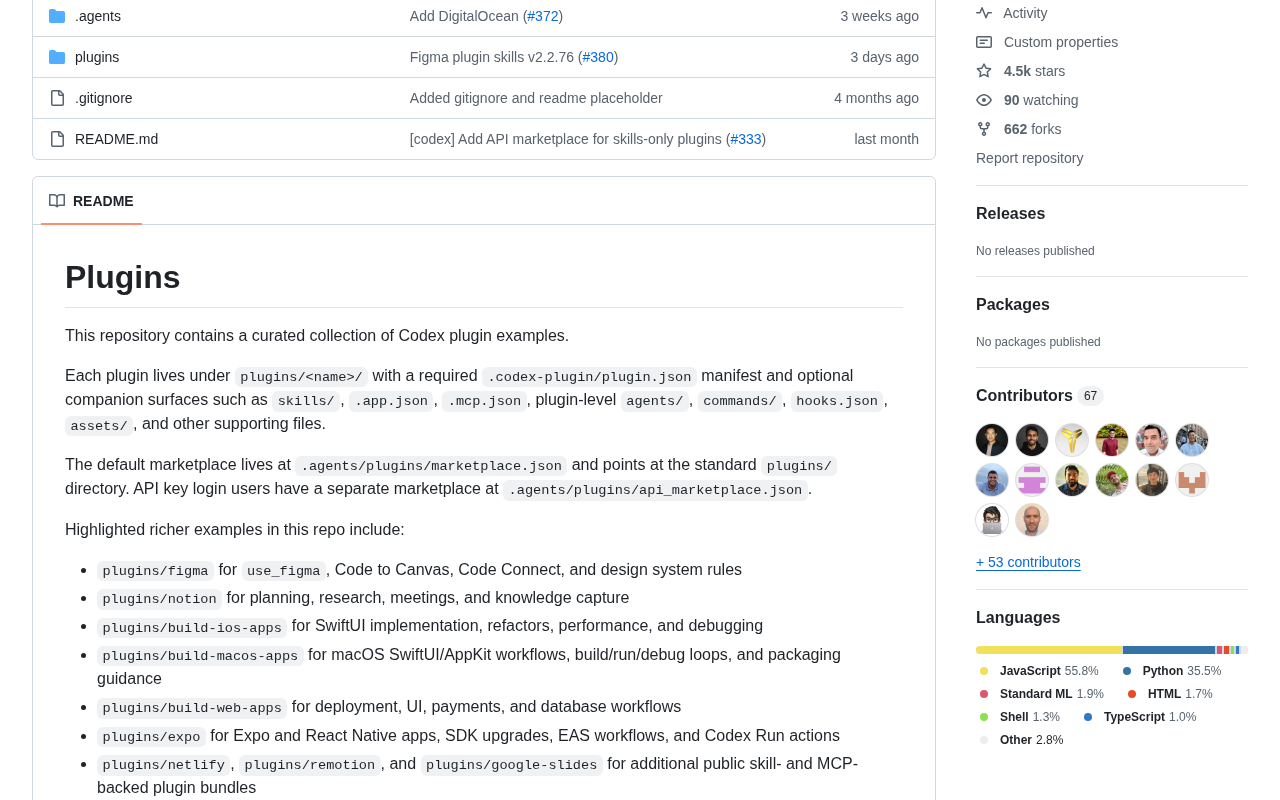
openai/plugins: OpenAI's Plugin Ecosystem
Project positioning: A collection of OpenAI's official plugin projects.
4,398 stars, +75—although small in size relative to the list, its high ranking shows the community remains highly interested in "how to extend the boundaries of LLM capabilities." The plugin/tool-calling mechanism is a key link in transforming LLMs from "chat toys" into "assistants that can actually get work done."
Tech stack: Primarily JavaScript, making it easy for frontend and full-stack developers to adopt. Together with claude-cookbooks, it confirms the current dominant theme in the AI field—engineering and deployment.
DayuanJiang/next-ai-draw-io: Drawing Flowcharts with Natural Language
Project positioning: A Next.js web application combining AI capabilities with draw.io, letting you create, modify, and enhance diagrams using natural language.
33,279 stars, +74 in a single day—this is a very clever example of "AI + a mature tool." draw.io is a diagramming tool used daily by countless people, and plugging an LLM into it, so a command like "draw me a microservices architecture diagram" directly becomes an editable diagram, hits the pain point precisely.
Tech stack: Next.js + TypeScript, the standard setup for frontend AI applications, making it a great study case for developers wanting to learn "how to integrate an LLM into a real SaaS product."
Use cases: Architects drawing system diagrams, product managers making flowcharts, and teachers creating instructional illustrations can all greatly speed up their work.
prisma/prisma: The Next-Generation TypeScript ORM
Project positioning: A modern ORM for Node.js and TypeScript, supporting almost all mainstream databases.
47,245 stars, +85—the steady growth reflects the continued flourishing of TypeScript full-stack development. Prisma's type-safe queries and auto-generated client have vastly improved the developer experience of database operations. Interestingly, together with today's pgrust, it forms a complete "database tech stack" narrative—the underlying kernel is being rewritten, while the access layer above it keeps evolving.
cypress-io/cypress: A Reliable Testing Framework for the Browser
Project positioning: A fast, simple, and reliable testing tool for anything that runs in a browser.
50,614 stars, +43. As frontend projects grow increasingly complex, the importance of end-to-end testing rises accordingly. Cypress, with its intuitive debugging experience and "what you see is what you test" design, has become one of the mainstream choices for frontend testing. Written in TypeScript, it's friendly to frontend teams.
dotnet/aspnetcore & ansible/ansible: Evergreen Infrastructure
ASP.NET Core (38,302 stars, +28), as Microsoft's cross-platform web framework, continues to provide a solid foundation for enterprise-grade cloud applications; Ansible (69,581 stars, +20) is a benchmark in the IT automation field, using near-natural-language syntax to achieve agentless deployment and configuration management. Both grow steadily, representing those "quiet but indispensable" forces of infrastructure.
nasa/fprime: An Embedded Framework Bound for Space
Project positioning: A flight software and embedded systems framework produced by NASA.
11,474 stars, +64. This is the most "hardcore romantic" project on the list—it's genuinely used to go into space. Written in C++, it provides a component-based architecture for resource-constrained aerospace and embedded environments. For embedded developers, being able to study NASA-level engineering practices is itself a pleasure.
nuxt/nuxt: The Full-Stack Vue Framework
Project positioning: A full-stack development framework based on Vue.
60,727 stars, +10. As an important part of the Vue ecosystem, Nuxt provides out-of-the-box capabilities like SSR, routing, and data fetching—the Vue camp's core weapon to rival Next.js.
Today's Trend Observations
Taken together, today's list reflects three clear main themes:
First, Rust's "heartland offensive." The explosion of pgrust is not an isolated event, but yet another sign of Rust moving from the toolchain into core systems like databases and operating systems. Memory safety at the language level is becoming a powerful driver for rewriting legacy C projects.
Second, the deepening of AI engineering. The appearance of openai/plugins and claude-cookbooks shows the community's attention has shifted from "chasing more powerful models" to "how to use existing models well and reliably." next-ai-draw-io demonstrates the best deployment paradigm for "AI + a mature tool."
Third, the return of local-first and privacy values. Home Assistant's continued high growth is a collective choice by users fatigued with "cloud dependence."
Today's Must-See TOP 3
- malisper/pgrust — A phenomenal explosion of nearly 800 stars in a single day; rewriting Postgres in Rust and passing all regression tests, it's an excellent case for understanding modern systems programming.
- anthropics/claude-cookbooks — Official best practices for AI engineering deployment; no team developing with Claude should miss it.
- home-assistant/core — Still growing fast despite its massive size, the flagship project of local-first smart homes.
Looking ahead, the wave of rewriting infrastructure in Rust, the continued deepening of AI engineering, and the spread of privacy-first ideals are very likely to be the three main themes of the open-source world in the coming months. See you next time.
Related articles

Poison-Resistant Concept Anchoring: A New Approach to Defending Against AI Data Poisoning
Deep dive into Poison-Resistant Concept Anchoring, defending against data poisoning via signed anchors and bounded updates. Experiments show 62% poison isolation with 0% false rejection rate.

Hungarian Algorithm Explained: Principles, Complexity, and Engineering Implementation Guide
In-depth explanation of the Hungarian Algorithm: core principles, O(N³) time complexity advantages, and engineering implementation. Covers assignment problem definition, step-by-step algorithm walkthrough, Python/C++ libraries, and applications in multi-object tracking and resource scheduling.
OpenAI's First Enterprise AI Report: H…
OpenAI's First Enterprise AI Report: How ChatGPT Is Changing the Way Organizations Work
OpenAI's first enterprise AI report reveals three key traits of ChatGPT Enterprise adoption: the shift from novelty to necessity, writing and coding as top use cases, and data governance as a core prerequisite.