GitHub Daily · July 30: A Triple Act of AI Education, Terminal Tools, and the WhatsApp Ecosystem

AI education, Rust terminal tools, and WhatsApp automation define today's GitHub Trending landscape.
Today's GitHub Trending features three standout projects: Microsoft's AI-For-Beginners (53K stars) remains a top educational resource as demand for foundational AI knowledge grows; Rust-based terminal code review tool tuicr explodes with 338 new stars in a single day, reflecting the shift toward humans as code reviewers in the AI era; and WhatsApp API library Baileys maintains steady real-world adoption with an exceptional 1:3 Fork/Star ratio, proving the enduring demand for ecosystem integration tools.
GitHub Daily · July 30: A Triple Act of AI Education, Terminal Tools, and the WhatsApp Ecosystem
Today's GitHub Trending presents a rather interesting distribution — no single breakout dark horse dominating the scene. Instead, three projects with vastly different positioning jointly occupy the core of the leaderboard. From Microsoft's veteran AI education course holding firm at the top, to a WhatsApp ecosystem developer tool sustaining momentum, to a Rust-built terminal code review tool surging at an astonishing pace — today's chart reads like a condensed cross-section of the open-source ecosystem: education democratization, ecosystem integration, and developer experience. These three themes each represent different driving forces in today's open-source world.
What's particularly interesting is that the tech stacks of these three projects cover the three most dominant paradigms today — Jupyter Notebook representing data science/education, TypeScript/JavaScript representing web and ecosystem integration, and Rust representing system-level high-performance tooling. Let's dive deep into each one.
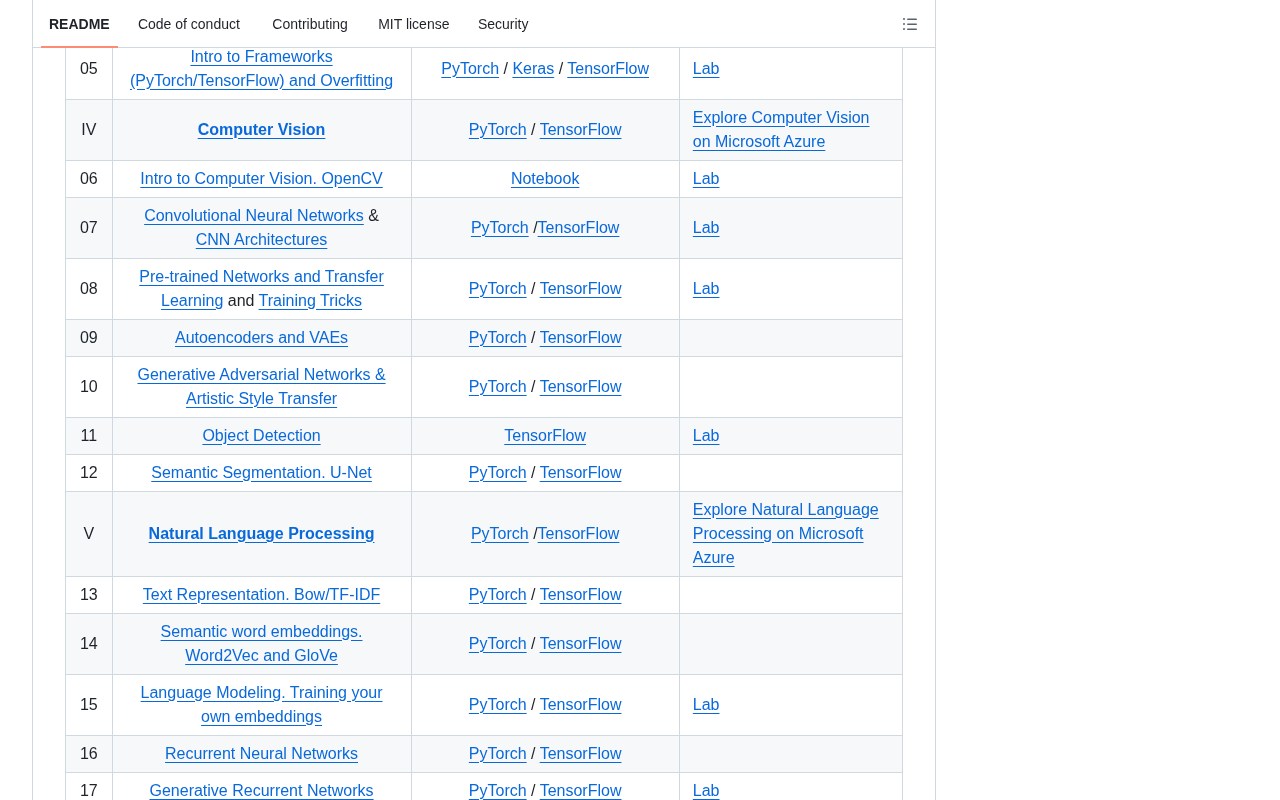
microsoft/AI-For-Beginners: The Evergreen of AI Education for All
Project positioning: An official Microsoft AI introductory course with a structured 12-week, 24-lesson pathway that systematically teaches the core concepts of artificial intelligence to everyone.
Problem it solves: In a world where GPT-5, Claude Fable 5, and Gemini 2.0 have become everyday tools, the barrier to using AI keeps dropping — but the barrier to understanding AI hasn't dropped with it. Many people can write prompts but have no idea how neural networks, convolutions, or attention mechanisms actually work. This project bridges the gap between "can use it" and "understands the principles." It's not another prompt tips collection — it's a classic curriculum spanning from symbolic AI and neural network fundamentals all the way to computer vision and NLP.
Core features: The course uses Jupyter Notebooks as its primary medium, meaning every lesson is runnable, interactive code rather than dry slide decks. Learners can read and run simultaneously, seeing results immediately. It also covers implementations in both TensorFlow and PyTorch, accommodating readers from different tech stacks.
Use cases: Supplementary self-study material for university CS programs, an onboarding roadmap for engineers transitioning into AI, ready-made content for corporate technical training. Anyone who "wants to seriously understand AI rather than just call APIs" is its target user.
Tech stack & reference value: Jupyter Notebook as the backbone, paired with the Python ecosystem. For developers, the course's organizational approach itself serves as an excellent technical documentation writing template — how to break down complex concepts into 24 progressive modules is something every aspiring tech educator should study.
Stars/Forks analysis: 53,277 stars, 10,842 forks, with 115 new stars today. This growth rate is remarkably healthy "evergreen" performance for a project already this massive. The 10,000+ forks are especially telling — a large number of educators and learners are forking it for secondary development and localization. It has evolved from a "trending project" into an "infrastructure-level" educational resource.
WhiskeySockets/Baileys: The Invisible Foundation of WhatsApp Automation
Project positioning: A Socket-based TypeScript/JavaScript WhatsApp Web API library that lets developers interact with WhatsApp programmatically without relying on the official, cumbersome, and expensive commercial API.
Problem it solves: WhatsApp is one of the world's largest messaging platforms, but its official Business API has high barriers, strict approval processes, and significant costs. For small and medium developers and startup teams wanting to build an auto-reply bot, customer service system, or notification push service, the official channel is often too heavy. Baileys reverse-engineers the WhatsApp Web protocol to provide a lightweight, flexible, and free technical path.
Core features: Pure Socket connection — no need for Selenium or Puppeteer to drive a real browser, resulting in extremely low resource usage and excellent performance. It supports multi-device mode, message sending/receiving, media handling, group management, and nearly all core capabilities. Written entirely in TypeScript with comprehensive type definitions.
Use cases: E-commerce order notification bots, community automation tools, SME intelligent customer service, and various automation scripts for individual developers. In many emerging markets (Latin America, Southeast Asia, India), WhatsApp is the de facto communication infrastructure, and the demand for integrations around it is enormous.
Tech stack & reference value: TypeScript + WebSocket. For developers interested in learning protocol reverse-engineering, binary message encoding/decoding, and how to build a robust long-lived connection library in TS, Baileys' source code is a treasure trove.
Stars/Forks analysis: 10,321 stars, 3,240 forks, with 12 new stars today. Growth is moderate, but the Fork-to-Star ratio (approximately 1:3) is exceptionally high — a hallmark of a "utility library." Users aren't just bookmarking and starring; they're actually pulling it into their own projects for deep use and customization. Behind this ratio lies a vast and active real-world application ecosystem.
agavra/tuicr: A Rising Star in Terminal Code Review, Written in Rust
Project positioning: A terminal code review TUI tool with Vim keybindings that lets you complete the entire code review process without leaving the command line.
Problem it solves: Today's code reviews are mostly tied to web interfaces like GitHub and GitLab — clicking with a mouse, waiting for pages to load, constantly switching context. For developers accustomed to terminals and keyboard-driven workflows, this is far from efficient. tuicr pulls code review back into the terminal, leveraging Vim muscle memory to drive the entire flow, pursuing ultimate keyboard efficiency and zero context-switching.
Core features: Vim keybindings are its biggest selling point — for heavy Vim/Neovim users, this means virtually zero learning curve. The TUI (Terminal User Interface) form factor lets it integrate perfectly into tmux, SSH remote workflows, and other pure-terminal environments. Being written in Rust guarantees fast startup and runtime performance.
Use cases: DevOps and backend engineers reviewing code directly on remote servers, senior developers who pursue keyboard-driven efficiency, and "terminal-first" teams whose entire workflow is built in the terminal. In an era where AI programming tools (like Claude Code, Cursor) are ubiquitous, more and more code is AI-generated, and the human role is shifting toward "reviewer" — an efficient code review tool arrives at exactly the right time.
Tech stack & reference value: Rust + TUI framework (most likely from the ratatui ecosystem). For developers wanting to learn how to build high-performance terminal applications in Rust, this is an extremely fresh, practical case study.
Stars/Forks analysis: 1,678 stars, 151 forks, 338 new stars today — the most eye-catching growth figure on today's leaderboard. For a new project still small in scale, a single-day increase approaching 20% of its total stars is a classic "eve of explosion" signal. It has precisely hit a pain point in the terminal enthusiast community and is likely to continue surging in the coming days.
Trend Observations: The Hidden Thread Behind These Three Projects
Looking at these three projects together reveals a hidden throughline — the developer's role is being redefined by AI, and the tooling ecosystem is evolving accordingly.
First, the sustained popularity of AI-For-Beginners shows that in an age where AI tools are readily available, the thirst for "foundational understanding" is actually increasing, not decreasing. When calling a model requires just one line of code, the real competitive advantage lies in understanding why the model works the way it does.
Second, tuicr's explosive growth reveals a subtle shift: as the proportion of AI-generated code rapidly rises, code review is transforming from a supporting activity into core work. Humans increasingly play the role of "gatekeeper" rather than "writer," dramatically amplifying the value of an efficient review tool.
Third, Baileys reminds us that no matter how hot AI gets, "integration tools" built around real business scenarios will always have stable and massive demand. The WhatsApp ecosystem serving billions of users worldwide is fertile ground for such tools.
Together, they sketch a profile of the 2026 open-source world: education is reaching deeper, tools are becoming more specialized, and review is on the rise.
Today's Must-See TOP 3 Recommendations
-
agavra/tuicr — Today's growth champion, with a single-day surge of 338 stars signaling it could be this week's biggest dark horse. If you're a Vim user or terminal-first developer, try it immediately. It also represents the best footnote to the trend of "humans doing reviews in the AI era."
-
microsoft/AI-For-Beginners — The evergreen among evergreens. Whether you're an AI newcomer or a veteran looking to systematically fill theoretical gaps, this official Microsoft course is the most reliable starting point — and it's completely free.
-
WhiskeySockets/Baileys — If you have any WhatsApp automation, notification, or bot needs, it's practically the only choice. Its exceptionally high Fork/Star ratio proves its reliability in real production environments.
Looking ahead: Today's leaderboard features no noisy Agent framework wars. Instead, it returns to the most fundamental open-source values of "learning, integration, and efficiency." This might be a signal — after the explosive frenzy of AI tools, the community is settling back down, refocusing attention on solid tools that genuinely improve daily productivity. We'll continue watching whether rising stars like tuicr can sustain their momentum tomorrow.
Related articles

DIY Air Purifier: Building a Silent CR Box with PC Fans and an Aluminum Frame
Learn how to build a quiet Corsi-Rosenthal air purifier using PC case fans and an aluminum frame, covering fan selection, PWM speed control, and cost analysis.

Universality of Gradient Descent Training: Does Neural Network Architecture Choice Really Matter?
Exploring the universal approximation capability of gradient descent training, analyzing the relationship between neural network architecture choice and learnability, from UAT to NTK theory.

From AI to Large Models: Understanding the Conceptual Landscape and Technological Evolution of Artificial Intelligence
Understand how AI, machine learning, deep learning, large models, and generative AI relate to each other. From Deep Blue to ChatGPT, learn how Transformer architecture gave rise to LLMs.