GitHub Daily · November 24: Agent Skill Packs Erupt Across the Board
Agent skill packs and plugin specs dominate GitHub Trending as open source shifts from building models to building agent equipment libraries.
GitHub Trending shows a clear shift from building models to building agent equipment: skill frameworks, plugin standards, and vertical skill packs dominate. diagram-design tops the chart with 1,600+ stars, showing suppressed demand for quality AI visuals. Experience capitalization — turning security and compliance know-how into reusable tools — is emerging as a key trend.
Today's GitHub Trending list has a particularly striking pattern. Of the top fifteen, at least seven projects revolve around agent skills, plugins, and specifications. This is no coincidence — it's a signal. The entire open-source community is shifting from building models to building equipment libraries for agents. Competition over model capabilities has entered a plateau phase, and whoever can arm agents more effectively will occupy the next ecological niche.
Another thread is the deep cultivation of vertical scenarios. Projects like vulnerability hunting, app store compliance, video editing, and downloaders all point to one thing: the window for general-purpose tools is narrowing, and the real opportunity now belongs to domain experts who package industry experience into tools.
Let's look at today's noteworthy projects one by one.
cathrynlavery/diagram-design: A Design Specification for Diagrams in Claude Code
Project positioning: A Claude Code skill library containing 29 editorial-grade chart types, outputting self-contained HTML plus SVG.
Problem solved: The biggest fear when generating diagrams with AI is that the output looks obviously fake. Shadows slapped on carelessly, tacky color schemes, loose layout. This project directly provides a set of design constraints, explicitly stating no shadows and no Mermaid-style pipeline aesthetics. Put plainly, it turns a designer's taste into rules an agent can execute.
Core features: 29 chart types cover the common needs of editorial scenarios. The output is self-contained HTML and SVG with no external rendering dependencies. The phrase "no Mermaid-slop" in the project description is itself an attitude — it shows the author has clear standards for the quality of AI-generated content.
Use cases: Content creators will need this badly. Writing reports, making infographics, organizing data stories — you can have the agent produce the visuals directly. Designers can also use it as a reference template for style constraints.
Tech stack: HTML plus SVG. The technical barrier is low, but design judgment is the core moat. The takeaway for developers is that a skill pack isn't just functional packaging — it can also be packaging for aesthetic standards.
Stars/Forks analysis: It gained over 1,600 stars today, shooting straight to the top. This growth rate is extremely rare among skill-type projects. It shows that market demand for high-quality AI-generated visuals has long been suppressed — there just wasn't a good solution before.
mvanhorn/last30days-skill: An Agent Skill for Cross-Platform Topic Research
Project positioning: An agent skill that researches topics across Reddit, X, YouTube, Hacker News, Polymarket, and the general web, then synthesizes a summary.
Problem solved: Information is too fragmented now. If you want to know what's happened with a topic in the last thirty days, you have to open five or six platforms and dig through each one. This skill strings cross-platform retrieval and summary synthesis into one pipeline, saving a huge amount of manual labor.
Core features: The platform types covered are very comprehensive — covering both social discussion and prediction markets and long-form video. It outputs grounded summaries rather than hastily stitched-together text. The project places special emphasis on being grounded, meaning every conclusion is backed by sources.
Use cases: Market researchers, industry analysts, and trend trackers can all use it directly. Content creators will also find it well-suited for intelligence gathering before choosing topics.
Tech stack: Python. The implementation approach is orchestrating multiple retrieval sources plus a synthesis stage, which offers direct lessons for developers wanting to build multi-source agent applications.
Stars/Forks analysis: Over 53,000 stars, up 200+ today. The base is already large and still growing steadily, which shows strong user stickiness. Once tools like this enter daily workflows, switching costs become very high.
obra/superpowers: An Agent Skill Framework and Methodology
Project positioning: An agent skill framework that also ships with a software development methodology.
Problem solved: Many people use agents to write code, and what comes out runs but isn't maintainable. The problem isn't the model — it's the lack of method. This project tries to codify the development process itself into specifications an agent can follow.
Core features: It's not just a tool; it emphasizes methodology. That is, it cares about how the agent collaborates with humans, how to advance in stages, and how to ensure quality. This kind of framework-level thinking is scarcer than any single skill.
Use cases: Teams introducing AI coding can directly reference its process design. Individual developers can also use it to constrain their own agent workflows.
Tech stack: Shell. The lightweight stack shows the focus is on rules and processes rather than complex implementation. That's good news for developers who want to quickly replicate the ideas.
Stars/Forks analysis: At 240,000 stars, up nearly 900 today. This number has already pushed it into the top-tier project position. Star explosions for framework-type projects often mean the community is looking for a unified standard.
HKUDS/CLI-Anything: Making All Software Agent-Native
Project positioning: A project that gives software agent-native capabilities, from the University of Hong Kong's Data Science Lab.
Problem solved: A huge number of traditional software programs have no API and no agent interface. For agents to operate them, they can only rely on screenshotting and clicking the mouse — slow and brittle. This project aims to break through at the command-line layer, letting agents drive software directly.
Core features: The slogan is making ALL software agent-native. There's also a companion skill entry point like CLI-Hub. The idea is to treat the command line as a universal interface layer, bypassing each vendor's closed ecosystem.
Use cases: People building automation workflows will benefit immediately. Ops, data processing, batch operations — all these scenarios can have the agent issue commands directly instead of simulating human operation.
Tech stack: Python. The inspiration for developers is that rather than waiting for software vendors to open up interfaces, it's better to build a universal adaptation layer yourself.
Stars/Forks analysis: 47,000 stars, up 100 today. The steady growth shows the project has passed its explosive phase and entered a stage of stable accumulation. Projects with academic backgrounds usually have more staying power.
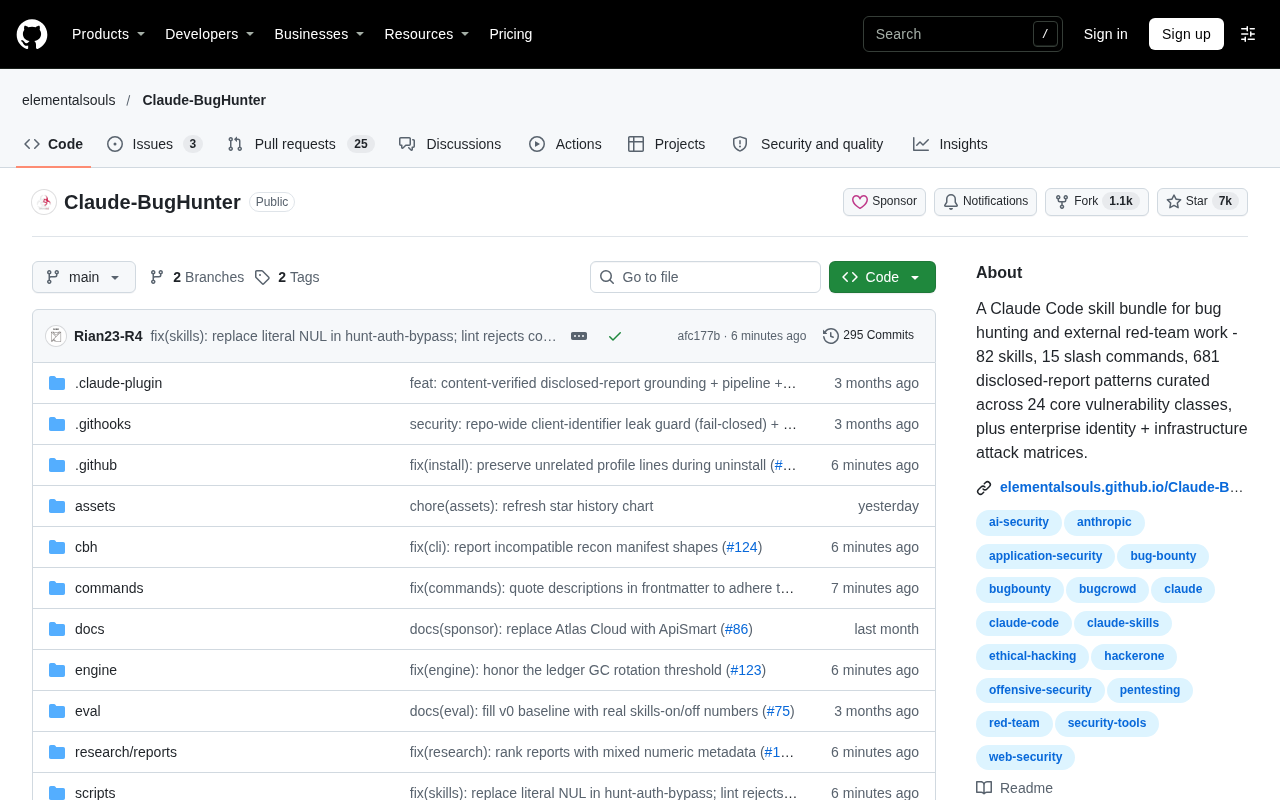
elementalsouls/Claude-BugHunter: A Skill Pack for Vulnerability Hunting
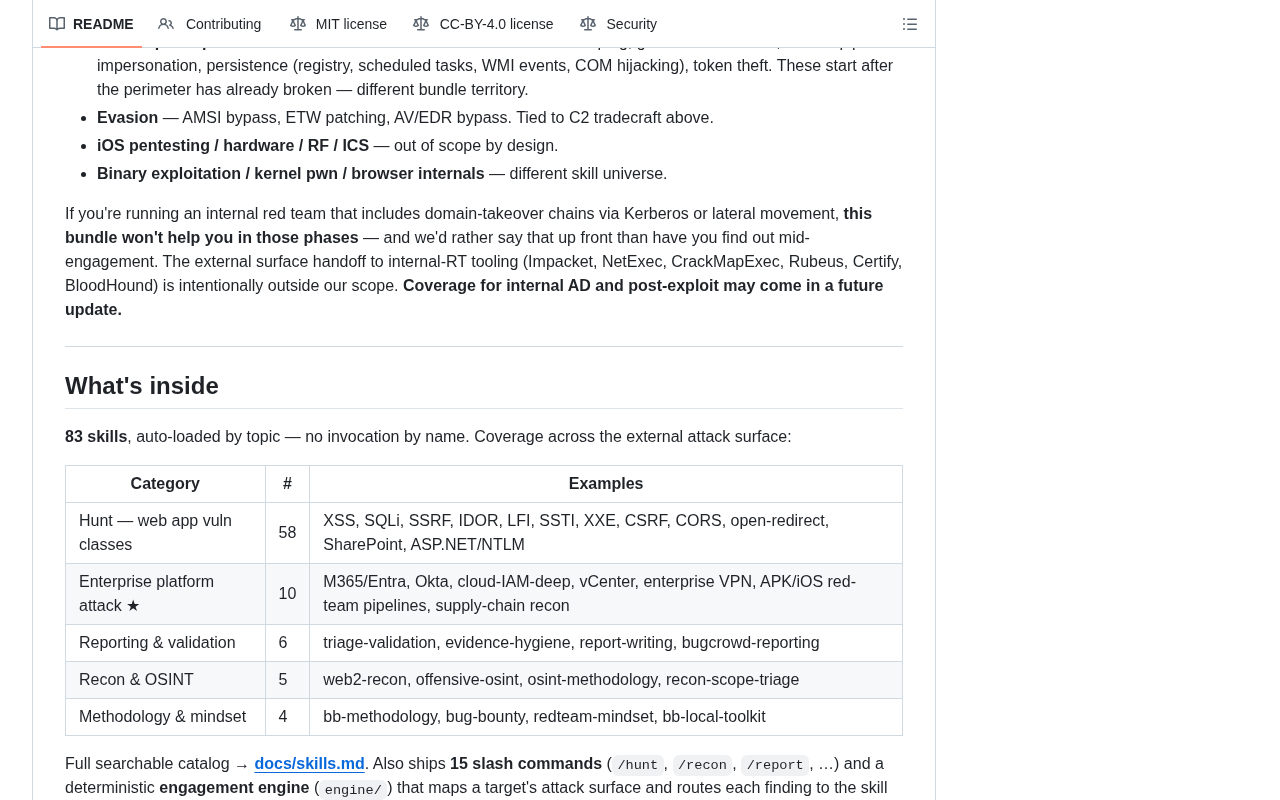
Project positioning: A Claude Code skill pack for vulnerability hunting and external red team work, containing 82 skills and 15 slash commands.
Problem solved: The barrier to security testing has always been high. Newcomers don't know where to start, and veterans have to look things up repeatedly. This project organizes 681 disclosed vulnerability patterns into 24 core vulnerability categories — essentially stuffing an experience library directly into the agent.
Core features: It covers the attack matrix for enterprise identity and infrastructure. The distillation of patterns from disclosed reports is its greatest value, because these are all real cases that actually happened, not armchair speculation.
Use cases: Security researchers will use it for authorized testing. Enterprise security teams can also use it for self-assessments and training. It must be emphasized that these tools should only be used within the scope of legal authorization.
Tech stack: Python. The reference value for developers lies in the way knowledge is organized — structuring scattered security experience into skills. This approach can be transferred to any vertical domain.
Stars/Forks analysis: Nearly 7,000 stars, up 98 today. Security projects usually grow slowly but retain well, because users are professionals who can't do without it once they start using it.
google-labs-code/stitch-skills: Google's Practice of the Agent Skills Specification
Project positioning: A set of Agent Skills libraries for use with the Stitch MCP server.
Problem solved: Agent skills are currently each fighting their own battles, lacking a unified standard. This project explicitly follows the Agent Skills open standard, with the goal of making skills universal across different coding agents.
Core features: Compatible with Antigravity, Gemini CLI, Claude Code, Cursor, and more. This cross-platform compatibility is exactly the key need in the early days of an ecosystem. Google entering the fray to build specifications shows that big companies also recognize the importance of the standards war.
Use cases: Teams that want to develop their skills once and reuse them across platforms will pay close attention. Developers building agent toolchains should also follow this standard.
Tech stack: TypeScript. The reference value for developers is the concrete way the standard is implemented — more intuitive than reading specification documents.
Stars/Forks analysis: 6,500 stars, up 100 today. For a new project to have this starting point, Google's brand endorsement played a big role. Whether the ecosystem actually follows remains to be seen.
cursor/plugins: Cursor's Plugin Specification
Project positioning: Cursor's plugin specification documentation and official plugin collection.
Problem solved: The editor plugin ecosystem has always been fragmented. As a mainstream AI coding tool, Cursor launching its own plugin specification gives third-party developers a clear interface expectation.
Core features: The specification and official plugins are open-sourced together. Developers can follow the spec to build extensions or directly reference the official implementations.
Use cases: Developers who want to build tools in the Cursor ecosystem, and engineering teams that want to customize workflows for their organizations.
Tech stack: TypeScript. The reference value for developers is plugin design patterns, especially extension point design for scenarios like AI editors.
Stars/Forks analysis: 2,700 stars, up 54 today. The project is still young and the star count isn't high. But the value of a plugin specification isn't in its star count — it's in how much third-party ecosystem it can leverage.
jingyaogong/minimind: Train a Small Model from Scratch in Two Hours
Project positioning: Train a 64-million-parameter language model from scratch in two hours.
Problem solved: Large model training is out of reach for individual developers, with compute costs too high. This project lowers the barrier to what consumer-grade hardware can handle, turning learning into hands-on practice.
Core features: 64 million parameters, completed in two hours. Although the scale is small, it's enough to run through the complete training process. It's very helpful for understanding the transformer architecture and training details.
Use cases: Ideal for students and career changers to get started. Researchers who want to validate training techniques can also use it for quick experiments.
Tech stack: Python. The inspiration for developers is that mastering the complete process is more important than parameter scale.
Stars/Forks analysis: 55,000 stars, up 472 today. The fact that an educational project can achieve this growth rate shows that demand for learning AI remains strong.
firecrawl/firecrawl: A Web Context Interface for Agents
Project positioning: A context API for large-scale searching, scraping, and interacting with web pages.
Problem solved: For an agent to get work done, it first has to be able to understand web pages. But scraping web pages directly runs into anti-bot measures, dynamic rendering, messy formats, and a whole lot of hassle. This project packages the dirty work into an interface.
Core features: Supports operations at scale. The output is structured context rather than raw HTML, which exactly matches how agents consume information.
Use cases: Teams building RAG applications, competitor monitoring, and data collection all use it.
Tech stack: TypeScript. The reference value for developers is the interface design approach — packaging complex capabilities into an agent-friendly form.
Stars/Forks analysis: 160,000 stars, up 815 today. This growth rate stands out among mature projects, showing that demand for agent infrastructure is still accelerating.
Other Projects Worth a Glance
The official nginx repository gained 73 stars today — the signal of centralized official management is more meaningful than the star count itself. OpenVINO gained 18 stars; the edge inference line has always been steady. AFFiNE gained 182; competition in open-source knowledge bases continues. app-store-compliance gained 377 today — 117 rejection cases sound practical; anyone who's shipped an app knows how painful rejections are. Ghost-Downloader-3 gained 341; even old categories like downloaders still have users voting with their feet. autoclip gained 126; the demand for turning long videos into short ones is real. opensre targets CI/CD reliability and gained 38; the scenario is highly focused.
Today's Trend Analysis: The Agent Ecosystem Enters an Arms Race
The strongest signal on today's list is that agent skills and plugins are becoming an independent category. superpowers builds frameworks, CLI-Anything builds the interface layer, stitch-skills and cursor plugins build specifications, plus various vertical skill packs — a complete ecosystem chain has taken shape.
The logic behind this isn't hard to understand. Model capabilities are the battleground for a handful of companies, but how agents are used and what equipment they use is something the open-source community can lead. Whoever establishes standards first and accumulates skill libraries first will hold the power of discourse.
A second trend is the capitalization of experience. BugHunter turns security experience into skills, app-store-compliance turns app store pitfalls into a manual, and diagram-design turns aesthetics into rules. What these projects have in common is that the authors have distilled hard-won industry experience into reusable assets. This may be the most realistic entry point for ordinary developers in the AI era.
A third trend is the continued strength of educational projects. minimind's growth rate shows that the number of people learning AI is still growing. As tools become more powerful, understanding the principles becomes more valuable instead.
Today's Must-See TOP 3
No. 1: cathrynlavery/diagram-design. A single-day growth rate of over 1,600 stars is no accident. It proves one thing: agent skills aren't just features — they can also be quality standards. Content creators should look at this immediately.
No. 2: obra/superpowers. The 240,000-star scale speaks for itself, but what's more worth seeing is its emphasis on methodology. If you're using agents to write code but always feel something's off, this project likely has the answer.
No. 3: HKUDS/CLI-Anything. Making all software agent-native — this ambition is worth watching. If this path works, the capability boundary of agents will be greatly expanded.
Outlook
In the coming weeks, I expect to see more skill packs in vertical domains. Security, compliance, design, data analysis — in each domain, people who know the field will package up their experience. At the same time, competition over skill standards will intensify. Google and Cursor have already entered, and more players may follow.
For ordinary developers, the best strategy now isn't to compete on models, but to find the domain you know best and turn your experience into equipment agents can use. Today's list has already pointed the way clearly.
Related articles

Jensen Huang Returns to Nvidia: The Power Game Behind an "Aggro Reset"
Nvidia's board reappointed Jensen Huang as CEO less than two weeks after his scandal-driven resignation. This analysis explores the board's decision-making, Trump's political intervention, media power failure, and market reaction behind the dramatic return.

Why Voice AI Can't Understand Kenyans' Everyday Conversations
Swahili speech recognition hits 3.24% error on read text, but everyday Kenyan speech mixes English, Sheng slang, and accents—leaving mainstream voice AI struggling.

Data Centers Build Their Own Natural Gas Plants: AI Compute's Breakout Around a Decade-Long Grid Wait
Grid interconnection approvals can take a decade, so xAI and others are building off-grid natural gas plants to power AI clusters. This article analyzes the drivers, costs, and impact of behind-the-meter generation on AI infrastructure.