GitHub Daily · November 6: Rust Rewrites Everything and Legacy Infrastructure Makes a Collective Comeback

Infrastructure dominates GitHub Trending; Rust projects surge while legacy tools return.
Today's GitHub Trending is dominated by infrastructure projects like Zed, VSCode, React, Rails, Prometheus, etcd, and OpenSSL, with no AI agent frameworks. Rust appears three times (Zed, nushell, ruff), highlighting the trend of rewriting system tools in Rust. Zed and VSCode compete closely in daily stars.
Today's Trending list is unusually different. No swarm of AI agent frameworks, no LLM inference acceleration repos. The list is almost entirely occupied by old friends we know well: Zed, VSCode, React, Rails, Prometheus, etcd, OpenSSL. A day that belongs to infrastructure.
Today's Overview: A Collective Warming of Infrastructure
Let's start with the data. Among today's top fifteen, the highest single-day star gain is VSCode at 295, followed closely by Zed at 292 and React at 244. None of these numbers would be considered high on any day when an AI project explodes. But the fact that they appear together is quite interesting.
Now look at the language distribution. Rust appears three times (Zed, nushell, ruff), Go twice (Prometheus, etcd), C twice (mpv, OpenSSL), JavaScript once, TypeScript once, Ruby once, PHP once. No Python. That's quite rare on a 2026 GitHub list.
My assessment: there's no single explosive event today; rather, a batch of long-maintained projects appear on the list simultaneously due to their respective release cadences or community discussions. Days like this actually reveal the baseline noise of the open source world. That is, infrastructure never goes cold—it's just usually overshadowed by the noise of AI.
Zed: A High-Performance Editor That VSCode Users Are Voting For with Their Feet
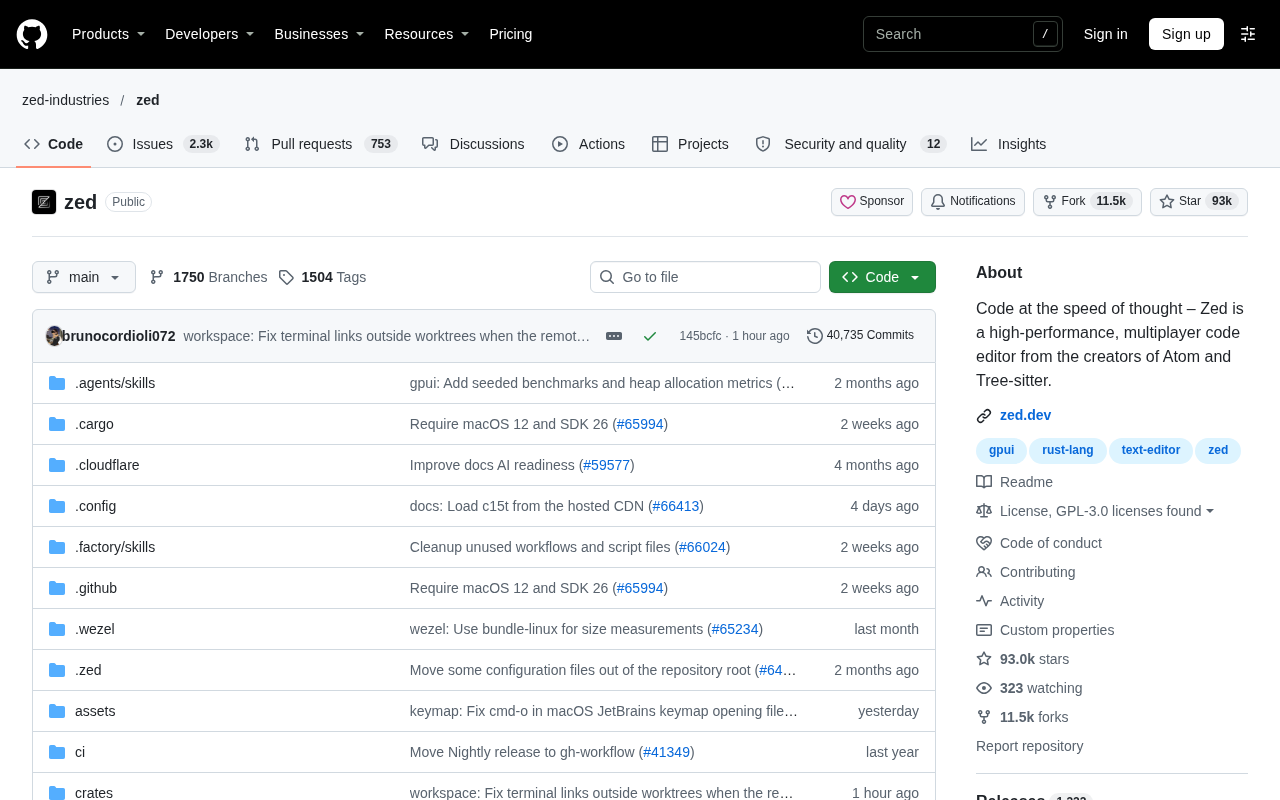
Project positioning: A high-performance multiplayer collaborative code editor built by the original team behind Atom and Tree-sitter, with its core written in Rust.
Problem it solves: Traditional Electron editors (including VSCode) lag when opening large files or massive repositories. Zed aims to prove that an editor can achieve zero latency. It's not just fast; it also builds real-time multiplayer collaboration into the editor core rather than tacking on a plugin.
Core features: GPU-accelerated rendering is its biggest trump card. Combined with its self-developed GPUI framework, the interface refresh goes through the graphics pipeline, not the DOM. Multiplayer collaboration is also native—multiplayer cursors, shared terminals, and voice calls are all inside the editor. It also has built-in AI completion that can connect directly to Claude or local models.
Use cases: Engineers who navigate hundreds of thousands of lines of code repositories every day. And remote teams that need pair programming. Think about it: two people sharing the same buffer with latency far lower than screen sharing—that experience is completely different.
Tech stack: Rust + GPUI + Tree-sitter. High reference value. GPUI is a pure Rust UI framework that doesn't depend on the web tech stack. If this path succeeds, it will offer another paradigm for desktop application development. Tree-sitter's syntax parsing capability also makes its highlighting and structural editing very solid.
Stars/Forks analysis: Over 92,000 stars, over 11,000 forks, +292 in a single day. For an editor still iterating rapidly, this growth rate is a steady climb, not an explosion. But note that its forks-to-stars ratio is nearly 8:1, indicating that quite a few people are actually modifying the code. That's different from projects that are just bookmarked and never used.
Rails: Twenty Years Old and Still on the List
Project positioning: Ruby on Rails, the living fossil of full-stack web development frameworks and the teacher of countless frameworks.
Problem it solves: It sets conventions for all the dirty work in web development—repetitive CRUD, routing, database migrations, authentication. The phrase "convention over configuration" was popularized by Rails.
Core features: Its appearance on the list today isn't about new features but about the stability of continuous maintenance. After Rails 8, it incorporated database-backed background components like Solid Queue, Solid Cache, and Solid Cable into the main framework. This means a small-to-medium project no longer needs extra dependencies like Redis and Sidekiq, making deployment much simpler.
Use cases: Independent developers and small teams quickly validating products. Especially for scenarios where an MVP needs to go live in a week, Rails remains one of the most efficient choices. GitHub itself was written in Rails in its early days.
Tech stack: Ruby. Its reference value for developers lies in its engineering philosophy. Rails proved one thing: a framework's restraint and conventions can translate into team collaboration efficiency.
Stars/Forks analysis: Over 58,000 stars, over 23,000 forks, only +44 in a single day. This number is very healthy. A twenty-year-old project still gaining forty-plus stars a day shows it continues to attract newcomers. The fork count exceeds the star count, which is rare on the list, reflecting a large number of actual deployments and secondary development.
React: A 250,000-Star Behemoth Still Growing
Project positioning: A JavaScript library for building web and native user interfaces.
Problem it solves: Breaking UI into components and driving views with state. This idea is now industry consensus, but it was revolutionary back in the day.
Core features: After React 19, Server Components and Actions have gradually matured. Things like form submission and data mutation, which previously required a bunch of state management code, can now be declared directly in components. The compiler direction is also advancing—React Compiler can automatically memoize, so scenarios requiring manual useMemo will become increasingly rare.
Use cases: Almost all front-end projects requiring complex interactions. Meta-frameworks like Next.js and Remix are built on top of it. React Native brings it to mobile.
Tech stack: JavaScript, with TypeScript being the mainstream pairing. Its reference value lies in its architectural ideas—immutable data, one-way data flow, reconciliation algorithm—which have influenced almost all subsequent front-end frameworks.
Stars/Forks analysis: Over 252,000 stars, over 51,000 forks, +244 in a single day. Gaining over two hundred a day at this scale shows the ecosystem is still expanding. Note that it ranks sixth today, behind Zed and several legacy projects. This ordering itself shows that today's traffic is dispersed, with no single blockbuster.
VSCode: Highest Single-Day Gain, the Editor War Enters the Second Half
Project positioning: Microsoft's open-source code editor and currently the most widely used editor in the world.
Problem it solves: Maximizing editor extensibility. Through the extension marketplace, any language and any framework can get support.
Core features: Recent versions have focused on AI integration and performance optimization. Deep Copilot integration, plus improvements to the editor's startup speed, are key to maintaining user stickiness. Additionally, its Remote and Codespaces capabilities make cloud development part of daily life.
Use cases: From students to large enterprise teams, the broadest coverage. Especially suitable for organizations that need a unified development environment.
Tech stack: TypeScript + Electron. Its reference value lies in proving the feasibility of using the web tech stack for desktop applications and the commercial value of plugin ecosystems.
Stars/Forks analysis: Over 194,000 stars, over 44,000 forks, +295 in a single day, topping today's list. This number is worth pondering. Zed is right behind it at 292—almost hand-to-hand combat. The editor competition is now out in the open: one side is ecosystem and habit, the other is performance and native experience. This赛道 will be very interesting over the next two years.
Prometheus and etcd: The Two Pillars of Cloud Native
Prometheus project positioning: Monitoring system and time-series database, the de facto standard for cloud-native monitoring.
It solves the problem of connecting metric collection, storage, querying, and alerting into one line. Core features are the Pull model and the PromQL query language. Once a team gets familiar with PromQL, it's almost impossible to replace. Use cases are all teams running Kubernetes. Tech stack is Go. Today over 66,000 stars, +140 in a single day—steady growth.
etcd project positioning: Distributed reliable key-value store for storing the most critical data in distributed systems.
Its core value is consistency. The Raft protocol ensures data synchronization across every node in the cluster. Kubernetes' entire state is stored in etcd. Think about it: if a cluster's brain has inconsistent data, everything falls apart. So etcd's stability is more important than anything. Tech stack is also Go. Over 52,000 stars, +123 in a single day.
Looking at these two projects together is interesting. Both are written in Go, both are the foundation of cloud native, and their growth rates today are similar. This shows that demand for infrastructure at the cloud-native layer remains strong.
nushell and ruff: Rewriting Old Unix Tools in Rust
nushell project positioning: A new type of shell that treats command output as structured data.
In traditional shells, everything is text. To parse the output of ls, you have to use awk or sed. nushell turns output into tables, and you can filter, sort, and select columns like operating a database. This approach is very clean. Use cases are ops engineers and developers who write complex scripts every day. Tech stack is Rust, over 40,700 stars, +88 in a single day.
ruff project positioning: An extremely fast Python linter and code formatter written in Rust.
It solves a straightforward problem. In the Python ecosystem, tools like flake8, isort, and black each do their own thing, and they're slow. ruff replaces them all with a single binary, dozens of times faster. It's now one of the most popular tools in the Python community. Tech stack Rust, over 50,400 stars, +107 in a single day.
The commonality between these two projects is obvious. Rust is launching a full-scale replacement of traditional implementations at the system tool layer. Speed is their shared selling point.
Other Entries: mpv, symfony, openssl
mpv is a command-line media player evolved from MPlayer and mplayer2. Written in C, over 37,000 stars. Its value lies in extremely low resource usage and powerful scripting capabilities; many player front-ends are based on it.
symfony is the flagship framework of the PHP ecosystem, with excellent componentization—Laravel uses many of its components. Over 31,000 stars, +89 in a single day, very healthy for a PHP project.
openssl needs no introduction—the foundation of TLS and cryptography libraries. Over 31,000 stars, +24 in a single day. The number isn't large, but its importance is completely disproportionate to its star count.
Today's Trend Observations: No AI, but AI's Underlying Dependencies Everywhere
First observation: no AI agent frameworks made the list today. That's anomalous in 2026. But looking closely, these projects are actually the underlying layer of the AI toolchain. Zed and VSCode are the entry points for AI programming, ruff helps check AI-generated code, and nushell provides a structured environment for agents. The hotter AI gets, the more important this infrastructure layer becomes.
Second observation: Rust has a strong presence. Three projects made the list, covering editors, shells, and the Python toolchain. The phrase "Rust rewrites everything" has been shouted for years, and today's list provides some empirical evidence.
Third observation: legacy projects are making a collective comeback. Rails is twenty years old, OpenSSL over twenty, React over ten. They didn't make the list through new features but through long-term reliability. This reminds us that although attention in the open source world is always drawn to new projects, what truly supports the software industry is this group of quiet old-timers.
Today's Must-See TOP3
Number one: zed-industries/zed. It's the most observation-worthy project today. The answer to the route war between performance and ecosystem may be revealed in the next two years. If you want to participate in a project that is defining the future of editors, look at it.
Number two: astral-sh/ruff. One tool replaces an entire Python toolchain—this engineering approach is worth learning from for anyone building developer tools. Its architecture and performance optimization techniques can be directly borrowed.
Number three: etcd-io/etcd. A textbook on distributed consistency. Even if you don't use it for now, reading its Raft implementation will help you understand any distributed system.
Outlook
What's worth watching in the coming days is whether the close competition between Zed and VSCode will continue. If this trend persists, the editor赛道 will see a wave of feature arms races, benefiting all developers. Additionally, the wave of Rust toolchain replacement continues—what will be rewritten next, git? Or grep? We'll see tomorrow.
One-line Summary
Today's list is dominated by infrastructure projects, with no AI agent frameworks, reflecting developers' attention returning to underlying tools; three Rust projects appear simultaneously (Zed, nushell, ruff), confirming the wave of Rust rewriting system tools; Zed and VSCode gained 292 and 295 stars respectively in a single day, and the battle between editor performance and ecosystem has entered hand-to-hand combat.
Related articles
 Tech Frontiers
Vibe Coding Step-by-Step Guide: Learn to Build Products with AI in Six Steps
Breaking down the six-step methodology of Bilibili's 748-episode Vibe Coding course, analyzing the usage boundaries and prompt techniques of Codex, Claude Code, and Cursor, and discussing who this AI coding course suits, who it doesn't, and how to avoid the trap of watching without acting.
 Tech Frontiers
Is a $50 Pro Tier Really Coming? Plus Could Face Major Restrictions
A Reddit rumor suggests a $50 Pro subscription tier is coming and that the existing Plus tier will be aggressively limited. We analyze the rumor's credibility, the business logic behind subscription tiering, and practical ways to evaluate such pricing-change rumors.
 Tech Frontiers
Coldframe: A Honeypot Disguised as a Supermarket Freezer Controller
Coldframe is a honeypot disguised as Danfoss AK-SM 800A and Dixell XWEB freezer controllers, built as a single Python file that detects CVE-2025-41450 attempts and is identified as real devices on Shodan.