GitHub Open-Sources Agent Host Protocol: Seamless AI Session Continuity Across Devices

GitHub launches the open Agent Host Protocol to let AI coding sessions follow users across devices.
GitHub proposes the open Agent Host Protocol to solve the device-bound limitation of AI coding assistants, where context cannot continue across endpoints. The protocol decouples session state from the execution environment: the Agent Host handles persistence and synchronization, while editors, mobile apps, and cloud services share the same session. Agent sessions include tool call history, intermediate file states, and pending operations, making sync more complex than ordinary chat logs. GitHub advances this as an open protocol to avoid ecosystem lock-in.
When AI coding assistants expanded from a single IDE plugin to a core tool for multi-device collaboration, a thorny problem emerged: you spend half an hour refining a code refactoring plan with an Agent in your office editor—how do you pick up the conversation exactly where you left off when you get back to your phone? GitHub's answer is an open Agent Host Protocol.
From "Device-Bound" to "Session-Following"
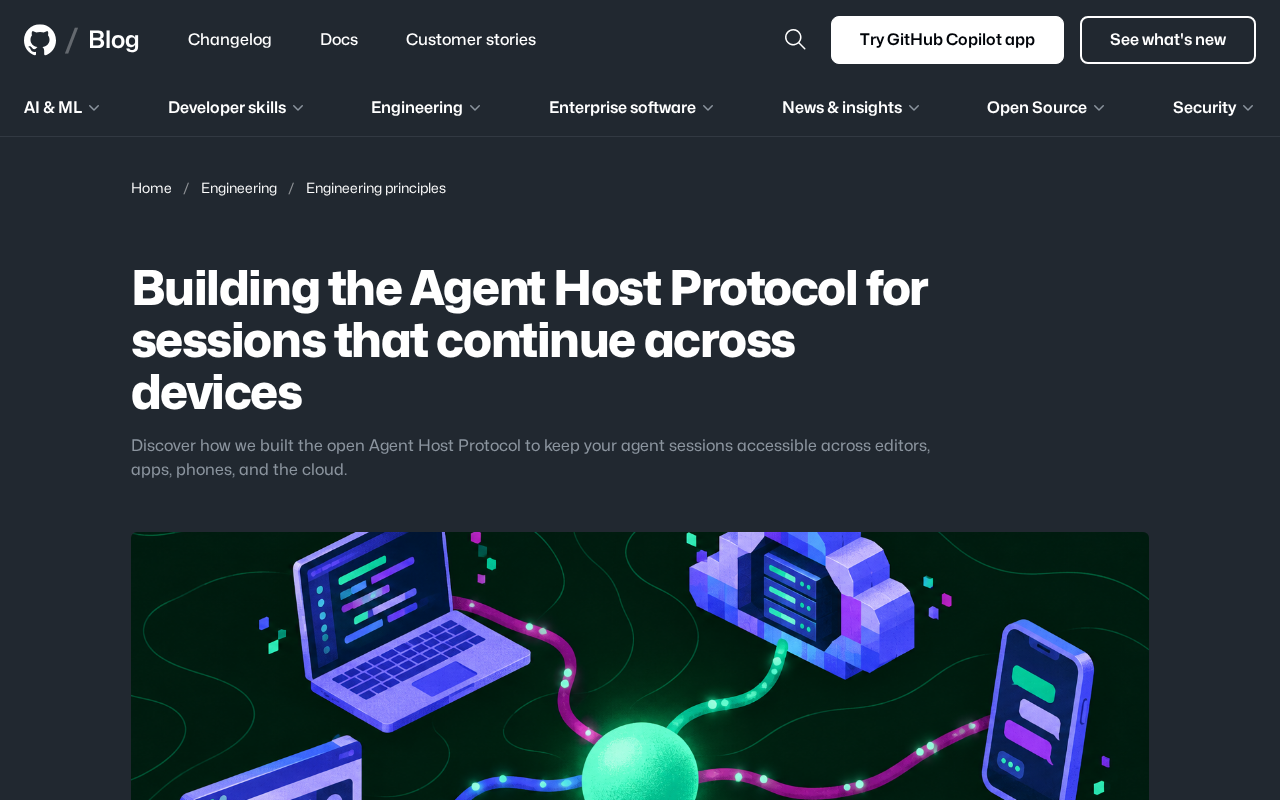
Currently, the dominant way to use Agents is still device-bound—each client independently maintains its own conversation context. This means that when users switch between editors, standalone apps, phones, or the cloud, they often need to rebuild context or manually transfer information. GitHub explicitly states in its blog that the goal of building the Agent Host Protocol is to keep Agent sessions accessible across editors, apps, phones, and the cloud.
The essence of the protocol's approach is "decoupling session state from the execution environment." The Agent Host is responsible for session persistence and state synchronization, while different clients—editors, mobile apps, cloud services—act as access points that read and write the same session through the protocol. This architecture makes "where the conversation happens" no longer a constraint; what truly matters is "how far the conversation has progressed."
Session Persistence refers to detaching conversation state from process memory and writing it to a storage layer that can be preserved long-term, so that complete context can be restored after a client process exits, a device switch, or a network interruption. For Agents, what needs to be persisted is not just message text, but also tool call parameters and return values, file snapshot references, pending operations awaiting user confirmation, and more. Common implementations include structured event logs (event sourcing) and state snapshots: the former facilitates replay and auditing, while the latter enables fast recovery. The granularity and frequency of persistence directly affect sync latency and storage costs, making it a key trade-off in protocol design.
Engineering Trade-offs in Protocol Design
GitHub positions this protocol as an "open" standard rather than an internal implementation detail. The open-source approach means that third-party editors, independent developers, and cloud service providers can all implement compatible Hosts or clients, preventing the ecosystem from being locked in by a single vendor.
From an engineering perspective, cross-device session synchronization needs to handle several core issues: the serialization format of session state, conflict handling during concurrent multi-device access, and reconnection and state recovery under unstable network conditions. GitHub categorizes this part as a discussion at the level of engineering principles in its engineering blog, emphasizing that the protocol should provide a stable foundation for long-running Agent sessions rather than being optimized only for single request-response scenarios.
You may not have noticed that Agent sessions differ from ordinary chat logs—they often include tool call history, intermediate file states, operations awaiting confirmation, and more. The protocol needs to incorporate this "execution context" into migratable session state, which is what distinguishes it from general-purpose chat synchronization protocols.
Multi-device Concurrent Conflict Handling is unavoidable in cross-device session scenarios: the same session may be read and written simultaneously by a desktop and a phone—for example, the desktop is streaming code generation while the mobile user submits a correction instruction at the same time. Common strategies include optimistic concurrency control (attaching version numbers or vector clocks to session state, rejecting writes on conflict and requiring replay), operational transformation (OT), and conflict-free replicated data types (CRDTs). OT is suitable for collaborative text editing but complex to implement; CRDTs can merge automatically under network partitions but have larger state sizes. Agent sessions also involve side-effect operations such as tool calls, which cannot be simply merged and typically require serialization queues or session ownership (lease) mechanisms to ensure that only one execution endpoint holds write permission at any given time.
Why Open Protocols Matter More Than Features
Implementing cross-device synchronization for a single product is not difficult; what's difficult is getting the entire ecosystem to speak the same language. GitHub's choice to advance this as an open protocol sends a clear signal: the Agent session layer should become infrastructure that all parties can implement, much like how the Git protocol serves code hosting.
For developers, this means that in the future they may only need to follow one protocol to let their Agent flow between VSCode, mobile devices, and cloud CI. For tool vendors, the openness of the protocol lowers the barrier to integration and prevents users from being unable to migrate due to session lock-in.
Of course, actual adoption of the protocol still depends on implementation quality and the speed of ecosystem response. GitHub's blog does not disclose specific protocol specification details or the list of initially supported clients; that information will need to wait for subsequent documentation and the open-source repository.
The relationship between protocol standardization and vendor lock-in deserves elaboration. When a vendor's session data format and synchronization interfaces are not public, once users accumulate a large amount of Agent session history, migration costs create de facto lock-in; third-party tools also struggle to integrate and can only adapt passively. Open protocols turn "sessions" into portable assets by publishing the state model and transport contract—similar to how LSP (Language Server Protocol) decouples editors from language services and how Git makes code hosting interoperable. The cost is that the protocol requires a more cautious version evolution strategy and compatibility commitments; otherwise, ecosystem fragmentation would actually increase integration burden.
Impact on AI Coding Workflows
Cross-device session continuity may look like a UX optimization, but it actually changes the boundaries of how Agents are used. When sessions can be invoked anytime and anywhere, an Agent becomes closer to a persistent collaborator rather than a one-off Q&A tool. Mobile devices can take on the role of "review and confirmation," desktops handle heavy code generation and debugging, and the cloud takes on long-running tasks.
This division of labor imposes new requirements on Agent product design: sessions no longer depend on the lifecycle of a particular window, and products need to be modeled around "sessions" rather than "editor instances." The Agent Host Protocol is exactly an infrastructure step in this direction.
Long-running Agent Sessions refer to task-oriented sessions that span hours or even days and include multiple human-AI interactions and tool calls. What distinguishes them from the single request-response pattern is that state continues to evolve and may include background task handles, unfinished plan steps, and asynchronous results that depend on external systems (such as CI pipelines). Such sessions require the protocol to support state catch-up after reconnection, incremental event subscriptions, and session lifecycle management (suspension, archiving, recovery). This is also why the Agent Host Protocol emphasizes "providing a stable foundation for long-running sessions."
One-line Summary
GitHub launches the open Agent Host Protocol, letting AI coding sessions follow users across devices.
Paragraph Summary
GitHub proposes the open Agent Host Protocol to solve the current problem of AI coding assistants being device-bound, with context unable to continue across endpoints. The protocol's core idea is to decouple session state from the execution environment: the Agent Host handles session persistence and state synchronization, while clients such as editors, mobile apps, and cloud services share the same session as access points. Unlike ordinary chat logs, Agent sessions include tool call history, intermediate file states, and pending operations, making synchronization more complex. GitHub chooses to advance this as an open protocol rather than a single product feature, aiming to let third-party editors and vendors implement a unified session layer and avoid ecosystem lock-in. The specific protocol specifications and initially supported clients have not yet been disclosed; actual adoption depends on subsequent documentation and ecosystem response.
Related articles

Gemini 4 Neon Leak: A Potential Strong Contender Against Opus 5.5
A Hacker News thread suggests Gemini 4 Neon looks like an Opus 5.5 competitor. This article unpacks the product positioning behind this community signal, shifts in the top-model competitive landscape, and what it means for developers' model selection strategy.

Claude Fable 5.2's Self-Authored Short Film 'Fable' Sparks Discussion
A short film 'Fable,' credited to Claude Fable 5.2 for script, visuals, and directing, appears on Hacker News. This article analyzes the significance of full-pipeline AI creation, community reactions, and what it means for content creators.

Anthropic IPO Pricing: A Signal of AI Giants Going Public
Anthropic's IPO pricing draws attention. This article analyzes its potential impact on AI industry valuation, commercialization paths, and the competitive landscape, and highlights public-market expectations and challenges for AI companies.