GitHub Trending Roundup: 9 AI Open-Source Projects Worth Watching

9 trending GitHub AI projects reveal shifts toward edge AI, Agent orchestration, and spec-driven development.
This roundup examines 9 noteworthy AI open-source projects from GitHub Trending, including Needle (a 14MB edge foundation model), collaborative Agent workspaces Macro and OlaOS with shared AI memory, EgoLite browser for Agents, GitHub's official SpecKit for spec-driven development, and security tools. Three key trends emerge: edge-side AI deployment, multi-Agent engineering maturity via MCP protocol, and a paradigm shift toward specification-first development.
As the AI wave sweeps through the developer ecosystem, GitHub's Trending page has become a window into the direction of technology. This edition's trending list features a cluster of emerging projects centered around AI Agents, edge intelligence, and spec-driven development, reflecting a shift in the open-source community from "model racing" to "engineering implementation." This article examines each project and analyzes the technical trends behind them.
Edge Intelligence: Squeezing AI into 14MB
One of the most eye-catching projects this time is Needle — an ultra-small foundation model of just 14MB. It's designed specifically for micro-devices like smartphones, wearables, smart home gadgets, and robots, with the goal of fitting AI capabilities into extremely small storage spaces so edge devices can run intelligent applications.
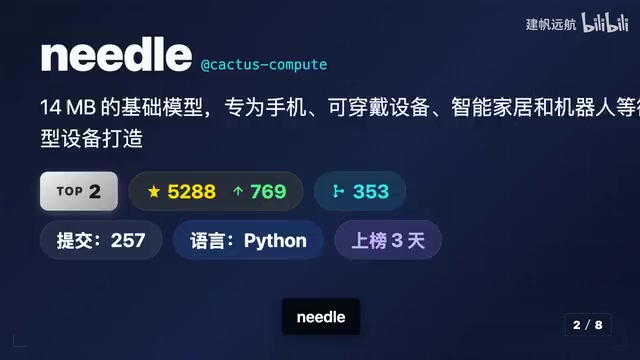
This type of "Tiny Model" represents a completely different technical path from cloud-based large models. While GPT-class models easily reach hundreds of gigabytes, Needle opts for extreme compression, bringing inference to the edge. To understand what 14MB really means, you need to understand the technical context of Edge AI: edge intelligence refers to running AI inference directly on terminal devices where data is generated, rather than uploading data to the cloud for processing. This technical approach has emerged due to three practical constraints: latency issues caused by limited network bandwidth, strict data privacy regulations (like GDPR) restricting data transfer across borders, and the hard requirement for offline operation in IoT scenarios. Model compression is the core technique for achieving edge intelligence, primarily including knowledge distillation (using large models to guide small model learning), quantization (converting floating-point parameters to low-bit integers), and pruning (removing redundant neural connections). A 14MB model size implies it likely employs extreme quantization strategies and architecture designs specifically optimized for edge chips, such as inference optimization for ARM Cortex-M series microcontrollers.
The significance behind this: privacy protection, low latency, and offline availability. For robots and IoT devices, local inference capability that doesn't depend on network connectivity is often more important than parameter scale. It's foreseeable that as terminal computing power increases, edge-side small models will become a crucial branch of AI deployment.
The Explosion of AI Agent Workspaces
Agent-related projects dominate half of this edition's trending list, and this is no coincidence.
Unified Collaboration: Macro and OlaOS
Macro is a unified workspace for teams that integrates email, chat, documents, tasks, Agents, calls, and CRM all in one place, connecting every component through shared AI memory. Its core philosophy is to move team collaboration from fragmentation to integration — AI is no longer an isolated tool but a memory hub that runs through the entire workflow.

With a similar philosophy, OlaOS is an open-source all-in-one AI Agent workspace that can run various Agents across your tools, apps, browsers, and files, supporting over 100 integrations and the MCP protocol, with all Agents likewise sharing memory.
Interestingly, "shared AI memory" has become the common keyword for both projects. This indicates that individual Agent capability is no longer the bottleneck — memory synchronization and collaborative orchestration among multiple Agents is the current technical focus. To understand the importance of this direction, consider the architecture design behind it: Shared AI Memory allows multiple Agents to access the same persistent context store, including user preferences, historical decisions, project progress, and other information — similar to a shared knowledge base in human teams, but implemented through vector databases or structured storage. MCP (Model Context Protocol) is an open protocol standard proposed by Anthropic in late 2024, designed to establish unified communication standards between AI models and external tools and data sources. It defines standard interfaces for context passing, tool invocation, permission management, and more — similar to how the USB protocol unified hardware connections. MCP's value lies in solving the fragmentation problem of incompatible tool interfaces in the current Agent ecosystem, enabling Agents from different vendors to collaborate through a unified protocol. The widespread support for the MCP protocol confirms that this standard is becoming the connective foundation of the Agent ecosystem.
Seamless Browser: EgoLite
EgoLite claims to be the fastest browser built specifically for AI Agents. Its most clever design feature: it can share your logged-in browser state directly with agents like Codex or Claude Code, without disrupting your ongoing work at all.

The zero-cost, zero-configuration philosophy addresses a long-standing pain point in Agent automation — authentication and session state. Letting AI "borrow" the user's logged-in state to execute tasks avoids the hassle of repeated logins while making automation workflows smoother.
This design involves a subtle security boundary issue. Traditional browser automation tools (like Selenium and Playwright) typically launch independent browser instances that require re-logging into all services — not only tedious but potentially triggering platforms' anomalous login detection. EgoLite's approach is to securely share Cookies and Session Tokens in an isolated environment, letting Agents operate as the user while using sandbox mechanisms to ensure Agents cannot access sensitive data beyond their scope. This approach essentially seeks a balance between convenience and security — Agents receive restricted, specifically-scoped session permissions rather than full account control.
Spec-Driven Development: GitHub Officially Enters the Arena
SpecKit is an official GitHub development toolkit specifically designed to help developers quickly get started with Spec-Driven Development, pushing teams from "code-first" to "documentation and specification-first," using specifications to drive the entire development process.

The official backing of this project is telling. Spec-driven development isn't an entirely new concept — its intellectual roots trace back to Formal Methods and Design by Contract. In traditional software engineering, OpenAPI/Swagger specification-driven API development is a successful practice of this philosophy — define the interface specification first, then automatically generate server frameworks and client SDKs. But in the AI programming era, the scope of spec-driven development has expanded dramatically: specifications are no longer limited to API interface definitions but encompass business logic descriptions, behavioral constraints, test cases, architectural decisions, and other comprehensive requirements documentation.
In the age of AI-assisted programming, code generation is becoming increasingly cheap, while clear requirement specifications have become the scarce resource. When AI can automatically generate implementations from specifications, the "write specs first, then generate code" workflow will dramatically improve development efficiency and quality. This aligns with the philosophy of "prompt engineering," but SpecKit systematizes it into a collaborative, version-controlled engineering practice. SpecKit's emergence can be seen as GitHub's official bet on the future paradigm of software engineering — developers' core competitive advantage is shifting from writing code to precisely describing intent.
Chart Generation and Security Tool Recommendations
Beyond the Agent ecosystem, several practical vertical tools from this edition are worth mentioning.
Diagram Design is a chart library tailor-made for Claude Code, featuring 29 editorial-grade diagram types, all implemented using self-contained HTML SVG without relying on bloated Mermaid, making AI-generated diagrams both professional and clean. This is very friendly for scenarios that require generating visualizations within AI conversations. The technical decision to choose self-contained HTML SVG over Mermaid is noteworthy: while Mermaid has concise syntax, its rendering depends on a JavaScript runtime and offers limited chart style customization; native SVG embedded in HTML enables pixel-level visual control, smaller file sizes, and renders in any browser without additional dependencies.
In the security domain, Hohi is an email occupancy checking tool that can quickly discover whether an email address is registered on platforms like Twitter, Instagram, and others — useful for investigating email leaks or account traces. Spiderfruit is an automated Open Source Intelligence (OSINT) tool that helps security teams automatically collect threat intelligence and map attack surfaces, turning tedious information gathering into automated workflows.
OSINT (Open Source Intelligence) refers to the methodology of systematically collecting and analyzing intelligence from publicly available information sources. In cybersecurity, OSINT tools are widely used for Attack Surface Management (ASM) — identifying all assets and potential entry points an organization has exposed on the internet. Traditional OSINT work is highly dependent on manual operations, with security analysts needing to individually query DNS records, certificate transparency logs, social media profiles, code repository leaks, and dozens of other information sources. The value of automated tools like Spiderfruit lies in orchestrating these scattered queries into repeatable workflows and assembling fragmented information into complete threat profiles through correlation analysis.
Trend Summary
Looking at this edition's trending list as a whole, several clear technical themes emerge:
- The Rise of Edge-Side AI: Small models represented by Needle bring intelligence down to edge devices, retaining core reasoning capabilities in minimal footprints through compression techniques like knowledge distillation, quantization, and pruning;
- Agent Engineering Maturity: Shared memory, MCP protocol, and browser state sharing — multiple projects collectively push Agents from "functional" to "practical," with multi-Agent collaborative orchestration becoming the new frontier;
- Development Paradigm Shift: SpecKit signals that spec-driven development will become the new standard in the AI programming era, with developers' core value shifting from code implementation to intent expression and specification design.
For developers, maintaining sensitivity to these open-source projects and promptly converting new technologies into competitive advantages is key to staying at the cutting edge. For more detailed technical information, head to the GitHub Trending page for further exploration.
Related articles

Should U.S. College Fraternities Be Banned? A Researcher's Incisive Observations
Why not just ban U.S. college fraternities? A researcher finds the key resistance comes from decision-makers' own fraternity identities and schools' "willful ignorance."

Microsoft Discovery: Accelerating Scientific Discovery with AI Agents
Microsoft's Discovery platform runs specialized AI agents to help researchers screen and prioritize the most promising compounds and experimental paths, reducing experiments and accelerating scientific discovery.

Cambridge Heavy Industries Secretly Develops Desktop-Scale Nuclear Fusion Device
Cambridge Heavy Industries is secretly developing a desktop-scale laser-driven nuclear fusion device, targeting the equipment supply market for fusion power plants. This article analyzes its miniaturization technology path, commercialization logic, and unique positioning in the fusion startup wave.