GitHub Weekly Highlights: Open-Source Grok Bot and Multi-Agent Coding Workbench

This week's GitHub highlights cover open-source AI employee OpenMouseBot, multi-agent interface T3 Code, scraper framework Scrapling, and more.
The article reviews five trending GitHub projects and two resources. OpenMouseBot is an open-source Grok Bot that can assign each bot a cloud Linux desktop, local VM, or the current machine, and supports connecting to Claude Code, Codex, and other CLI tools, with one-click integration to hundreds of apps via Composio. T3 Code brings Claude Code, Codex, Open Code, and other coding agents into one management interface, using a thread-plus-environment design for easy multi-environment switching and Git worktrees to isolate parallel tasks. Scrapling is a modern Python scraping framework supporting browser scraping, Spider batch crawling, and MCP and Skill to convert web pages to Markdown. Meta open-sourced a Beta React design system evolved internally, with a command-line tool for querying components and design rules to prevent style drift in AI-generated pages. There are also an open-source Zi Wei Dou Shu charting tool and two resources: a China internet statistics report and DeepSeek Harness tutorials.
Open-Source Grok Bot: Your AI Employee Is Now Live
Recently, AI companies have started "assigning AI employees" to users. Meta launched Muse, Grok rolled out Bot, and OpenAI has Dots—the idea is similar across the board: give the AI a cloud computer and browser to handle daily tasks, or assign long-running tasks that execute automatically in the background. OpenMouseBot, featured in this week's GitHub highlights, aims to be an open-source version of Grok Bot.
Its interface is styled like a chat app, except the contact list on the left is replaced by bots you create yourself. Give a bot a name, assign it a responsibility, pick a model, and it can start working. You can also put several bots into the same channel, or even connect them to Claude Code, Codex, or Grok command-line tools already installed on your computer—the area below is where these agents actually do the work, and the overall experience feels very similar to multi-agent orchestration tools.
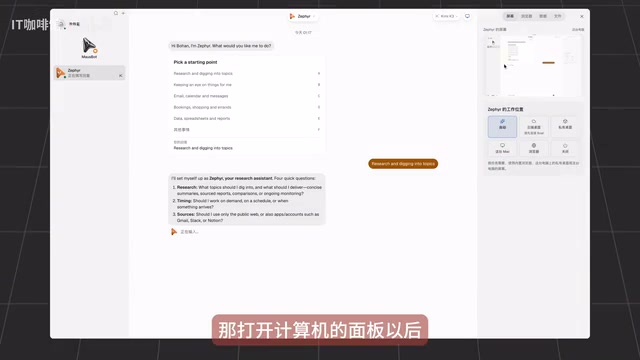
One distinctive feature of OpenMouseBot: each bot can be assigned its own computer. This computer can be a cloud Linux desktop, an isolated local virtual machine, or simply the machine you're currently using. After opening the computer panel, the bot's cloud desktop appears automatically, and you can watch tasks run in real time. Cloud computers are provided by the bot, an approach very similar to what many cloud vendors are doing now. In addition, the project implements one-click app integration through Composio's Session, connecting to hundreds of common tools. To try it out, first download the desktop client, then create a bot, and decide how to allocate computers based on your own situation—note that cloud computers are not free.
MCP (Model Context Protocol) is an open protocol proposed by Anthropic in late 2024 to standardize how AI models connect to external tools and data sources. Think of MCP as the "USB interface" of the AI world: models use a unified protocol to call capabilities like the file system, databases, browsers, and third-party APIs, without needing to write adapter code for each tool. In this article, OpenMouseBot connects to hundreds of tools via Composio's Session, and Scrapling provides an MCP interface to convert web pages to Markdown—both essentially let agents acquire external capabilities in a standardized way. For developers, MCP lowers the cost of extending tools for agents; for users, it means the same agent can quickly plug into different service ecosystems. Currently, mainstream agent tools like Claude Code and Codex already support MCP.
T3 Code: A Unified Management Interface for Multiple Coding Agents
If you have several coding-agent development tasks on hand at the same time and need to switch between Claude Code, Codex, or Open Code, you might otherwise have to jump back and forth between several windows. T3 Code wants to put all of this into a single management interface.
It supports connecting to various agent tools and offers entry points on desktop, web, and mobile. Compared with ORAC, which we covered earlier, T3 Code doesn't particularly emphasize the concept of an "Agent Team"; its positioning is more centered on development itself and is somewhat more straightforward to use. Its thread-plus-environment design gives it an advantage when managing multiple development environments. If you only develop in a single machine environment and want to explore the concept of automated agents, ORAC's features are stronger; but if you frequently switch quickly between multiple agents, T3 Code will be much more convenient.
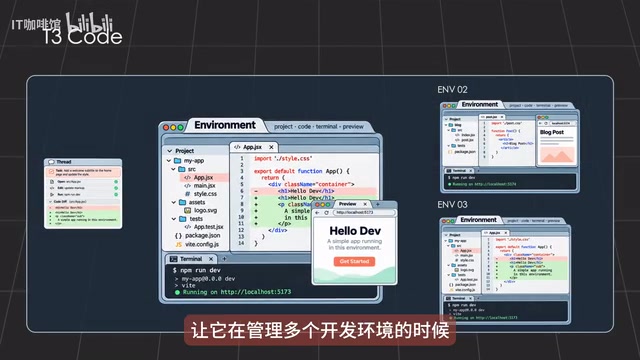
To use it, download and install the desktop version and launch it; it will prompt you to configure agents and can automatically detect agents already present locally. If you use Claude Code rather than the Claude desktop app, you need to change the path to the full path. Besides the default agent, you can also connect other tools via ACP—for example, if Kimi Code is installed locally, just configure the path and set ACP in the parameters to connect. Choose a directory, create a new task, decide which agent should complete it, and when the work is done you can see which code was changed, commit the changes, and create a PR. When handling several tasks at once, you can use Git worktrees to create separate working directories for each to avoid interference; you can also configure multiple environments to bring multiple development environments in at once. It can also give you a unified view of each agent's token consumption.
ACP (Agent Client Protocol) is a type of protocol convention used to connect different coding agents with a unified client. Because tools like Claude Code, Codex, and Kimi Code each have their own invocation methods and parameter formats, a unified management interface needs an intermediate layer to hide the differences. In this article, T3 Code connects to Kimi Code via ACP by specifying the executable path in the configuration and declaring ACP mode in the launch parameters, so the client can communicate with that agent using a unified protocol. A similar idea appears in the LSP protocol between editors and language servers—using one standard interface to connect to multiple implementations. For users, the value of ACP is that they don't need to adapt the interface separately for each agent; as long as a tool supports the protocol, it can be brought into the same workflow. This is also the key to why multi-agent collaboration tools can quickly expand their ecosystems.
Git worktree is a mechanism provided by Git that allows multiple working directories to be checked out simultaneously on the same repository, each on a different branch while sharing the same version repository data. Compared with copying multiple repositories, worktrees save disk space and avoid the problem of inconsistent commit histories between copies. When the article mentions using worktrees to create separate working directories for several tasks at once, it is leveraging exactly this feature: each agent modifies code and submits PRs in its own directory without interfering with the others, and the main working area is not messed up. A common usage is git worktree add ../feature-x feature-x, and when done, clean up with git worktree remove. For scenarios that need to run multiple coding agents in parallel, worktree is almost an essential isolation mechanism.
Zi Wei Dou Shu Charting: Traditional Culture Goes Open Source Too
This week also features a project with a rather different flavor—an open-source Zi Wei Dou Shu charting tool. Zi Wei Dou Shu is a form of traditional Chinese astrology that uses the year, month, day, and hour of birth to arrange information into a natal chart, then places stars such as Zi Wei into different palaces according to rules, and interprets them in combination with the Four Transformations, luck periods, and other rules.
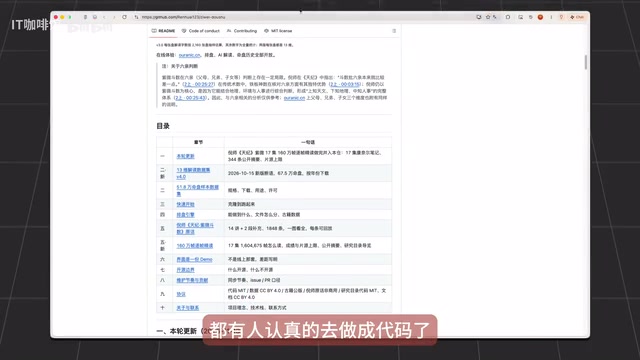
The project is based on the authentic Zi Wei Dou Shu system systematically organized by Teacher Ni Haixia in Tian Ji. There is an online version you can try directly: enter birth information to generate a chart, click on palaces to view the contents, as well as the changes at different age stages and in different years within this system. The repository also collects some ancient texts and knowledge materials for cross-reference. What the project mainly open-sources is the charting engine, the reference materials, and the demo; the full AI interpretation and backend need to be built yourself.
Zi Wei Dou Shu is one of the important schools of traditional Chinese astrology, traditionally said to have originated in the Song Dynasty. Based on the year, month, day, and hour of birth, it places more than a hundred stars into twelve palaces to form a natal chart. The twelve palaces include the Life Palace, Siblings, Spouse, Children, Wealth, Health, Travel, Friends, Career, Property, Fortune, and Parents, corresponding to different aspects of life. After charting, interpretation also combines the "Four Transformations" (Hua Lu, Hua Quan, Hua Ke, Hua Ji) as well as luck-period rules such as major limits and annual cycles. Ni Haixia, mentioned in the article, is a well-known contemporary Chinese medicine practitioner and astrology researcher whose "Tian Ji" course systematically organizes the Zi Wei Dou Shu system. The core value of an open-source charting tool lies in engineering the complex star-placement rules, so developers can layer their own AI interpretation or backend services on top of the engine.
Scrapling: A Modern Python Web Scraping Framework
Anyone who writes scrapers knows the feeling: getting the data scraped for the first time is quite satisfying, but a few days later the website is redesigned and you probably can't fetch the data again. Scrapling aims to solve these common problems in a centralized way.
For simple web pages, just make a request; if JavaScript needs to run, use a browser to scrape; after scraping, read content with CSS selectors or XPath. If you need to crawl pages continuously, it also has a Spider crawling feature where you can set how many requests run concurrently, the interval between them, and which sessions to use. For those using agents today, even more directly, it provides MCP and Skill capabilities to convert web pages to Markdown. Of course, the most important thing when using scrapers is to follow the rules—what can be scraped and what cannot—don't mess around.
Meta Open-Sources a React Design System: Keeping Agent-Generated Pages on Track
If you often use AI to write pages, you may have encountered something like this: the first page is generated nicely, but later the styles of buttons, forms, and modals start to drift, and when put together they don't look like the same product. A design system can constrain what buttons look like, how forms are laid out, and what the colors and spacing are, so everything afterward follows suit.
This project evolved from a design system used internally at Meta and provides ready-made components, themes, color modes, and page templates. It is currently in Beta and requires React 19 or above. Its biggest highlight is a command-line tool specifically prepared for agents to query components and design rules. To use it, you can install the component library and theme into a React project and use the corresponding components directly; if you want to switch to your own brand colors, just adjust the theme variables. This kind of thing is very practical when building admin dashboards and internal management tools, because ready-made components are very convenient.
Two Resources Worth a Look
Finally, two resources to share. The first is the 57th Statistical Report on China's Internet Development, covering China's internet development in 2025, including the scale of internet users, online shopping, short videos, and more, with a dedicated chapter on generative AI. Looking at this kind of survey can remind you not to mistake your own circle for everyone; data enthusiasts should enjoy it. The second is a set of DeepSeekAd Harness introductory tutorials, from beginner to advanced, with both tutorials and a website available—take a look if interested.
Related articles

Gemini 4 Neon Leak: A Potential Strong Contender Against Opus 5.5
A Hacker News thread suggests Gemini 4 Neon looks like an Opus 5.5 competitor. This article unpacks the product positioning behind this community signal, shifts in the top-model competitive landscape, and what it means for developers' model selection strategy.

Claude Fable 5.2's Self-Authored Short Film 'Fable' Sparks Discussion
A short film 'Fable,' credited to Claude Fable 5.2 for script, visuals, and directing, appears on Hacker News. This article analyzes the significance of full-pipeline AI creation, community reactions, and what it means for content creators.

Anthropic IPO Pricing: A Signal of AI Giants Going Public
Anthropic's IPO pricing draws attention. This article analyzes its potential impact on AI industry valuation, commercialization paths, and the competitive landscape, and highlights public-market expectations and challenges for AI companies.