GitHub Weekly Trending: 5 AI Coding Tools from Beginner to Advanced

5 trending GitHub AI coding tools linking beginner guides to advanced tooling.
This week's GitHub trending list centers on AI coding: Skills sets engineering rules for Agents, Omniroute builds a never-down AI gateway, Code Review Graph offers a local-first code knowledge graph, PI provides an open-source Agent toolkit, and AI Engineering from Scratch is a build-from-scratch course—covering the full chain from beginner to advanced.
One Main Theme: Use AI Well, Use It Cost-Effectively, and Use It to Engineering Standards
This week's GitHub trending list has a clear theme—AI coding. From a skills library that sets rules for engineers, to an API gateway that never goes down, to an AI engineering course you build from scratch, these 5 newly popular projects happen to link AI coding from beginner guides to advanced tools, all pointing in a surprisingly consistent direction: use AI well, use it cost-effectively, and use it to engineering standards.
Below, let's break down these 5 popular GitHub projects one by one and see what real pain points each of them solves.
Skills: An AI Skills Library Built for Real Engineers
Matt Pocock's Skills gained around 10,969 new stars this week, taking the top spot. It cures a problem that plagues countless people: AI writing code that's too verbose, messing with files, and even daring to execute dangerous Git operations—completely ignoring engineering standards.
This set of Skills comes directly from the author's own Agent directory, is MIT open source, and can be installed into Claude Code, Cursor, and Codex with a single command. Its core lies in a few powerful tools:
- Grill Me: Interrogates you before you write code until every decision is thought through, avoiding blind action;
- TDD: Forces you to write tests first, following test-driven development;
- Code Review: Runs a self-review before you commit.
The most hardcore is Git Guard Rails—it puts guardrails on the Agent, blocking dangerous commands like force push and hard reset unless you give the green light.
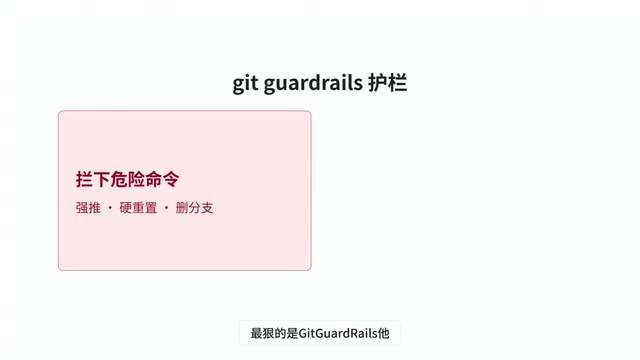
In one sentence: it lets you use AI without giving up the standards of a real engineer. This also highlights the most realistic tension in AI coding today—between efficiency and standards, you need a layer of human constraint.
Omniroute: An AI Gateway That Never Goes Down
Diego's Omniroute gained around 9,965 new stars this week. The pain point it targets is very real: the APIs of AI coding tools are expensive and prone to outages—if your single channel goes down, your work grinds to a halt.
Omniroute uses a single OpenAI-compatible interface to connect to over 290 providers and more than 500 models, over 90 of which are free. Its core is an automatic scheduling engine that scores each candidate across 12 factors such as health, quota, cost, and latency—if one goes down, it immediately switches to the next.
It also has built-in token compression, which can save anywhere from 10% to 90% of usage. With both desktop and web versions, Claude Code, Cursor, and Cline can all connect directly.

In one sentence: it packages "freeloading off everyone's free quotas" and "never going down" into a one-click AI gateway. For developers who rely on multiple models long-term, this kind of aggregation gateway is becoming a must-have.
Code Review Graph: A Local-First Code Knowledge Graph
Turso's Code Review Graph gained around 6,565 new stars this week. It solves the efficiency problem of AI reading code: every time AI reviews, it scans the entire repo, causing context to explode—slow and expensive.
It uses Tree-sitter to parse your code into a graph, storing all functions, classes, calls, inheritance, and tests into a local database. Change one piece of code, and it does an incremental update within two seconds. It can even calculate the "blast radius" of a change—precisely framing the smallest set of affected files and their risk scores.
The project supports over 30 languages, runs entirely locally with no data uploads, and can connect to 14 AI coding tools to automatically perform risk-scored reviews in CI.
In one sentence: it gives AI a map so it only reads the few files it needs to. This approach of "precisely feeding context" is exactly the key direction for solving the context cost problem of large models.
PI: Your Own Open-Source Agent Toolkit
Arendale's PI gained around 4,880 new stars this week. Most coding agents are someone else's black box; PI flips this around by open-sourcing the entire harness and handing it to you.
It's divided into three parts:
- An LLM interface that unifies multiple models;
- An Agent kernel with tool calling and state management;
- An interactive command-line Coding Agent.

One of its bets is particularly unusual: every message, every tool call, and every result is serialized into JSON, so every one of your sessions can be saved, uploaded to Hugging Face as training data, and used to analyze how the Agent actually works.
In one sentence: it's an open-source, self-extensible Agent foundation that's entirely yours. For developers who want to deeply understand or customize Agent behavior, this kind of transparent design is extremely valuable.
AI Engineering from Scratch: An AI Engineering Course Built from the Ground Up
Rohit's AI Engineering from Scratch grew astonishingly this week. It pushes back against the kind of learning where you only know how to call an API—you can attach a function to an Agent, but you can't explain what the attention mechanism inside the model it calls is actually computing.
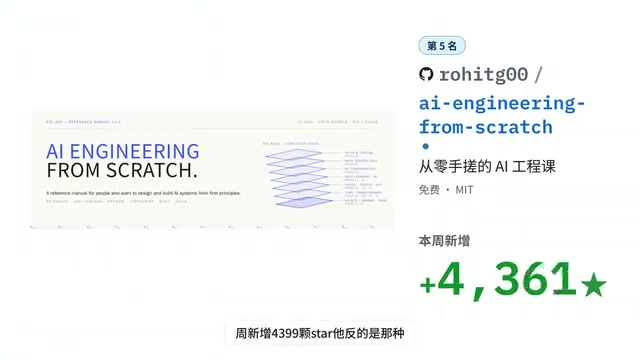
This course is free and MIT open source, with 20 stages and over 500 lessons, going from mathematical fundamentals all the way to multi-agent systems and production deployment. Every algorithm is first hand-written from raw math, so by the time frameworks appear, you already know what's happening underneath.
Every lesson follows the same loop: understand the problem → derive the math → write the code → pass the tests → leave behind a reusable finished product.
In one sentence: it's a systematic, free path of "understand the principles first, then use the frameworks." In an era where everyone calls APIs, returning to the underlying principles has instead become a scarce competitive edge.
Conclusion: A Complete Chain from Beginner to Advanced
When you link these 5 AI coding projects together, a clear main theme emerges:
- AI Engineering from Scratch teaches you to systematically learn AI engineering;
- Skills sets rules for the Agent;
- Omniroute builds a gateway that never goes down;
- Code Review Graph lets AI read code and self-check efficiently;
- PI provides an Agent foundation that's your own.
They all point in one direction: use AI well, use it cost-effectively, and use it to engineering standards. This also represents the maturing trend of the AI coding ecosystem—shifting from pursuing "it works" to pursuing "controllable, economical, and professional."
Related articles

Older Google Home Gets Gemini Live Upgrade: Conditions and Experience Fully Explained
Google is rolling out Gemini Live conversational AI to older Google Home speakers, but subscription or plan requirements may apply. Here's what you need to know.

Older Google Home Gets Gemini Live Upgrade: Complete Breakdown of Requirements and Experience
Google is rolling out Gemini Live conversational AI to older Google Home speakers, but subscription or plan restrictions may apply. Full breakdown of the upgrade details and impact.

GPT-5.6 Hands-On Review: Analyzing the Agent Capabilities Behind Its #1 Ranking on the Frontend Development Leaderboard
GPT-5.6 SoulX High tops the frontend dev leaderboard at 1636 points with Agent Arena rank #2. Hands-on tests of portfolio pages and mystery games reveal its task decomposition and self-correction capabilities.