GitNexus: Replacing Vector Retrieval with Code Knowledge Graphs, Cutting AI Coding Costs by 51%

GitNexus uses deterministic code knowledge graphs instead of vector retrieval to cut coding AI costs by 51%.
GitNexus is an open-source knowledge graph kernel from Akon Labs with 45K GitHub Stars. It replaces traditional vector embedding retrieval with deterministic graph-based code analysis, providing coding AI Agents with precise cross-repo call relationships and dependency tracking. Official benchmarks show a 51% reduction in Agent operational costs by eliminating redundant token consumption. Supporting MCP protocol, it works as a plug-and-play code cognition layer for any compatible Agent.
When Coding AI Hits the "Code Cognition" Wall
Over the past two years, AI Agents for coding have proliferated—from code completion to automated refactoring, their capabilities keep growing. But a fundamental problem has never been properly solved: Does AI truly "understand" your codebase?
The current mainstream approach uses vector embeddings to retrieve relevant code snippets. Vector embedding is a technique that converts unstructured data like code into numerical representations in a high-dimensional vector space—code snippets are encoded as fixed-length vectors, and then metrics like cosine similarity are used to find "semantically close" code segments. Under the hood, this relies on large language model encoders (such as OpenAI's text-embedding series or open-source alternatives like CodeBERT), which are trained on massive code corpora to capture semantic features. This approach works reasonably well for small projects, but when facing enterprise-scale multi-repo environments with complex call relationships, its fatal weakness is exposed—it's essentially "guessing" at relationships between code, rather than precisely knowing who calls whom and who depends on whom. Two stylistically similar but completely unrelated code segments might be judged as "highly relevant," while a module that indirectly affects a target function through a complex dependency chain could be completely missed. This is the "semantic gap" problem that embedding-based retrieval faces.
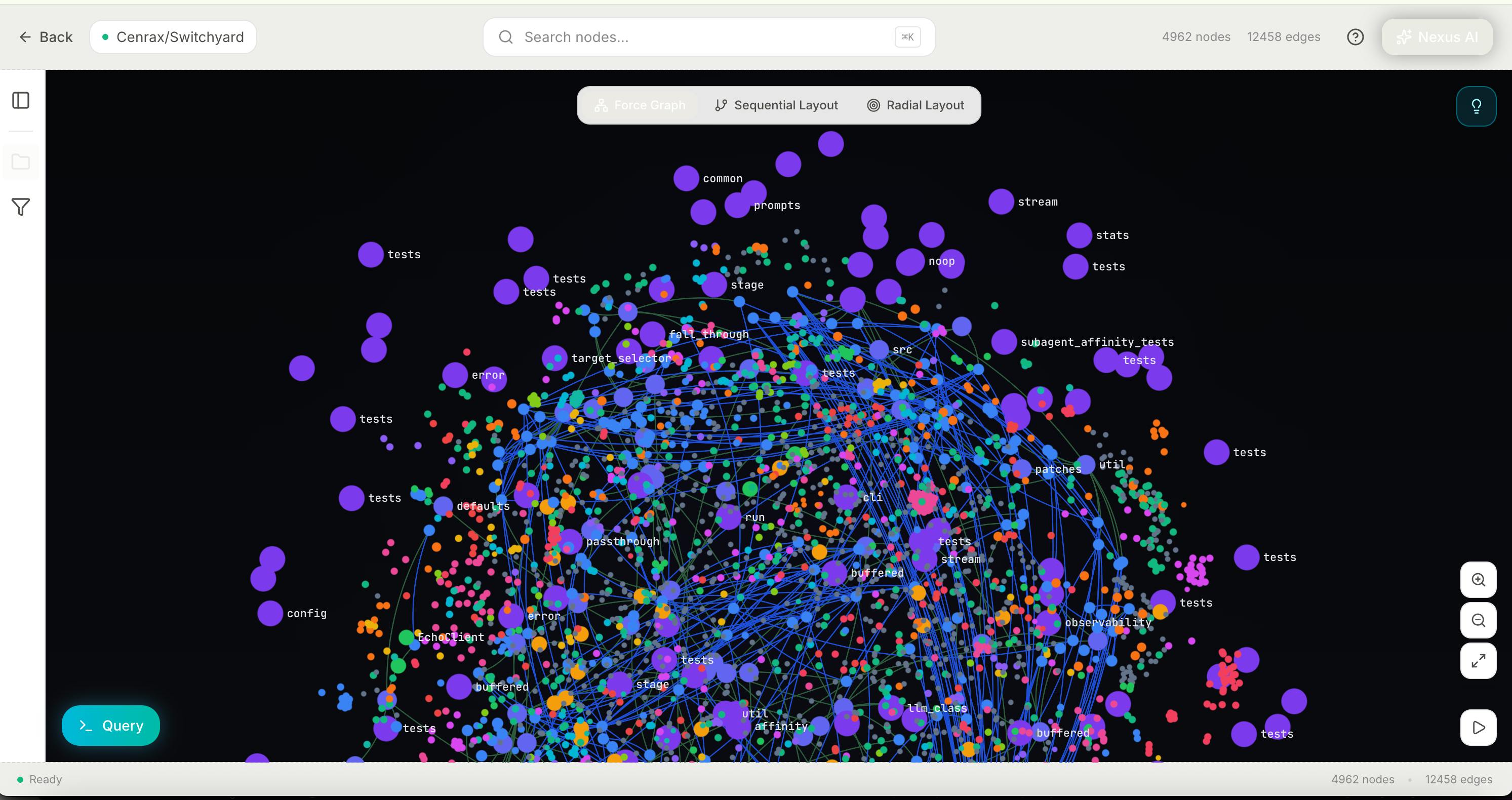
The open-source project GitNexus from Akon Labs targets exactly this pain point. As a Knowledge Graph Kernel with 45K GitHub Stars, it ranked #8 on Product Hunt with 142 votes, and its positioning is clear: an open-source kernel for coding Agents.
What Problem Does GitNexus Solve?
From "Embedding Guesswork" to "Deterministic Graphs"
GitNexus's core approach is to parse every codebase across an entire organization into a single queryable source of truth. Instead of relying on fuzzy semantic similarity, it parses code into a deterministic graph.
From a technical standpoint, a Knowledge Graph is a data model that organizes information using graph structures, consisting of nodes (entities) and edges (relationships). In code analysis, nodes represent code entities such as functions, classes, modules, and variables, while edges represent deterministic relationships like calls, inheritance, imports, and dependencies. Unlike statistics-based embedding methods, building a code knowledge graph typically relies on compiler-level static analysis techniques such as Abstract Syntax Tree (AST) parsing, symbol table analysis, and control flow/data flow analysis. These techniques can precisely extract structural information from code, ensuring that every edge in the graph corresponds to a real code relationship rather than a probabilistic inference.
This means when an AI Agent needs to understand the impact scope of a piece of code, it no longer gets "roughly related" snippets but precise information about:
- Callers: Exactly which functions call this method
- Imports: The real dependencies between modules
- Impact scope: What areas will be affected by modifying a particular location
This determinism is critical for code understanding. In scenarios like refactoring, debugging, or security auditing, the cost of "guessing wrong" is often enormous, and the precise relationships provided by a graph-based approach can significantly reduce the Agent's error rate.
A Unified View Across Repos and SCMs
For large enterprises, code is often scattered across dozens or even hundreds of repositories, potentially spanning different Source Code Management (SCM) systems. In modern software engineering practices, the widespread adoption of microservice architectures has led to highly fragmented enterprise codebases. A mid-sized internet company might have hundreds of code repositories distributed across platforms like GitHub, GitLab, and Bitbucket. These repositories form complex dependency networks through API calls, shared libraries, message queues, and more. When an interface in a foundational service changes, the impact can cascade to multiple downstream services, which may reside in entirely different repositories or even fall under different teams' jurisdictions.
GitNexus's value lies in its ability to cross these boundaries and integrate all codebases into a single graph. Traditional dependency analysis tools typically only work within a single repository and can't trace complete dependency chains across repo boundaries, making cross-repo change impact assessment largely dependent on engineers' experience and manual communication. GitNexus addresses this long-standing "cross-repo context" problem for enterprise development teams by building a global graph that spans repositories. When an interface change in one microservice might affect a caller in another repository, only a graph-level global view can capture this cross-boundary dependency.
The 51% Cost Savings: The Logic Behind the Numbers
According to GitNexus's official public benchmarks, integrating GitNexus reduced coding Agent operational costs by 51%.
To understand this figure, you first need to understand the composition of LLM inference costs. In real-world usage of large language models, tokens are the fundamental unit for billing and computation. The cost of each API call is directly related to the total number of input and output tokens. Take GPT-4 as an example: its context window supports up to 128K tokens, but the more input tokens there are, the higher the cost and the greater the inference latency—because the attention mechanism in the Transformer architecture has a computational complexity that scales quadratically with sequence length. When a coding Agent needs to understand code context, the traditional approach is to stuff large amounts of potentially relevant code snippets into the prompt through multiple retrieval rounds, resulting in massive consumption of redundant tokens. If the first round of retrieval isn't precise enough, the Agent needs to perform multiple iterative retrieval and reasoning cycles, further amplifying costs.
When an Agent can directly obtain precise call relationships from the graph:
- No need for extensive exploratory retrieval, reducing redundant token consumption
- More precise context, so the model doesn't have to process irrelevant code noise
- Shorter reasoning paths, reducing the number of multi-round trips
In other words, GitNexus front-loads the work of "letting the model guess the structure" by "providing answers directly through a deterministic graph," thereby dramatically compressing computational overhead. For enterprises with massive daily call volumes, a 51% cost reduction translates to real budget savings.
MCP Protocol: Plug-and-Play with Any Agent
Another key design choice of GitNexus is collaborating with any Agent through MCP (Model Context Protocol).
MCP is an open protocol introduced by Anthropic in late 2024, aimed at standardizing how AI models interact with external data sources and tools. Before MCP, integrating each AI Agent with external systems required writing custom interface code, leading to severe ecosystem fragmentation. MCP defines a unified communication specification—including standardized operations like resource discovery, tool invocation, and context injection—enabling any data source or tool that follows the protocol to be called plug-and-play by any compatible Agent. As of mid-2025, MCP is supported by mainstream AI products including Cursor, Claude Desktop, and Windsurf, and platforms like GitHub and Notion have released official MCP servers. It's rapidly becoming a foundational standard at the "USB interface" level for the AI application ecosystem.
GitNexus's embrace of MCP means it's not tied to any specific Agent framework but can serve as a universal "code cognition layer" callable by various coding assistants.
This "kernel" positioning is very smart—it doesn't compete with upper-layer Agent products but instead serves as foundational infrastructure. Just as an operating system kernel provides unified services to upper-layer applications, GitNexus aims to become the shared code understanding engine for all coding Agents.
Worth Watching, But Still Needs Validation
GitNexus's approach represents an important evolutionary direction for coding AI infrastructure: shifting from probabilistic embedding retrieval to deterministic structural graphs. This shift is especially critical for handling complex, large-scale codebases.
However, as a technology observer, several points are worth ongoing attention:
- Graph construction and maintenance costs: Parsing massive codebases into graphs requires computational resources, and keeping the graph up-to-date during frequent code changes is an engineering challenge. In active enterprise development environments, codebases may see hundreds of commits per day, each potentially introducing new functions, modifying call relationships, or deleting modules. Maintaining consistency between the graph and the codebase requires an incremental update mechanism—only parsing and updating graph nodes and edges affected by changes, rather than full rebuilds. This involves a series of engineering challenges including change detection (typically through Git's diff mechanism), incremental AST parsing, localized graph updates, and consistency verification.
- Depth of multi-language support: The extent of deterministic parsing support for different programming languages directly affects its practicality. For code written in dynamic languages (such as Python and JavaScript), static analysis may not capture all call relationships due to features like runtime binding, monkey patching, and dynamic imports—this is the core technical challenge for multi-language support depth. By comparison, statically-typed languages like Java and Go typically achieve higher parsing accuracy.
- Generalizability of benchmarks: The 51% cost savings comes from official benchmarks; actual benefits in real-world business scenarios still need more third-party validation.
Overall, as an open-source project with 45K Stars, GitNexus has already demonstrated the community's recognition of the "code knowledge graph" direction. For teams currently building or deploying coding Agents, it's worth adding to the technology evaluation shortlist.
Related articles
Google Antigravity + Gemini 3.7 Flash: An Efficient Approach to Multi-Agent Collaboration
Explore how Google's Antigravity orchestration platform and Gemini 3.7 Flash model work together to solve complex multi-agent math and engineering problems.
Max Plan Shifts from Subscription to Credits — Has Your Usage Actually Shrunk?
AI coding subscriptions shift from session-time to API credits. A $100 Max plan now offers $300 in credits at a 3:1 ratio — has actual usage really shrunk?

OpenAI Cuts Off Cursor: The Full Story Behind the Feud and China's Push for Open-Source, Affordable AI
OpenAI cuts Cursor's model access over Musk's acquisition; Cursor pivots to Claude. Meanwhile, Chinese AI models like Qwen, GLM, and Hunyuan push open-source affordability, accelerating AI democratization.