GitNexus: Using Knowledge Graphs to Stop AI Coding Tools from Blindly Modifying Code

GitNexus uses knowledge graphs to give AI coding tools precise, on-demand code retrieval instead of blind modifications.
This article introduces the open-source tool GitNexus and how it solves key pain points in AI-assisted programming. It builds a knowledge graph from the codebase, recording dependency and call relationships between functions, classes, and modules, enabling AI to precisely retrieve relevant code snippets on demand rather than loading everything at once. This not only dramatically reduces Token consumption but also analyzes impact ranges through reverse queries before code modifications, preventing cascading effects from breaking existing functionality.
Why Does AI Programming Need Knowledge Graphs?
When using AI coding tools for project development, as projects grow in scale, we frequently encounter several pain points:
- Every time you open a new conversation window, you need to repeatedly explain the project architecture, conventions, and caveats to the AI
- Worrying that the AI doesn't understand the full project picture, causing cascading effects when modifying code and breaking existing functionality
- Stuffing documentation, directories, and key files all into the AI's context window, which quickly fills up and causes Token costs to skyrocket
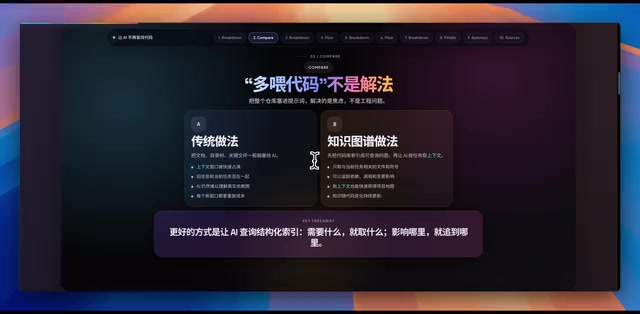
The traditional approach is to dump all relevant files into the AI at once. This not only wastes Tokens but also causes the AI to gradually forget earlier conventions and agreements during long conversations.
It's important to understand the deep contradiction of large language models' "context windows." The context window refers to the maximum text length a model can process in a single inference, measured in Tokens (1 Token ≈ 0.75 English words or 0.5 Chinese characters). Mainstream models have evolved from an early 4K Token context window to today's 128K or even 200K Tokens, but this doesn't mean the problem disappears—longer context brings two new issues: first, costs grow linearly since input Tokens are typically billed by volume; second, the "Lost in the Middle" phenomenon, where research shows models pay significantly more attention to information at the beginning and end of the context than in the middle. When code files are stuffed in bulk, critical specification information may be "ignored" by the model.
What we need is a smarter approach—letting the AI retrieve information on demand rather than loading everything at once.
What Is GitNexus?
GitNexus is an open-source tool (currently with 36K Stars) whose core capability is transforming a codebase from a simple file listing into a structured relationship network—a knowledge graph.
Knowledge Graphs were originally proposed by Google in 2012 to organize entity relationships across the internet. In the codebase context, a knowledge graph abstracts functions, classes, modules, and variables in code as "nodes," and abstracts call relationships, inheritance relationships, and dependency relationships as "edges," forming a queryable directed graph structure. This is fundamentally different from traditional file tree indexing: a file tree only records "where files are," while a knowledge graph also records "how files relate to each other." This graph structure naturally supports graph traversal algorithms, enabling queries like "find all places that call function A" to complete in milliseconds without scanning the entire codebase.
Specifically, GitNexus does the following:
- Scans the codebase and builds a knowledge graph: Analyzes dependency relationships, call chains, and module boundaries between code
- Runs locally, installs MCP and Skills: Provides standardized interfaces that allow various AI coding tools to query the index
- On-demand indexing, precise retrieval: The AI only reads files and symbols relevant to the current task
- Tracks change impact: Before modifying code, it first analyzes which modules and processes will be affected
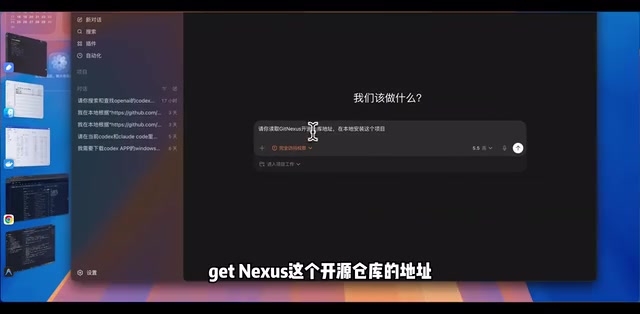
Simply put: GitNexus is like giving the AI a "project map." The AI no longer needs to read the entire codebase but instead precisely locates needed information by following relationship chains based on the task.
How Does It Perform in Practice?
What Does the AI Itself Think of This Tool?
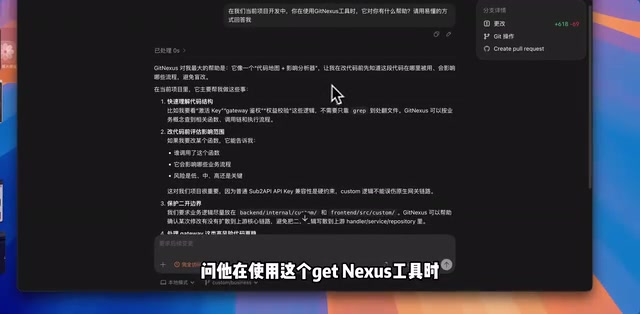
In actual use, the AI's assessment of GitNexus is: "It's like a code map + impact analyzer that lets you know where things are referenced and what processes will be affected before changing code, avoiding blind modifications."
Extremely Low Token Consumption
One of GitNexus's most outstanding advantages is very low context Token consumption. Its workflow is:
- When the AI triggers the GitNexus tool, it first checks whether there are new modifications not yet reflected in the index
- Automatically refreshes the index (read-only index update, no source code modification involved)
- Performs boundary queries and dependency analysis based on the task
- Returns only code snippets and relationship information relevant to the current task
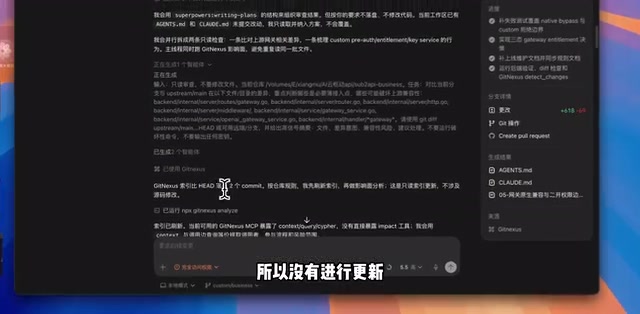
The entire process is like following a trail of clues—fetching what's needed and tracing wherever impact occurs, rather than reading through the entire codebase. GitNexus's on-demand indexing strategy essentially transforms the "needle in a haystack" problem into a "precise navigation" problem, fundamentally avoiding both Token waste and attention dispersion.
Solving the Cascading Effect Problem of Code Modifications
Previously, when asking AI to modify a feature, it might not know that the code in question is referenced by 10 other places. The root cause of this problem lies in the complexity of code dependency analysis. When GitNexus builds its knowledge graph, it performs multi-level Static Program Analysis on the code: at the syntax level, it parses function definitions and calls through AST (Abstract Syntax Tree); at the semantic level, it tracks cross-file references through Symbol Resolution; at the module level, it analyzes dependency declarations like import/require/include. This information is persisted as a graph database structure, supporting the critical "reverse query"—not only can it query "what does A depend on," but also "what depends on A."
With GitNexus, before making changes the AI will:
- First read the knowledge graph index
- Analyze the top-level architecture and dependency relationships of the code
- Enumerate all potential impact ranges through reverse graph traversal (which may involve dozens of files and hundreds of call sites in large projects)
- Identify potential risk points
- Formulate a reasonable optimization or development plan
For AI development enthusiasts with limited programming experience, this means a significant reduction in issues caused by AI "blindly modifying" code.
Related articles
 Tutorials
ChatGPT Plus Subscription Guide: Are GPT-5.5, image-2, and Codex Worth the Upgrade?
A detailed look at ChatGPT Plus features — GPT-5.5, image-2, and Codex — with a Plus vs Pro comparison and a complete step-by-step subscription guide for users outside the US.
 Tutorials
Harness AI Engineering in Practice: Using Claude Code to Master Enterprise-Level E-Commerce Development
Deep dive into Harness AI Engineering: master enterprise e-commerce development with Claude Code using the Rules, Skills, Wiki, and Changes framework.
 Tutorials
Cursor + Codex Dual-IDE Collaboration: A Practical Methodology for Open-Source Project Customization
A complete methodology for open-source project customization based on real-world experience, detailing the Cursor+Codex dual-IDE workflow, seven-stage process, MVP validation, and AI source code reading techniques.