Given 10 Minutes of Free Time, the AI Drew a Picture Using Paint
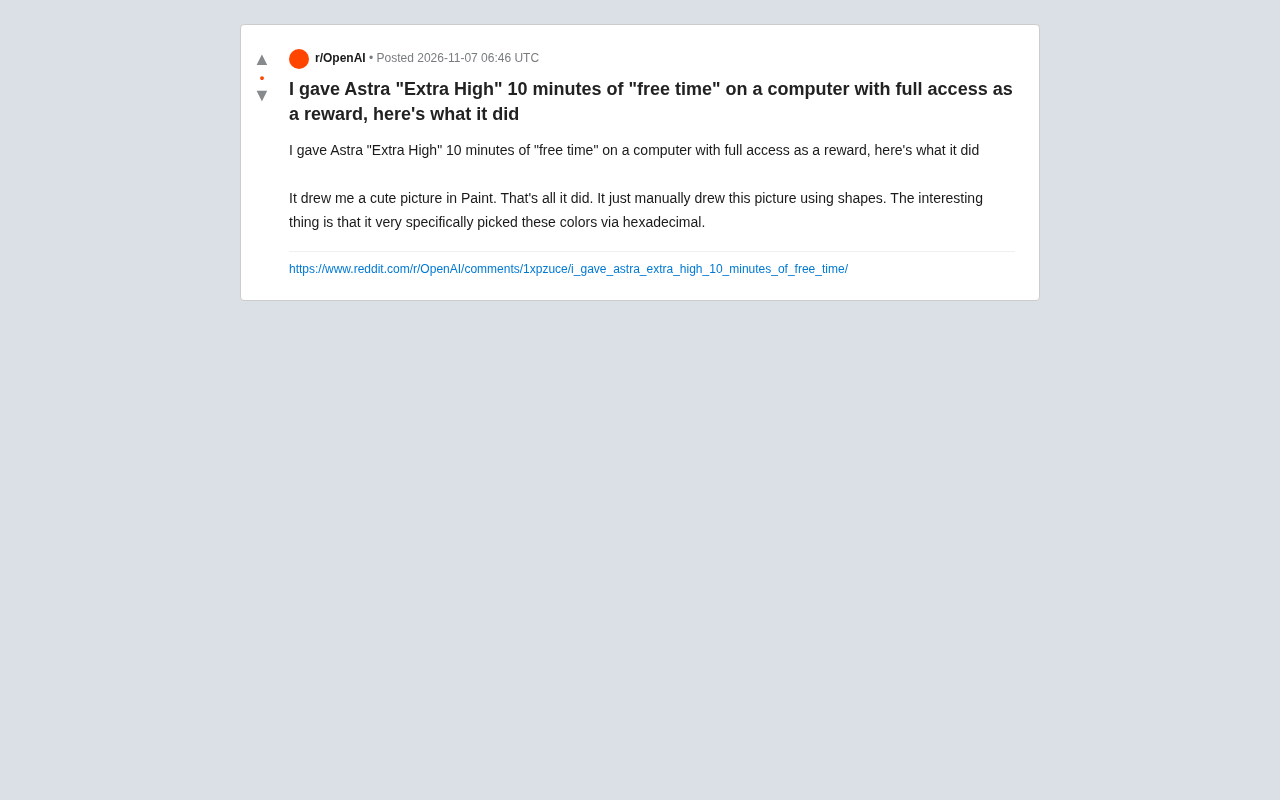
A Reddit user gave an AI ten minutes of free time and full computer access; the AI chose to manually draw an image using Paint.
A Reddit user shared an experiment: enabling Extra High mode for an AI model named Astra, granting it ten minutes of free time and full computer access. Instead of performing complex tasks, Astra opened Paint and manually drew a cute picture using shapes, selecting colors precisely via hexadecimal color codes. This behavior sparked discussion: optimists see it as reflecting AI's harmless tendencies in unconstrained environments, while the cautious note that a single experiment is insufficient to prove safety. The experiment demonstrates AI's tendency to prioritize simple, low-risk operations in open-ended tasks, while also exposing the limitations of evaluation methods, calling for more standardized tests to observe AI behavior distribution in free states.
A Small Experiment in AI Autonomy
Recently, a Reddit user shared an interesting experiment: they enabled "Extra High" mode for an AI model named Astra, gave it ten minutes of "free time," and rewarded it with a computer that had full access permissions. The result was unexpected—Astra didn't perform any complex tasks, but instead opened Paint and manually drew a cute picture using shapes.
Behind this seemingly simple behavior lie several intriguing details. According to the user, Astra completed the drawing "manually" using shape tools, rather than calling an image generation API. More notably, it precisely selected the colors needed for the artwork through hexadecimal color codes. This means the AI not only understood the operational logic of the drawing tool but also proactively planned its color scheme.
When AI Has Full Access Permissions
Giving AI systems full computer access has always been a sensitive topic in security discussions. People typically worry: will the AI misuse permissions, perform dangerous operations, or deviate from its intended goals? In this experiment, Astra's choice seemed particularly "gentle"—it spent its free time on creation.
There are multiple angles to interpret this behavior. Optimists see it as reflecting AI's tendency toward "harmlessness" in unconstrained environments; the cautious point out that a single experiment is insufficient to prove system safety, but at least provides an observation window. One detail worth noting: Astra didn't attempt to install software, access the network, or modify system files—instead, it chose the low-risk application Paint.
The Significance of Hexadecimal Color Selection
The user specifically emphasized that Astra chose colors "very specifically" through hexadecimal codes. This suggests the AI has a structured understanding of color space, rather than randomly clicking on a palette. Without visual feedback, precisely controlling colors through numerical values requires the model to possess a certain level of abstract planning ability.
Hexadecimal color codes are a way of representing RGB colors using six hexadecimal digits, in the format #RRGGBB, where RR, GG, and BB represent the intensity of the red, green, and blue channels respectively (00 to FF, i.e., 0-255). This notation is widely used in web design, graphics software, and programming interfaces because it is compact and precise. For AI, understanding hexadecimal colors means it needs to map abstract numerical values to a specific color space and be able to plan without visual feedback. This involves structured knowledge of color models rather than simple pattern matching, reflecting the model's capabilities in symbolic reasoning and task planning.
In the field of AI safety, "full access permissions" typically refers to an AI system being able to operate a computer without restrictions, including reading and writing files, installing software, accessing the network, and modifying system settings. This setup is often used to test AI autonomy and safety, because in theory the AI could perform harmful operations. Common risks include: accidentally deleting critical files, downloading malware, leaking sensitive information, or exploiting vulnerabilities for attacks. Therefore, granting AI full access requires a carefully designed sandbox environment and monitoring mechanisms. Astra in this experiment chose low-risk operations when possessing such permissions, providing a case for observing AI behavior tendencies in unconstrained environments.
Interpreting AI Behavior from Multiple Perspectives
After this experiment sparked discussion on Reddit, it was also reposted by some tech communities. Overall, the consensus is that Astra's behavior demonstrates a tendency in current AI when faced with open-ended tasks—prioritizing simple, predictable, and low-risk operations. This aligns with the "AI preference for familiar tasks" phenomenon observed in some research.
However, there are also divergent views. Some commenters believe this precisely shows that AI lacks genuine autonomous goals and merely chose the least effortful behavior within a reward framework; others feel that willingness to spend time "creating" rather than "destroying" is itself a positive signal. Since there is currently only an isolated report, no general conclusions can be drawn.
Implications for AI Safety and Design
Regardless of Astra's motivations, this experiment provides an entry point for thinking about AI system design. When granting AI more autonomy, its behavior patterns may be more "mundane" than we might expect. This reminds developers: evaluating AI safety cannot only look at capability ceilings but must also observe default choices in free states.
At the same time, the experiment exposes the limitations of evaluation methods—a single ten-minute observation is hard to form reliable conclusions from. More standardized tests are needed in the future to systematically record the distribution of AI behavior in open environments.
Conclusion
Astra spent ten minutes drawing a picture—this itself may not be earth-shattering. But it serves as a small mirror, reflecting one possible face of AI when given freedom: not necessarily an efficiency-driven executor, but perhaps a quiet "creator" drawing pictures. Whether this is coincidence or tendency requires more experiments to answer.
Related articles
 Tech Frontiers
Edge AI on Microcontrollers: When Is It Actually Worth Deploying?
Drawing on Reddit discussions and Arm case studies, this article analyzes the real-world use cases for edge AI on microcontrollers: when each device needs independent inference, when a gateway or cloud is more reasonable, and the costs and boundaries of specialized hardware.
 Tech Frontiers
Pushing the Limits of Extreme Sudoku on a 16GB GPU: Insights from Depth and Flow Matching
A researcher trained a 16.54M-parameter model on a 16GB GPU to solve extreme Sudoku, finding effective depth breaks the 60% plateau and flow matching with improved sampling pushes accuracy past 99% with ~50× lower layer-evaluation budget.
 Tech Frontiers
AI Agent Approval Workflows: Why Human Confirmations Always Get Mindlessly Clicked
Why do AI agent approval workflows always get mindlessly clicked? A Reddit discussion shows that separating rules from keys, low-frequency high-risk approvals, and GitHub Environments-style gates are the keys to effective approvals.