GLM-5.3 Benchmark Analysis: The Globalization Journey of Chinese Large Language Models

Analyzing GLM-5.3 benchmarks and what they reveal about Chinese LLMs going global.
This article examines Zhipu AI's GLM-5.3 performance on the Artificial Analysis platform, exploring why independent third-party evaluation matters in an era of benchmark gaming and data contamination. It traces the GLM series evolution, discusses composite evaluation metrics beyond single scores, and analyzes industry trends shifting from leaderboard obsession toward practical, multi-dimensional assessment—signaling Chinese LLMs' growing presence in the global developer community.
Introduction: Another Benchmark Test Sparks Discussion
Recently, benchmark results for GLM-5.3—the latest version in Zhipu AI's GLM series—on the Artificial Analysis platform sparked a lively discussion on Hacker News. The post received 69 upvotes and 31 comments. While these numbers may seem modest, given the Hacker News community's notorious selectivity and rationality when it comes to technical topics, generating this level of discussion itself signals that Chinese large language models are gradually entering the global developer community's awareness.
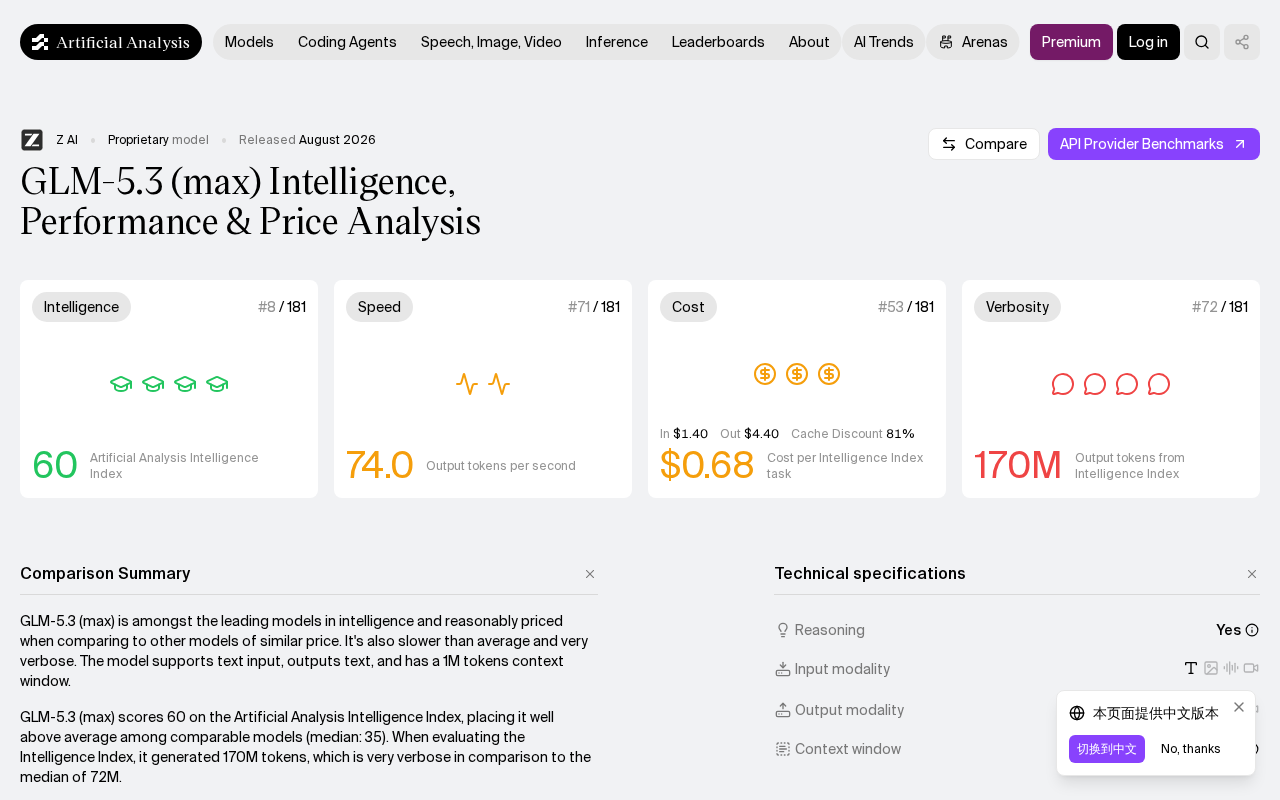
This article examines the key takeaways behind the GLM-5.3 benchmarks, and explores the significance of third-party evaluation platforms for understanding the true capabilities of large language models.
Artificial Analysis: A Third-Party LLM Evaluation Platform Worth Following
Why Third-Party Evaluation Matters
In today's white-hot competition among large language models, virtually every vendor publishes impressive benchmark scores when releasing a new model. However, self-reported evaluations tend to cherry-pick favorable test sets, employ specific prompt engineering techniques, or even raise suspicions of training data contaminating the benchmarks.
Data contamination is one of the core challenges facing LLM evaluation today. Since pre-training corpora are often scraped at massive scale from the internet, and many classic benchmark questions and answers have long been publicly available online, models may have already "seen" these test questions during training. This means high scores on benchmarks may not reflect genuine reasoning ability, but rather a form of memorized retrieval. Multiple studies in 2024 revealed the severity of this issue—for example, Scale AI's research team found that some models scored 10-15 percentage points higher on contaminated benchmarks compared to newly written questions of equivalent difficulty.
This is precisely why independent third-party evaluation platforms like Artificial Analysis are gaining importance. Artificial Analysis is an independent AI model evaluation organization founded in 2023 and headquartered in London. Its core mission is to provide developers and enterprises with objective, reproducible model comparison data. Unlike static academic benchmarks, Artificial Analysis regularly updates its evaluation methodology and publicly shares details of its testing processes. The platform currently covers products from dozens of model providers including OpenAI, Anthropic, Google, Meta, Mistral, and Chinese companies like Zhipu AI and DeepSeekAd, forming a relatively comprehensive industry capability map. Through standardized testing criteria and transparent evaluation methods, it conducts side-by-side comparisons of mainstream LLMs across multiple dimensions including intelligence level, reasoning ability, coding proficiency, response speed, and pricing. This "standardized examination hall" approach ensures different vendors' models are measured with the same yardstick.
Composite Metrics Rather Than a Single Score
A distinctive feature of Artificial Analysis is its comprehensive evaluation framework—rather than fixating on a single test set score. It aggregates multiple metrics including MMLU, GPQA, coding tests, and mathematical reasoning with weighted scoring, while also factoring in inference speed (tokens/second) and cost per million tokens.
It's worth explaining several core benchmarks here. MMLU (Massive Multitask Language Understanding) was proposed in 2021 by institutions including UC Berkeley. It encompasses approximately 16,000 multiple-choice questions across 57 subject areas, spanning humanities to STEM, and is considered the "college entrance exam" for measuring a model's broad knowledge base. GPQA (Graduate-Level Google-Proof Questions) was designed by NYU researchers and contains highly challenging questions written by PhD-level domain experts—even with search engine assistance, non-experts achieve only about 30% accuracy, making it an effective test of a model's deep reasoning capabilities. HumanEval is a code generation benchmark released by OpenAI, consisting of 164 Python programming problems that evaluate a model's ability to translate natural language descriptions into executable code.
This means that even if a model scores extremely high on a particular intelligence test, its overall competitiveness will be diminished if inference speed is too slow or costs are too high. For developers making actual technology selection decisions, this multi-dimensional evaluation is far more valuable than any single score.
GLM-5.3: Positioning and Key Highlights
The Evolution of the GLM Series
Zhipu AI was founded in 2019, originating from the Knowledge Engineering Group (KEG) at Tsinghua University's Department of Computer Science, established by Professor Jie Tang's team. The company's core technology stems from Tsinghua's long-standing research in graph neural networks and pre-trained language models. The GLM (General Language Model) architecture was initially released as an academic project, employing a unique autoregressive blank-filling pre-training objective that differentiates it from GPT's purely autoregressive approach and BERT's masked language modeling. As of 2024, Zhipu AI has completed multiple funding rounds with a valuation exceeding 20 billion RMB, making it one of the leading companies in China's LLM landscape.
The GLM series has undergone rapid iteration—from the early open-source GLM to ChatGLM, and now the GLM-4 and GLM-5 series. GLM-5.3, as a minor version update, typically indicates targeted optimizations on top of the previous version—potentially improved reasoning capabilities, expanded context windows, or enhanced performance on specific tasks such as code generation or Agent tool calling.
It's worth elaborating on Agent tool calling (Tool Use / Function Calling), which represents a critical capability direction for current LLMs. It refers to a model's ability to understand user intent and autonomously decide to invoke external tools (such as search engines, calculators, database queries, API endpoints, etc.) to complete tasks, rather than relying solely on parametric knowledge. This capability is foundational for building AI Agents—a model with tool-calling abilities can perform actual operations like querying real-time weather, executing code, or manipulating file systems. It's viewed as the key technology enabling the leap from "chatbot" to "intelligent assistant."
Judging by the Hacker News community's interest, international developers are intrigued by the GLM series' cost-effectiveness and openness. Chinese models often maintain strong capabilities while offering more competitive API pricing, which is quite attractive for cost-sensitive developers and startup teams.
A Rational Perspective on Benchmark Scores
It must be emphasized that benchmark scores represent only one facet of model evaluation. A model that ranks highly on Artificial Analysis may not necessarily perform best in your specific business scenario. Real-world applications involve domain knowledge, multi-turn dialogue stability, consistency in instruction following, and many other factors that cannot be fully captured by a single benchmark score.
Discussions in the Hacker News comments often revolve around this very point—the technical community generally maintains a cautiously optimistic attitude, acknowledging progress in Chinese models while reminding everyone not to blindly worship leaderboard rankings.
Industry Trends in LLM Evaluation
From "Benchmark Gaming" to "Practical Orientation"
Over the past two years, the LLM space briefly fell into a "benchmark gaming" trap—with vendors racing to push scores higher on classic benchmarks like MMLU and HumanEval. However, as concerns about training data contaminating benchmarks surfaced, the industry gradually realized that leaderboard scores alone no longer reflect true capabilities.
The current trend is shifting toward evaluation methods that more closely mirror actual usage:
- Dynamically updated test sets: Preventing models from achieving inflated scores through memorized training data
- Human preference scoring: Such as Chatbot Arena's Elo mechanism, which directly reflects user experience
- Comprehensive cost assessment: Multi-dimensional evaluations like Artificial Analysis that balance capability, speed, and price
Among these, Chatbot Arena is a crowdsourced evaluation platform operated by UC Berkeley's LMSYS team, using an Elo rating system borrowed from chess to measure model capabilities. On the platform, users submit the same question to two anonymous models simultaneously, then vote for the better response. Each matchup result updates both models' Elo scores—beating a strong opponent earns more points, while losing to a weak one costs more. As of mid-2025, the platform has accumulated over 2 million human votes, forming what is currently the industry's most recognized ranking for reflecting genuine user preferences. Its advantages lie in dynamism and contamination resistance—questions are posed in real-time by actual users, making it impossible for models to memorize them in advance.
This shift is a positive signal for the healthy development of the entire industry.
Opportunities and Challenges for Chinese LLMs Going Global
The fact that GLM-5.3 made it onto Hacker News and sparked discussion reflects that Chinese LLMs are progressing from being "domestically usable" to being "globally discussed." With the maturation of open-source ecosystems and the internationalization of APIs, an increasing number of overseas developers are beginning to try and evaluate models from Chinese vendors.
This represents both opportunity and challenge—the opportunity lies in expanded market reach, while the challenge requires earning the international community's trust through transparency, reproducibility, and long-term reliability.
Conclusion: Beyond Benchmark Scores, Scenario Fit Matters More
GLM-5.3's benchmark results offer a window into the development of Chinese large language models. They remind us that while paying attention to specific scores, we should better understand the value of independent third-party evaluation and the significance of composite metrics (capability, speed, cost) for real-world technology selection.
For developers, rather than agonizing over a model's leaderboard ranking, it's better to conduct small-scale tests aligned with your own use cases. After all, the model best suited for your business may not be the one with the highest benchmark score. And for the industry as a whole, independent evaluation platforms like Artificial Analysis are driving LLM competition toward greater transparency, rationality, and practicality.
Related articles

Why Does the Tesla Roadster Need to Fly? A Deep Dive into Musk's Wild Demo
Tesla's Roadster launch showed wall-climbing, upside-down driving, and flying stunts—but The Vergecast notes the demo car may lack a battery, the Rocket version is invite-only and not street-legal, and the website terms don't guarantee delivery. After nine years of delays, why does this car still need to exist?

AI Is Not a Replacement: Human-AI Collaboration Through the Lens of Factory Root Cause Analysis
Starting from factory root cause analysis, this article explains how AI accelerates evidence chain construction rather than replacing human experts, exploring the pragmatic implementation logic and business value of 'AI supporting people rather than replacing them.'

AI Agent Decision Auditing: Building an Evidence Chain in Regulated Workflows
Starting from a Reddit discussion, this article analyzes three core issues in AI agent decision auditing within regulated workflows: what fields audit records should contain, how to handle feedback latency for erroneous decisions, and how to continuously calibrate LLM judge consistency with human judgment.