GLM-5.3 Cross-Request KV Cache Exposure Sparks Discussion

GLM-5.3 is alleged to have cross-request KV cache exposure, sparking discussion about isolation in multi-tenant inference services.
The article centers on a Hacker News discussion about "cross-request KV cache exposure" in the GLM-5.3 Workers AI model. KV cache is a key mechanism for accelerating Transformer inference, but in multi-tenant, high-concurrency inference services, optimizations such as cache reuse and prefix sharing can lead to user context leakage if strict isolation is lacking. The community discussion focused not on exploitation but on engineering practices such as detecting cache mixing and the difficulty of centrally managing cache lifecycles on edge inference platforms. The article draws three lessons: cache keys should include request-level unique identifiers, multi-tenant services should enable cache isolation audits by default, and edge scenarios need additional cache governance strategies. It stresses that the issue is fundamentally an engineering implementation flaw in inference services rather than a security defect in the model itself.
Event Overview: GLM-5.3's KV Cache Exposure Issue Surfaces
Recently, a discussion thread appeared on Hacker News about the GLM-5.3 Workers AI model, with a title pointing directly at "Cross-request KV cache exposure." The post received 155 replies but only 15 points and 5 comments—not particularly popular, yet it touches on a sensitive security and privacy issue in large model inference services.
KV cache (Key-Value Cache) is a key mechanism used by Transformer architecture models during inference to accelerate generation: by caching the Key and Value tensors of historical tokens, it avoids redundant computation and significantly reduces latency. However, if the cache is not properly isolated between requests, one user's context information could leak to another user, creating cross-request data exposure.
This post is worth attention because it points to a common risk at the AI infrastructure layer—when models are deployed as multi-tenant services, cache lifecycle management directly affects user data security.
Technical Background: Why KV Cache Becomes a Risk Point
In a standard large model inference flow, each request maintains its own KV cache. Ideally, the cache should be released or reset after the request ends. But in high-concurrency, low-latency production environments, inference engines often adopt optimization strategies like cache reuse and prefix sharing to improve throughput.
According to analysis from developers participating in the Hacker News discussion, GLM-5.3 may have had a flaw in cache key design or request isolation in the Workers AI model service, causing different requests to share cache content that should not be shared. Although the post itself did not disclose specific reproduction steps or scope of impact, this phenomenon is enough to spark discussion about the security boundaries of inference services.
Some commenters pointed out that similar issues are not unique to GLM-5.3—any inference framework using a shared cache pool has a theoretical possibility of boundary crossing, and the key lies in whether strict isolation validation is implemented at the implementation level.
Prefix Sharing and cache pools are the key mechanisms for understanding this risk. In inference services, if multiple requests share the same prefix (such as the same system prompt), the engine can let them share the same segment of KV cache, thereby avoiding redundant computation of that content and significantly improving GPU utilization. Implementation usually relies on a global cache pool indexed by content hash or prefix fingerprint. The risk is this: if the index key granularity is too coarse, or if cache blocks are not invalidated in time after a request ends and are incorrectly allocated to unrelated requests, then the latter request may read the residual Key/Value tensors from the previous request during decoding, leading to context contamination or even information leakage. This is why the industry emphasizes that cache keys must be bound to tenant or request identity and cannot be reused solely based on content similarity.
Multi-tenancy refers to the same model service instance simultaneously providing inference capabilities to multiple mutually untrusted users or organizations. In this mode, isolation boundaries include not only networks and storage but also extend to intermediate states in GPU memory, and the KV cache is the most easily overlooked part. Traditional security models often assume that GPU memory contents will be cleared when the process ends, but under optimized architectures with shared cache pools, this assumption no longer holds.
Community Reaction: Focus Shifts from Vulnerability to Engineering Practice
Although the post's popularity was limited, the concerns revealed in the 5 comments are quite representative. Some discussants were more concerned with "how to detect" rather than "how to exploit"—that is, in actual deployment, how to discover cross-request data mixing through logs, cache fingerprints, or request tracing.
Another part of the discussion pointed to the particularity of edge inference platforms like Workers AI. Unlike traditional data centers, request scheduling in edge environments is more dynamic, and cache lifecycle is harder to control precisely, which brings additional challenges to isolation mechanisms. According to the analysis in the post, as a relatively new model version, GLM-5.3's service stack may not yet have been sufficiently refined for such edge scenarios.
As a detail, the discussion did not raise doubts about model weights or training data; the focus remained on cache management in inference services, which also shows that the issue is more of an engineering implementation problem than a security flaw in the model itself.
Workers AI is an edge inference platform launched by Cloudflare that allows developers to run models on edge nodes close to users. Its architecture is characterized by highly distributed request scheduling, short instance lifecycles, and dynamic scaling, which makes cache state difficult to audit and forcibly clean up uniformly like in centralized data centers. Edge nodes may simultaneously host requests from different tenants. The benefits of cache reuse are greater, but the implementation complexity of isolation validation is also higher—this is exactly the "particularity of edge scenarios" repeatedly mentioned in the discussion.
Implications for Developers: Cache Isolation Should Become Default Design
From this incident, developers can extract several actionable implications.
First, cache key design must include sufficient request identity information. Using only prompt content or session ID as the key makes collisions likely in concurrent scenarios; request-level unique identifiers should be introduced together with strict invalidation policies.
Second, multi-tenant inference services should enable cache isolation audits by default. Whether using self-built inference clusters or managed services, concurrent requests should be simulated during the testing phase to verify cache invisibility between different requests.
Third, edge inference scenarios require additional cache governance strategies. Platforms like Workers AI have the advantage of low latency, but the cost is that cache state is harder to manage centrally. Developers should pay attention to whether the platform provides documentation and configuration options for cache isolation.
Conclusion
Although the discussion of GLM-5.3's cross-request KV cache exposure was not large in scale, it precisely hit an easily overlooked corner of AI inference services. As large models are increasingly delivered in the form of APIs and edge services, cache isolation will no longer be merely a performance optimization issue but a basic requirement for security and compliance. For teams using Workers AI or similar platforms, proactively checking cache boundaries is wiser than waiting for problems to surface.
One-line Summary
GLM-5.3 is alleged to have cross-request KV cache exposure, sparking discussion about isolation in multi-tenant inference services.
Paragraph Summary
The article focuses on a Hacker News discussion about "cross-request KV cache exposure" in the GLM-5.3 Workers AI model. KV cache is a key mechanism for accelerating Transformer inference, but in multi-tenant, high-concurrency inference services, optimizations such as cache reuse and prefix sharing may lead to leakage of user context information if strict isolation is lacking. The community discussion did not remain on vulnerability exploitation but shifted to engineering practice issues such as how to detect cache mixing and the difficulty of centrally managing cache lifecycles on edge inference platforms. Based on this, the article proposes three implications: cache keys should include request-level unique identifiers, multi-tenant services should enable cache isolation audits by default, and edge scenarios require additional cache governance strategies. It also emphasizes that the issue is essentially an engineering implementation flaw in inference services rather than a security problem in the model itself.
Related articles
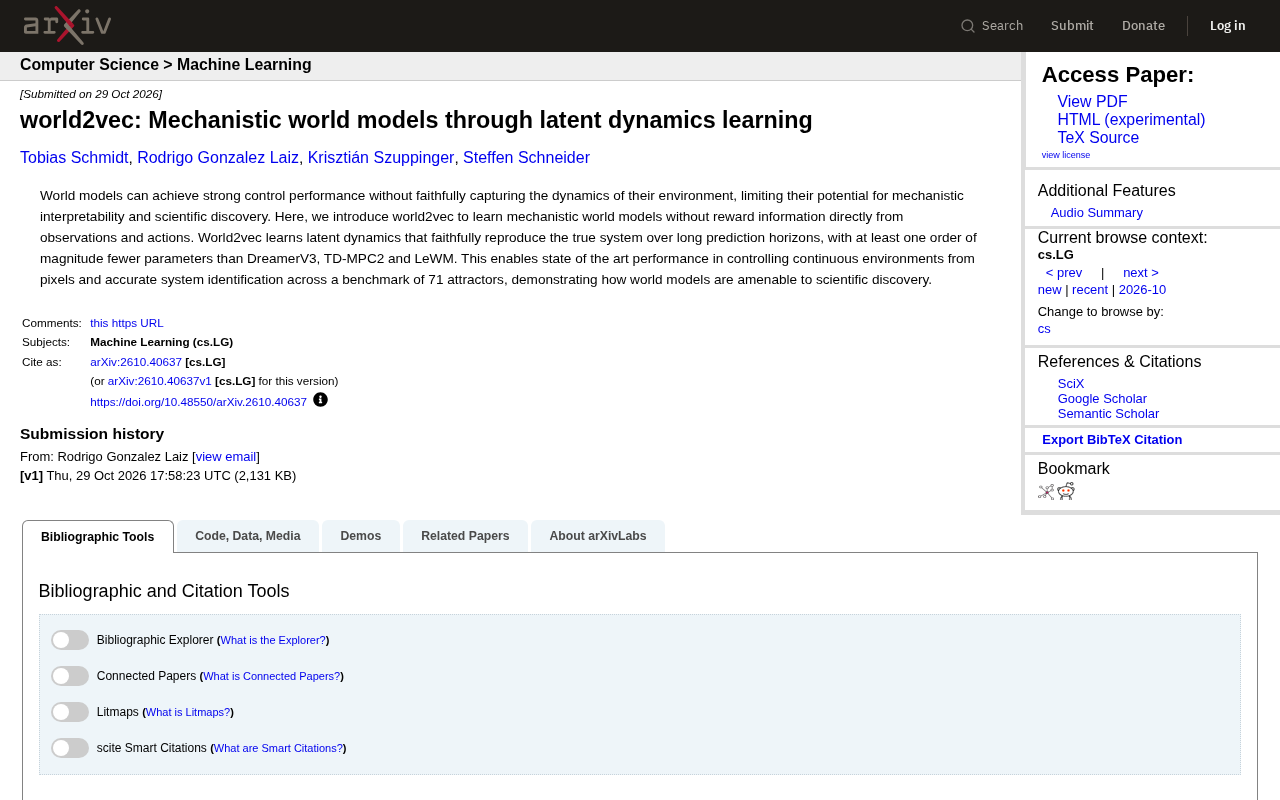
world2vec: Building Mechanistic World Models with Latent Dynamics Learning
world2vec proposes a reward-free method for learning mechanistic world models via latent dynamics, faithfully reproducing systems over long horizons with at least an order of magnitude fewer parameters than DreamerV3, TD-MPC2, and LeWM, and achieving accurate system identification on 71 attractor benchmarks.

A New KL-DRO Paradigm: Adaptive Scenario Generation Around a Learned Density Model
KL-DRO research proposes centering the KL ball on a learned density model instead of the empirical distribution, with adaptive scenario generation guiding sampling toward the worst case. Experiments show lower cost under distribution shift when records are scarce and the model can extrapolate, with comparable in-distribution cost.

ODE Samplers for Discrete Diffusion Models: Exponential Residual Flows Accelerate Generation
Discrete diffusion models lack deterministic ODE sampling? This article introduces Exponential Residual Flows (ERFs), which introduce continuous residual variables per token to construct piecewise ODEs for deterministic sampling and support consistency distillation acceleration. Superior to prior methods on code and text generation tasks.