GLM-5.3 Programming Capability Up 50%: Benchmark Analysis & Practical Validation Guide

A practical guide to interpreting GLM-5.3's 50% programming improvement claims and validating them with real tasks.
GLM-5.3 claims a 50% programming capability improvement over its predecessor across six benchmarks spanning terminal coding, software engineering, and agentic execution. This article breaks down what these numbers actually mean, examines the critical performance-cost tradeoff in agentic programming curves, and provides a practical validation framework for developers to test claims against their own real-world tasks.
GLM-5.3 Release: What Does a 50% Programming Improvement Really Mean
Zhipu has released GLM-5.3, with the most prominent claim being that programming capability has improved 50% over GLM-5.2. The official release date is August 14, with plans to open-source weights two weeks later. For practitioners building developer tools, these two pieces of information together carry significant weight: on one hand, a leap in the capability curve; on the other, the possibility of reproducible verification.
But a claim like "50% improvement" requires careful interpretation. In the large language model space, "X% programming improvement" typically refers to the model's comprehensive score improvement on a set of standardized programming benchmarks relative to its predecessor. These benchmarks may include code generation, code completion, bug fixing, test case generation, and other subtasks. It's important to note that difficulty distributions and scoring criteria vary enormously across benchmarks — for example, HumanEval focuses on function-level code generation, while SWE-bench requires models to locate and fix issues in real GitHub repositories, with the latter being far more difficult and complex. Therefore, "50%" is the result of weighting or averaging across multiple benchmarks, and the actual improvement on any single task may be significantly higher or lower than this number.
What it describes is the model's comprehensive performance across a series of benchmarks that approximate real work scenarios — not a promise that your specific repository will immediately see equivalent gains. Task distribution, context length, tool permissions, testing thresholds — any change in these variables will alter the actual experience. The rational approach is: look at the capability curve first, then wait for reproducible experiments.
Interpreting GLM-5.3's Six Benchmark Results
The first chart in the official materials displays six benchmarks side by side, showing GLM-5.3's scores across multiple dimensions:
- Terminal Bench 3.0: 28.3
- Deep SWE Bench: 66.9
- Agentic Midterm: 28.5
- AutoBench: 48.2
- Humanity's Last Exam with Tools: 62.5
- GDP Value Assessment AA2: 17.69
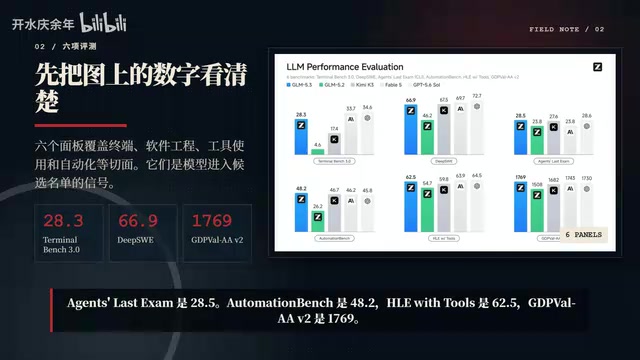
These six benchmarks cover the complete capability spectrum from basic coding to agentic execution. Terminal Bench evaluates the model's ability to autonomously complete programming tasks in a command-line environment, including end-to-end workflows of file operations, environment configuration, and code writing. Deep SWE Bench is an advanced variant of SWE-bench that simulates complex real-world software engineering scenarios such as cross-file dependency fixes and large-scale refactoring. Agentic Midterm assesses the model's decision-making ability as an autonomous agent in multi-step, multi-tool collaboration scenarios. AutoBench tests the model's performance in executing automated workflows. Humanity's Last Exam with Tools is a cutting-edge benchmark that allows models to call external tools like search engines and calculators to answer highly difficult questions, testing the combination of tool use and reasoning. GDP Value Assessment measures the actual commercial value of model-generated content from an economic output perspective.
These numbers essentially describe the same thing: the model is being evaluated in environments that closely resemble tool calling, software engineering, and agentic execution. They outline the model's capability profile, but they don't mean your repository will immediately see the same results.
A more prudent mindset is to treat these charts as a first-round reference for screening candidate models, not the endpoint of a procurement decision. Benchmark scores can help you narrow your options, but the real answer must come from your own actual tasks.
Agentic Programming Curve: The Binding Relationship Between Performance and Cost
The second chart focuses specifically on agentic programming and deserves careful attention from developers. The x-axis represents average output tokens per task (investment units), and the y-axis represents accuracy. GLM-5.3's curve goes from approximately 24.7 at low investment, to 31.5 at high investment, and up to 34.7 at maximum investment. The chart also plots the trajectories of Claude models (such as Claude 4.5 and Opus) for comparison.

To understand this chart, you first need to understand the relationship between tokens and inference costs. In large language models, tokens are the smallest units of text processing — one English word typically corresponds to 1-2 tokens, and one Chinese character roughly corresponds to 1-2 tokens. Model API pricing is typically charged per million input/output tokens, so the number of output tokens directly determines the cost per call. Additionally, output token count is positively correlated with inference latency — generating more tokens means longer wait times. In agentic programming scenarios, the model may need multiple rounds of "thinking" and tool calls, each consuming tokens. The "low investment," "high investment," and "maximum investment" tiers are essentially controls on the maximum tokens the model is allowed to consume on a single task — similar to setting different "thinking budgets" for the model. A larger token budget allows the model to engage in deeper reasoning and more trial-and-error attempts, but costs grow linearly or even super-linearly.
The most important takeaway from this chart is: model performance and investment units are bound together. If you only focus on the highest score, you'll miss critical variables like cost, output length, and completion time.
Therefore, when making model selection decisions, the correct approach is to run the same task across low, high, and maximum investment tiers, recording not just success rates but also token consumption, time spent, and rework counts. Only by placing performance within a cost coordinate system will your conclusions have practical operational value.
Security Audit Capability: What Does CyberGym 84.5 Tell Us
The official materials also present an important data point — a security capability score of CyberGym 84.5. The inclusion of this metric in the release narrative indicates that beyond code generation, security auditing is also a workflow stage this generation of models aims to cover.
CyberGym is a benchmark framework specifically designed to evaluate AI models' capabilities in cybersecurity and code security review, covering vulnerability detection, malicious code identification, security configuration auditing, dependency risk assessment, and more. Traditional code security reviews rely on a combination of static analysis tools (such as SonarQube, Semgrep) and manual code audits — the former has fixed rules and high false-positive rates, while the latter is accurate but expensive and hard to scale. The introduction of large language models brings new possibilities to this field: models can understand code semantics and context, identifying logic vulnerabilities and business-level security risks that rule engines struggle to capture. A score of 84.5 indicates that GLM-5.3 has achieved production-grade capability in this specialized vertical domain.

This opens new application directions for GLM-5.3. You can have it read dependency changes, check for dangerous calls, and generate audit checklists for confirmation. But it must be emphasized: when production permissions, keys, and external execution are involved, humans must remain in the approval loop. The special nature of security means that missing a single critical vulnerability could have catastrophic consequences, making the Human-in-the-Loop design principle especially crucial in security scenarios.
The model can serve as an efficient initial screening and auxiliary review tool, filtering out large volumes of low-risk routine checks for humans, but final execution authorization should not be entirely handed over to automated processes. This is both a security baseline and a consensus in current AI engineering practice.
Open Weights Plan: Validating Model Capability with Real Tasks
The plan to open weights in two weeks is also worth paying attention to. Open Weights means the model's parameter files can be downloaded and deployed locally, but this differs from fully Open Source — the latter typically also includes training data, training code, and complete reproduction pipelines. The core value of open-sourcing is: teams can run their own real tasks through the model and use the results to inform their next model selection.
However, whether the open version can reproduce the trends shown in official materials depends on several key conditions being met: inference configuration, hardware environment, and evaluation scripts. When actually reproducing official benchmark scores, inference configuration (such as temperature parameter, Top-p sampling strategy, maximum generation length) significantly impacts results — changing temperature from 0.0 to 0.6 can cause benchmark scores to fluctuate by 5-15 percentage points. Hardware environment is equally critical — subtle differences in floating-point precision implementation across GPU models, switching between FP16 and BF16, and different versions of CUDA and inference frameworks (such as vLLM, TensorRT-LLM) can all introduce result deviations. The version of evaluation scripts and execution environment (such as sandbox permissions, network access policies) directly determine whether evaluation conditions match the official setup. Missing any single component may cause reproduced results to deviate from official data. This is why an increasing number of model publishers are starting to simultaneously provide Dockerized evaluation environments to lower the reproduction barrier.

A Practical Validation Method
If you're currently evaluating coding models, consider starting with a small task:
- Choose a real fix task with tests
- Fix the repository version and tool permissions
- Have GLM-5.3 and your current model complete the same task
- Compare first-pass rate, patch readability, per-task cost, and number of human interventions
Conclusions obtained this way will directly serve your next model selection decision, rather than remaining at the level of paper score comparisons.
Summary: The Convergence of Programming, Tools, and Security Is the Inevitable Trend
The signal from this release is clear: model providers are beginning to evaluate programming, tool use, and security auditing together along the same capability line. This trend reflects the industry's evolving understanding of AI capabilities — early evaluations focused on isolated code generation quality, whereas today models are expected to demonstrate end-to-end capability within a complete software engineering workflow, from understanding requirements, writing code, calling tools, running tests, to auditing security vulnerabilities — every step is part of the capability assessment. The official charts provide a solid starting point, but real projects will give the final answer.
For developers, the most pragmatic path is: validate with a small task first, then decide whether to scale up investment. The capability curve is worth watching, but landing value needs to be verified with your own real tasks.
Related articles

Trump's Request to Rename the Atlantic Rejected by Google; 1Password Lets AI Agents Log In Securely
The Vergecast roundup: Trump's request to rename the Atlantic the 'Trump Ocean' was politely declined by Google's CEO; 1Password's new feature lets AI agents log into accounts without touching passwords; OPPO launches the world's first 200-megapixel phone, the Find X10 Pro Max. All three point to the boundaries of tech authorization and trust.

The Truth About American College Party Culture: The Risks Schools Won't Admit
Behind American college party culture, the administration's "don't ask, don't tell" attitude is amplifying freshman risks. This article analyzes how the pandemic strengthened Greek dominance, freshmen's difficulty accessing safety information, and the chain reactions caused by a culture of denial.

OpenAI Reportedly Raising $30B at $1.25T Valuation Ahead of IPO
OpenAI is planning a $30B funding round at a possible $1.25T valuation, paving the way for an IPO. If completed, it would set a private company valuation record. This article analyzes the funding size, pre-IPO logic, and industry signals.