GLM-5.4 In-Depth Analysis: How a Looped Transformer Punches Above Its Weight
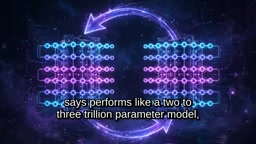
Z.AI releases the 75B-parameter GLM-5.4, taking on trillion-parameter models with a looped Transformer architecture.
Z.AI releases GLM-5.4, whose core innovation is a looped Transformer architecture: each of the 28 layers executes twice—first building a contextual representation, then refining it—enabling a 75B-parameter model to claim performance on par with 200-300T-parameter models. That figure is vendor-reported and unverified by third parties; however, a comparison on a 30B-parameter version showed the looped mechanism outperformed the standard version on all five benchmarks, with math rising from 19.17 to 30.42. The model is the first to embed vision into its coding solution, supporting screenshot-to-code and extending to generalized coding tasks like video, games, and 3D scenes. On the engineering side, response length is cut by up to 14%, off-peak speed reaches 200 tokens/s, context is 1M tokens, and paid users get a 50% quota increase. The article flags three risks: no public benchmarks, potential long looped-reasoning stalls, and a not-yet-open API.
Z.AI has released GLM-5.4, a model that doesn't win by piling on parameters but by letting the network "think it through twice." With only 75 billion parameters, it dares to take on models with 2 to 3 trillion parameters. This looped-reasoning approach may be more interesting than the parameter race itself.
Looped Transformer: Running 28 Layers Twice
Most models' forward pass is one-directional: from the first layer to the last, the output is the answer. GLM-5.4 has 28 layers, but each layer is executed twice—the first pass builds the contextual representation, and the second pass refines it on that basis. To use an imprecise analogy, it's like reading the question twice before picking up your pen in an exam.
Z.AI claims that this design lets a 75-billion-parameter model reach the performance level of 200- to 300-trillion-parameter models. That number needs to be taken with quotation marks: it's the vendor's self-reported figure, and there is currently no third-party benchmark to verify it.
However, one small-scale experiment is worth noting. Z.AI ran a comparison on a 30-billion-parameter version, and the looped version outperformed the standard version on all five benchmarks, with the math score rising from 19.17 to 30.42. That's no small improvement—at least it shows the loop mechanism is effective at smaller scales. But whether it can be linearly extrapolated to 75 billion or even larger remains an open question.
Forward propagation refers to the process in which a neural network computes layer by layer from the input layer to the output layer, ultimately producing a prediction. In a traditional Transformer, each layer is called only once, and information flows unidirectionally along the depth; as a result, the model's "thinking depth" is architecturally fixed to its number of layers. The looped Transformer breaks this constraint: it reuses the same set of weights along the time dimension, allowing information to flow through the same layers multiple times, thereby increasing computational depth without increasing parameter count. This idea is in line with weight sharing and adaptive computation—the model can decide "how many times to think" based on task difficulty. The cost is that inference latency grows linearly with the number of loops, and training must handle gradient propagation across loops, which is prone to instability.
Vision Capabilities and "Generalized Coding"
GLM-5.4 is the first model in the GLM series to embed vision capabilities directly into its coding solution. It can read screenshots, UI mockups, and error screens, and modify the underlying code accordingly. This capability is very practical in real-world development scenarios—often what developers receive is a design image or a screenshot of an error popup, rather than a structured requirements document.
Z.AI also proposes a concept called "Generalized Coding." Simply put, the model doesn't just write traditional business code; it can also generate videos, complete games, 3D scenes, and even CAD designs for robotic arms. In the release demo, it coded a complete animated music video using HTML and Canvas; in a comparison test with the same prompt, the image quality it generated was also superior to the previous generation.
These demos look quite polished, but demos are ultimately demos. The real boundaries of generalized coding will need independent evaluation and real-world project testing.

Vision-language models (VLMs) typically use a visual encoder to map images into embeddings of the same dimension as text, which are then processed by the language backbone. Embedding vision capabilities into a coding solution means the model not only has to "understand" screenshots but also align visual information with code structure—for example, inferring layout hierarchy from a UI mockup, or locating an exception stack from an error popup. This requires training data containing a large number of "image–code" paired samples. Compared with traditional multimodal models, visual understanding in coding scenarios places more emphasis on spatial structure and semantic precision, with a lower tolerance for error.
Speed, Context, and Quotas
The engineering improvements are fairly pragmatic. GLM-5.4's response length is shortened by up to 14%, reducing the model's tendency to be verbose; during off-peak hours, inference speed can reach 200 tokens per second, which is relatively fast for a model of this size. The context window is 1 million tokens, on par with current mainstream long-context models.
For paying users, the more direct change is the quota. Compared with GLM-5.3, the weekly quota has been increased by 50%, equivalent to 1.5 times more coding usage per week. The model is now available on all three paid tiers: Lite, Pro, and Max.
Context window refers to the maximum number of tokens a model can hold in a single inference pass; 1 million tokens is roughly equivalent to hundreds of thousands of Chinese characters or hundreds of pages of documents. The value of long context for coding scenarios lies in being able to read an entire code repository or long document in one go, but the cost is that attention computation grows quadratically with sequence length, and memory usage rises significantly. Mainstream models typically maintain usability under long context through techniques such as sparse attention and positional encoding extrapolation (e.g., RoPE scaling); the actual effective length is often shorter than the nominal value and needs to be verified separately with retrieval-type benchmarks.
Three Issues to View Calmly
First, there are no public benchmarks. The performance comparisons mentioned above all come from Z.AI's own data. Until independent evaluations are available, any claim of "comparable to trillion-parameter models" should be treated as an unverified statement.
Second, the risk of marathon-style loops. Release reports mention that the model may fall into prolonged "marathon thinking loops"—cycling repeatedly and taking a long time to give an answer. The loop mechanism itself is a double-edged sword: thinking one more time may lead to deeper thinking, or it may just go in circles.
Third, the API is not yet open. Currently, GLM-5.4 is only available to paid GLM Coding Plan subscribers, accessible within Zcode and Z.AI Chat. API access awaits security review, and open-source weights are promised to be released later. Developers who want to call the API directly will have to wait in line for now.

How to Try It
If you're already a subscriber, the process isn't complicated. Set the model to GLM-5.4 in the Z.AI Coding Plan; in Zcode, select GLM-5.4 Vision from the model selector, then crank the effort setting to maximum.

If you're not yet a paid user, the more pragmatic advice is to wait. Keep an eye on three things: when the API opens, when the open-source weights are released, and the results of the first batch of independent benchmarks. Migrating your workflow over before then carries considerable risk.
Is Looped Reasoning the Right Direction?
What's truly noteworthy about GLM-5.4 is not the vendor's self-reported parameter comparison, but the route it represents. As compute and data costs rise, continuing to scale up models becomes expensive and inefficient; letting the model spend a little more compute at inference time to "think it through" is a logically sound alternative path.
But this path also has costs: inference latency, runaway loops, and whether effectiveness scales stably are all unresolved issues. GLM-5.4 is a sample worth observing on this route, not the endpoint. Until independent evaluations appear, stay curious—and stay cautious.
Inference-time compute is an important direction in recent years: rather than piling on parameters and data during training, let the model generate more intermediate steps, self-check, or sample multiple times during inference. OpenAI's o-series, DeepSeekAd-R1, and others fall into this category, typically implemented through chain-of-thought or reinforcement learning training. The difference with the looped Transformer is that it writes "thinking more" into the architecture itself, rather than relying on generating longer text. Both paths face the same set of trade-offs: whether the accuracy gain is worth the latency and compute cost, and whether the model can learn to "stop early" on easy problems and loop more on hard ones.
Related articles
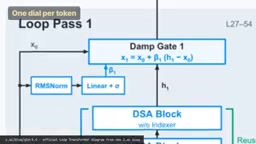
GLM-5.4 Released: Analysis of the First Recurrent Transformer and Claude Code Configuration Guide
Zhipu AI releases GLM-5.4, its first recurrent Transformer: 28 layers run twice with gating. We analyze the architecture, benchmark limitations, coding plan pricing, and Claude Code setup.
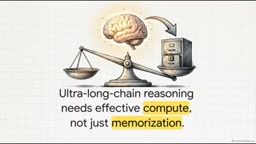
GLM-5.4 Loop Transformer: Three Times Smarter Without Stacking Parameters
An analysis of ZAI Research's GLM-5.4 Loop Transformer: 28 layers looped twice, 750B parameters rivaling trillion-scale models, using gated updates, hybrid KV cache, and index reuse to achieve low-cost deep reasoning and general coding.

GLM-5.4 Loop Transformer Tested: Full Guide to Claude Code Integration
Z.ai releases GLM-5.4, a loop transformer coding model with ~750B parameters, million-token context, and vision. Architecture, Claude Code setup, King Bench results, and the compute cost of marathon thinking.