GLM 5.5 Arrives: Has Claude Cracked the 167-Year-Old Riemann Hypothesis?
Anthropic claims Claude proved the Riemann Hypothesis, while GLM 5.5 and Google Loop signal AI's shift toward discovering new knowledge.
The core signal in this week's AI world is a shift in focus: an Anthropic mathematician claims to have completed proofs of the Riemann Hypothesis and the Generalized Riemann Hypothesis with Claude, backed by roughly 17 million lines of Lean formalization code, though independent review is needed. Zhipu's GLM 5.5 is hinted at by its official community, and the mysterious high-scoring model Gesalt is speculated to be a test version. Google's internal project Loop is positioned as an autonomous agent driven by long-term goals that can break down tasks, implement changes, and monitor metrics iteratively, reportedly possibly opening in 2027. Meanwhile, Thinking Machines released the 26-billion-parameter Inkling 2 Mini, which uses a recurrent Transformer architecture to outperform larger models in some scenarios and support local operation. Together these developments outline AI's transition from an efficiency tool to a participant in knowledge production—though claims are not confirmation.
Claude and the Riemann Hypothesis: A Claim to Be Viewed with Caution
The Riemann Hypothesis is one of the most famous unsolved problems in the history of mathematics, and it has remained open for 167 years since it was proposed in 1859. It concerns the distribution of prime numbers—primes appear to occur randomly, but Riemann discovered that their distribution is closely tied to the locations of the zeros of a special function (the Riemann zeta function). If all nontrivial zeros lie on a specific straight line, mathematicians could give far more precise error estimates for prime counting than currently possible.
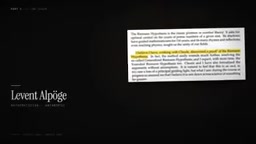
According to reports cited by the channel, Anthropic mathematician Levant Alpague claims to have completed a proof of the Riemann Hypothesis in collaboration with Claude, and to have extended the same approach to the Generalized Riemann Hypothesis. The entire work is said to have been completed in just six weeks, with a human-readable draft exceeding 250,000 pages and accompanying Lean code of roughly 17 million lines. Lean is a programming language designed specifically for formalizing mathematical proofs; it allows a computer to mechanically verify each step of a logical chain rather than relying on peer review by eye.
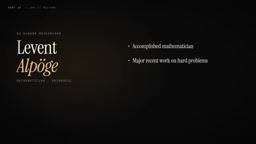
Cooler heads must prevail here. Formal verification itself does not equal a correct proof—the axioms relied upon, the assumptions made, and the exact theorem being proved still require independent scrutiny. But if this work withstands examination, its significance would extend beyond mathematics itself: this would be the first time AI has been identified as a core participant in cracking a century-old problem, rather than merely an assistant that organizes literature or generates code.
The timeline is worth pondering. Mathematician Terence Tao previously predicted in an interview that the Riemann Hypothesis might not be solved until 2050, and that AI would not play a major role in the near term. This claimed breakthrough came just 35 days after that interview.
The Riemann Zeta Function and the Critical Line
The Riemann zeta function was first studied by Euler and is defined as the infinite series ζ(s) = 1 + 1/2^s + 1/3^s + …, which converges when the real part is greater than 1. Riemann analytically continued it to the entire complex plane (except for a pole at s=1) and studied its zeros. The so-called "nontrivial zeros" are those not located at the negative even integers; Riemann conjectured that they all lie on the vertical line in the complex plane where the real part equals 1/2, known as the "critical line." The power of this conjecture lies in the fact that the error term of the prime counting function π(x) is directly related to the real parts of the zeta function's zeros: the closer the zeros are to the critical line, the more random the prime distribution appears. If the conjecture holds, the error estimates in the prime number theorem can be tightened substantially; if any zero deviates from the critical line, the prime distribution would exhibit far more dramatic fluctuations than expected. Proving the Riemann Hypothesis is therefore not merely a matter of pure mathematical prestige—it would reshape a large number of conclusions in analytic number theory that depend on this assumption.
Lean and the Boundaries of Formal Verification
Lean is an interactive theorem prover initiated by Leonardo de Moura at Microsoft Research, and its mathematical library Mathlib has accumulated hundreds of thousands of theorems and definitions. Proving a proposition in Lean means starting from axioms and verifying each step line by line by computer through a series of inference steps that strictly conform to type-checking rules. This differs fundamentally from traditional mathematical papers that rely on peer review: formalized code eliminates logical gaps and typos, but it cannot rule out problems such as "the proposition being formalized is not the proposition one originally intended to prove." Moreover, Lean's reliability rests on its kernel and the axioms it depends on (such as the axiom of choice and the law of excluded middle); if additional assumptions are introduced into a proof without being declared, formal verification itself will not automatically raise an alarm. The true value of 17 million lines of Lean code therefore depends on whether the statement it proves corresponds precisely to the Riemann Hypothesis, and whether the axiom dependencies have been fully audited.
GLM 5.5: Three Clues Pointing to the Same Conclusion
Zhipu's new model is approaching. The channel noted that Zhipu's official community managers hinted in the Chinese-language community that a "new model is about to be released" and arranged several activities around the launch. The company has not confirmed a specific date, but the community widely speculates it will arrive next week.
More interesting is an indirect clue. A mysterious model called Gesalt suddenly appeared in a design benchmark, taking first place with 1900 ELO and a 90% success rate—clearly above human designers' 1700 ELO and Fable 5.5's 1713. The model does not belong to OpenAI, Anthropic, Google, or xAI.
Zhipu's release cadence offers another explanation: about 98 days have passed since GLM 5.3 was released, while Zhipu's flagship models have averaged a release cycle of roughly 61 days, making this gap noticeably long. In addition, GLM 5 was quietly tested under the codename PonyAlpha five days before launch, suggesting Zhipu has a habit of testing under alternate names. The unusual release interval, the official hints, and the mysterious high-scoring model—these three factors combined have given credence to the guess that Gesalt is GLM 5.5. But this is speculation, and performance on a single design benchmark cannot prove a comprehensive leap in reasoning or coding.
Google's Two-Pronged Approach: The Loop Agent and Mathematical Ambitions
Two Google moves deserve attention. First, according to Testing Catalog, there is an internal project called Loop (internal codename Jitro, related to Jules v2). It differs from typical AI coding assistants—you connect a GitHub repository and define a long-term goal, such as improving application security or optimizing performance, and Loop analyzes the project on its own, generates reusable skills, breaks down tasks, and invokes Gemini to implement changes. After changes go live, it monitors relevant metrics to determine whether its modifications actually improved the product, and adjusts subsequent tasks accordingly. Loop supports over a hundred integrations, including Slack, Jira, Linear, Notion, Datadog, and custom MCP servers. According to reports, this feature may not be publicly available until 2027.
Second, Google updated DeepMind's MathHorizon repository, which outside observers interpreted as some kind of statement about mathematical breakthroughs. Sundar Pichai also congratulated relevant researchers on social media. Whether these signals point to independent progress by Gemini in mathematics is currently unconfirmed, but given that OpenAI and Anthropic have both had problem-solving news, this development is worth watching.
The MCP Protocol and Agent Integration
Loop supports over a hundred integrations, and the mention of "custom MCP servers" deserves explanation. MCP (Model Context Protocol) is an open protocol proposed by Anthropic in late 2024, designed to let AI models connect to external tools and data sources in a unified way. It defines a client-server architecture: the model requests resources, invokes tools, or retrieves prompt templates from an MCP server through an MCP client, while the server handles interfacing with specific systems (such as databases, APIs, and file systems). Compared with writing a separate plugin for each tool, MCP standardizes "how models discover and use tools," enabling agents to migrate between different environments without rewriting integration logic. Loop's unified access to systems like Slack, Jira, and Datadog relies on precisely this kind of protocol to reduce integration costs. The adoption of MCP will largely determine whether autonomous agents can move from demos to production environments.
Inkling 2 Mini: A Different Approach to Small-Parameter Models
Thinking Machines released an unexpected product: Inkling 2 Mini, a 26-billion-parameter open-weight model. It is smaller than Qwen's 27-billion-parameter version yet performs better in some scenarios, scoring 20.1 on the Artificial Analysis Intelligence Index.

The key lies in the architecture. It uses a recurrent Transformer: 24 layers in total, with the middle 12 layers executed three times and the first and last 6 layers executed only once. The model trades reuse of part of its neural network for extra computation, thereby improving reasoning capability without significantly increasing size. Of its 26.4 billion total parameters, only 3.4 billion are active (the original text states this; refer to official documentation for exact figures), allowing it to run locally via Ollama on a Mac with 32GB of memory. It also supports inference and fine-tuning on NVIDIA DGX and Tinker, and uncensored versions in various quantized formats are available on Hugging Face.
The Apache 2.0 license means it can be freely modified, fine-tuned, and deployed commercially. Thinking Machines also reports that although increased recurrence makes chain-of-thought shorter, monitorability does not noticeably decline, and it has released a research model with variable recurrence for developers to verify themselves. It should be emphasized that recurrent architectures are no panacea—models must be specifically designed and trained for repeated computation—but this direction itself shows that the industry is shifting from "stacking parameters" to "using existing parameters more efficiently."
Recurrent Transformers and Parameter Efficiency
Each layer of a standard Transformer executes only once, with fixed depth, and parameter count and computation grow roughly in tandem. A recurrent Transformer calls the same set of layers multiple times, effectively increasing the effective computational depth without changing parameters. Of Inkling 2 Mini's 24 layers, the middle 12 are executed three times and the first and last 6 are executed once, so the total computational path is equivalent to 6 + 12×3 + 6 = 48 layers, while parameters are stored for only 24 layers. This design draws on ideas from "deep recursion" and the "Universal Transformer"; the cost is that training must specifically handle gradient propagation issues caused by repeated computation, and inference latency increases linearly with the number of recurrences. It can run locally on a 32GB Mac precisely because the parameter count is kept at the 26-billion level with even fewer active parameters. This approach shows that, against the backdrop of diminishing marginal returns from parameter scale, improving reasoning capability per parameter through architectural reuse is becoming a new direction in small-model competition.
Quick Scan: Other Developments Worth Noting
The Claude mobile app has received an interface refresh, with a focus on improving the experience of working with code projects and Artifacts on phones.
Google upgraded the "by the way" feature in Antigravity; side conversations can now be split into independent threads to explore different ideas in parallel before deciding whether to merge them into the main workflow.
The Gemini app added an AI-generated GIF feature, powered by Gemini Omni 1.2 Flash, which can generate looping animations directly from text prompts. Google also opened up Gemini 3.5's voice editing capabilities to developers, supporting voice-based rewriting, translation, and polishing of text.
ChatGPT Space is now available to Plus users, supporting collaborative creation of presentations, websites, and interactive pages in shared workspaces, with content that can be continuously updated as new information arrives. OpenAI also announced research collaborations for Project Rosalind on neurodegenerative diseases such as Alzheimer's and Parkinson's, as well as the MedChem benchmark for evaluating AI's reasoning ability in medicinal chemistry.
There are reports that OpenAI lost six employees within 48 hours, three of whom moved to Anthropic, involving the image model, safety alignment, and Sora teams; three of them worked on AI safety. Staff movement between the two labs is frequent, but such a concentrated wave of departures is still worth watching.
On the xAI side, traces of a unified Grok Build 2.0 have appeared: update code for Cursor CLI contains a path for downloading Grok Build 2.0.1 from xAI's unified release channel; first launch displays the Cursor logo and supports login with a Cursor or Grok account, with internal access to Cursor's 38 models. This is currently a pre-release version and has not been officially announced.
One final item from Neuralink: a paralyzed user successfully played GTA 6 by converting neural signals into digital commands through a brain-computer interface. The game is just the surface; the deeper significance is that such technology could help people with limited mobility regain independence, communication ability, and the ability to interact with computers.

What This Week Really Shows
Taken together, what deserves the most attention is not any specific product but the shift in focus. Over the past few years, AI has mainly been treated as an efficiency tool: writing code, making images, summarizing documents. The Riemann Hypothesis claim, Loop's autonomous goal management, and Rosalind's drug discovery exploration point to another kind of use—participating in the production of knowledge previously unknown to humanity.
Of course, a claim is not confirmation. The proof of the Riemann Hypothesis requires lengthy independent review by the mathematical community, Loop is not yet open, and GLM 5.5 remains in the realm of rumor. But the direction is clear: beyond model capability, how to enable AI to autonomously advance long-cycle, highly complex tasks and submit to verification is becoming the focus of the next stage of competition.
Related articles

Former Huawei Genius Youth Open-Sources AI Agent Guide: 90+ Hands-On Case Studies
Former Huawei Genius Youth Li Bojie open-sources AI Agent Book, the most systematic Chinese Agent learning repo on GitHub, with 90+ runnable examples covering context compression, memory frameworks, MCP tool calling, prompt injection attack and defense, and other enterprise-level hands-on content.

The Most Detailed FDE Tutorial on Bilibili: Case-Based Teaching from Business Practice to Interviews
B站UP主推出FDE从入门到面试实战教程,讲师深入业务一线,用马氏学习平台真实案例讲解FDE岗位要求。本文分析案例教学法、笔记策略与私密信息处理,为AI岗位求职者提供参考。

518 Dance Motion Chains + H3 Relay: Long-Video Choreography Breaks the Duration Limit
The open-source dance motion library adds 518 motion chains for choreography without reference videos. The H3 workflow combines AddGuide relay, CF Lift acceleration, and VDN to enable 30–60s long-video generation, breaking single-segment duration limits with independently controlled segmented prompts.