GNOME Founder Blasts DHH: Why Political Infighting Among Open Source Leaders Is Escalating

GNOME founder de Icaza and DHH engage in a public spat over immigration policy, with a Red Hat spokesperson opening fire simultaneously, reflecting controversy over politicization in the open source community.
This article reviews a recent public conflict in the open source community over immigration policy and political stances. GNOME co-founder Miguel de Icaza publicly called DHH "lazy, racist, and ignorant" over DHH's comments on European immigration policy, and the conflict quickly escalated from policy discussion to personal attacks. Almost simultaneously, Red Hat's European spokesperson Jan Wildeboer used an official promotional account to call for the impeachment of the US President and to confront the "far-right funded by Musk." Commentator Lunduke pointed out that public moral accusations by leadership undermine the foundation for collaboration among developers with different stances, though his video itself carries a clear bias. The article further analyzes the lack of fact-checking, the silence of mainstream open source media, and the growing phenomenon of open source projects being instrumentalized as political platforms, ultimately asking how ordinary developers should face the entanglement of technical vision and political agendas when choosing projects.
The open source community has never lacked technical debates, but a recent public spat over immigration policy and political stances has thrust GNOME co-founder Miguel de Icaza and Omarchy Linux creator DHH into the spotlight. According to a breakdown by the YouTube tech commentary channel Lunduke Journal, de Icaza directly labeled DHH as "lazy, racist, and ignorant" on social media, while Red Hat's European spokesperson Jan Wildeboer simultaneously called for the impeachment of the US President and to confront the "far-right funded by Musk." This conflict has torn open far more than a personal feud between two individuals.
A Chain Reaction Ignited by One Sentence
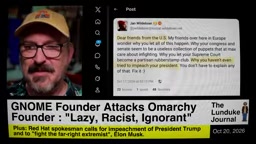
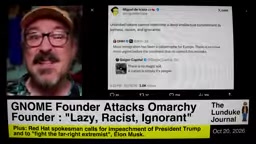
The origin is not complicated. DHH made a comment about violent incidents occurring in various parts of Europe: "Mass migration is a disaster for Europe, and correcting this mistake is the most urgent issue on the continent." The statement was aimed at the policy level and did not name any individual or ethnic group. But de Icaza's reaction was extremely fierce; he reposted it with the caption: "Unlimited tokens won't solve a deep ideological crisis. There is no commitment to laziness, racism, and ignorance here."
Screenshots shown by Lunduke in the video reveal that de Icaza's username includes a pineapple emoji, which the channel host interprets as a sign of his long-term online activity targeting Jewish and Israeli issues. This detail itself carries a strong personal bias, but de Icaza's public response was indeed the trigger for the entire conflict—he did not rebut DHH's policy argument but instead directly turned to personal attacks.
Miguel de Icaza is the co-founder of the GNOME desktop environment and founder of Xamarin (acquired by Microsoft in 2016), enjoying extremely high recognition in the open source community. DHH (David Heinemeier Hansson) is the creator of the Ruby on Rails framework and co-founder of Basecamp, and has repeatedly become a focal point of public opinion in recent years due to controversial views on immigration policy, remote work, and other issues. Both are highly influential figures in the open source ecosystem, so this conflict is not an ordinary online quarrel but represents a collision between two distinctly different political-cultural camps within the open source community. Understanding their backgrounds helps grasp why a single policy comment quickly escalated into a public war of words.
Red Hat Spokesperson Opens Fire Simultaneously
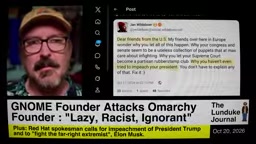
In almost the same time window, Red Hat's European evangelist and spokesperson Jan Wildeboer posted a sharply worded message from his official promotional account. According to Lunduke Journal, Wildeboer addressed American readers: "Why haven't you even attempted to impeach the president?" He also wrote that Europe must "confront the far-right extremists funded by Putin and Musk."
The subtlety of this statement lies in the account's nature. Wildeboer used the account he normally uses to disseminate official Red Hat information, meaning there is an inseparable binding between a corporate spokesperson's personal political expression and the company brand. Lunduke's comment on this was: "Instead of dealing with their own problems, they turn to attack America, attacking anyone who is not part of their Marxist collective." It should be noted that "Marxist collective" is the channel host's characterization, a single-source opinion rather than a factual statement.
Red Hat's "evangelist" or "spokesperson" role typically involves promoting the company's technical philosophy and open source culture within developer communities, and their public statements are often seen as an extension of the company's stance. Jan Wildeboer's use of an account normally used for official information to make political statements blurs the line between personal expression and corporate brand. In corporate communication practice, such accounts are generally subject to company social media policies, but open source company culture has historically been more tolerant of employees' public expression. This incident has therefore sparked discussion about the boundaries of corporate spokespersons' political expression: when personal political stances are communicated through official channels, does the company bear corresponding reputational risk?
The "Politicization" Controversy in Open Source Governance
The core controversy of this conflict can be divided into two layers. The first is the personal level: does an open source leader have the right to express strong political views on public platforms? The answer is obviously yes. The second layer is the truly thorny issue: when these stances manifest as moral accusations against peers, does the foundation of community collaboration suffer?
Lunduke repeatedly emphasized a point in the video: if key figures in organizations like GNOME, Red Hat, and Fedora publicly call people like DHH "racists," then the possibility of the two sides collaborating on the same open source project is substantially destroyed. He used the Yiddish term "chutzpah" as a metaphor—grabbing your little brother's hand to hit his own face, then asking "why are you hitting yourself." This metaphor points to a reversal of attribution: first initiate a personal attack, then treat the other's backlash as evidence of their combativeness.
From a community governance perspective, this dynamic is indeed harmful. Open source projects depend on sustained volunteer contribution, and whether volunteers are willing to stay in a project whose leadership publicly demeans their political stance is a real question. But this double-edged sword applies equally to DHH's side—his statements on immigration policy are themselves highly controversial within the tech community, and a narrative portraying him as a pure victim is incomplete.
"Chutzpah" is a Yiddish word literally meaning "audacity" or "nerve," often used to describe someone doing something absurdly outrageous with no self-awareness. Lunduke's metaphor—grabbing your little brother's hand to hit his own face, then asking "why are you hitting yourself"—is a classic interpretation of the term, implying the perpetrator inverts the victim's reaction into a fault. In the context of open source community governance, this metaphor is used to criticize a common pattern of argument: one side first makes a moral accusation, and when the other counterattacks, treats the counterattack itself as evidence of the other's irrationality, thereby occupying a double advantage in the narrative. Understanding this rhetoric helps readers identify attribution strategies in public debates.
The Boundaries of Fact-Checking and the Media Ecosystem
Worth noting is Lunduke's self-positioning at the end of the video. He stated that if Red Hat spokespersons, de Icaza, or GNOME believe his paraphrase is inaccurate, they are welcome to provide quotes, and he will publish them verbatim. He also mentioned that Red Hat has an internal policy of "not mentioning Lunduke," so the other side likely will not respond.
This detail exposes a structural problem: when political controversies in the open source world can only be recorded by a few independent commentators, a fact-checking loop is difficult to form. The silence of mainstream open source media on such topics leaves single-source narratives without opportunities for cross-verification. Readers receiving such information need to be aware that the video itself carries a clear stance—Lunduke does not hide his agreement with DHH's immigration views ("I tend to agree with him on this point") and also offers a derogatory interpretation of details related to de Icaza's ethnic background.
"Single-source" is a journalism term referring to reporting that relies on only one source. In professional journalism practice, single-source reporting is generally considered a situation requiring caution, because information lacking cross-verification is susceptible to source bias, memory errors, or selective narration. The open source community lacks editorial review mechanisms similar to traditional media, and political controversies are often first recorded and spread by individual commentators or self-media, making a fact-checking loop difficult to form. When encountering such content, readers should proactively identify the source's bias and seek multiple sources for comparison rather than treating a single narrative as complete fact.
When "Writing Software" Becomes a Declaration of Stance
The video ends with a rather ironic self-promotion: Lunduke claims that in the past few months he has written more code than Canonical, GNOME, and Fedora, and takes the opportunity to promote his Lunduke Journal subscription and the Elkaz 1.0 operating system—a Linux distribution touting "non-woke, no systemd, no online accounts, no built-in AI."
This ending actually points out the absurdity of the entire debate: both sides are instrumentalizing "writing software." One side treats open source projects as a platform for political action, while the other packages "I just want to write code quietly" as an ideological brand for sale. The tech community certainly cannot be completely isolated from politics, but when leadership energy is continuously consumed by labeling each other, what is truly squeezed out is the silent foundational work of code review, documentation maintenance, and mentoring newcomers. The trust cost of open source collaboration is being raised bit by bit by such public confrontations.
For ordinary developers, the practical impact of this turmoil may be very concrete: when choosing a distribution or participating in a project, are you contributing to a technical vision or to a political agenda you may not agree with? This question is becoming increasingly difficult to avoid.
One-line Summary
GNOME founder de Icaza and DHH engaged in a public spat over immigration policy, with a Red Hat spokesperson opening fire simultaneously, reflecting the controversy over politicization in the open source community.
Paragraph Summary
This article reviews a recent public conflict in the open source community over immigration policy and political stances. GNOME co-founder Miguel de Icaza publicly called DHH "lazy, racist, and ignorant" over DHH's comments on European immigration policy, and the conflict quickly escalated from policy discussion to personal attacks. Almost simultaneously, Red Hat's European spokesperson Jan Wildeboer used an official promotional account to call for the impeachment of the US President and to confront the "far-right funded by Musk." Commentator Lunduke pointed out that public moral accusations by leadership undermine the foundation for collaboration among developers with different stances, though his video itself carries a clear bias. The article further analyzes the lack of fact-checking, the silence of mainstream open source media, and the growing phenomenon of open source projects being instrumentalized as political platforms, ultimately asking how ordinary developers should face the entanglement of technical vision and political agendas when choosing projects.
Related articles

AgentCore in Practice: Connecting Custom Tools and MCP Servers to Agents
DebuggerCafe tutorial shows how to connect custom tools and MCP servers to Amazon Bedrock AgentCore agents, covering tool contract design, MCP reuse, and production concerns.

816B Parameters Scores Only 39? The Real Cost-Effectiveness of the Open-Source LLM Parameter Race
Meta's 816B Muse Spark Open scores just 39 on Artificial Analysis, while 180B Qwen3.8-Flash-Next scores 40. This article analyzes 11 open-weight models' parameters vs. scores, exploring the real impact of activated parameters, quantized size, and deployment cost.

Aerial Manipulators: The Next Step for Drones from 'Seeing' to 'Changing'
Starting from a Reddit discussion, this article analyzes the technical challenges, potential applications, and deployment bottlenecks of aerial manipulators, exploring the key challenges for drones moving from environmental perception to physical manipulation.