GOKO M6/X5 Robot Mowers Hands-On: Can a Boundary-Wire-Free Setup Conquer a Three-Acre Orchard?

After five years of rejecting robot mowers, gardening blogger Mark bets on GOKO's boundary-wire-free M6 and industrial-grade X5.
YouTube creator Mark, who owns a three-acre orchard, rejected hundreds of robot mower partnerships over five years because early products required buried boundary wire and couldn't handle complex terrain. GOKO won him over with its commercial robotics background (mining, shipbuilding, cleaning) and the M6's boundary-wire-free design. At its Sydney launch, GOKO introduced the M6 (home retail) and X5 (commercial heavy-duty). Mark plans to use the X5 to clear wetland and brush edges and the M6 for precision maintenance between fruit trees and around raised beds. He spends about five hours a week mowing and hopes the robots give that time back, but won't give a final verdict until thorough testing.
From Skeptic to Believer: A Gardening Blogger's Five-Year Wait
Three acres of orchard, 150 fruit trees, 54 raised garden beds, eucalyptus branches that drop without warning, and chickens running everywhere—that's the daily reality for Mark, the creator behind the YouTube channel Self Sufficient Me. Over the past five years, he's turned down partnership requests from hundreds of robot mower companies, and for a simple reason: not a single machine could handle his complex terrain and harsh climate.
Then GOKO came along. What convinced him wasn't marketing talk but two things: first, the company's deep background in commercial robotics (mining, shipbuilding, cleaning), with parent company robotplus bringing extensive industrial-grade robotics experience; second, the M6's specs made him feel for the first time that "this one might actually work."
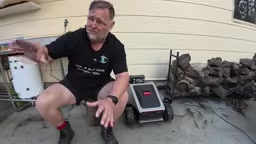
This shift from skepticism to willingness to bet is exactly the microcosm of what the robot mower category is going through. Early products relied on buried boundary wires, which meant high installation costs and maintenance headaches for large, complex yards—the core reason Mark avoided these products for years.
M6 and X5: One for the Home, One for "Beast-Level" Scenarios
GOKO showcased two products at its Australian market launch in Sydney. The M6 targets the retail home market, while the X5 is heavy-duty equipment built for commercial scenarios—Mark described it as "a massive beast" and figured it could "flatten" his backyard in five minutes.
The two have clear roles in Mark's testing plan: the X5 handles the wetland and brush edges around the orchard's perimeter where ride-on mowers tend to get stuck, knocking down the overgrown grass first; the M6 then handles routine maintenance, doing precision trimming between fruit trees and around the raised beds.
This "rough first, fine later" combination approach is a useful reference for large landowners—a single machine often struggles to cover everything from wild edges to precision gardening.
The Divide Between Commercial and Consumer Robot Mowers
Heavy-duty robot mowers built for commercial scenarios and retail home products differ significantly in their engineering trade-offs. Commercial models typically use wider cutting decks, higher-power motors, and hydraulic or heavy-duty track chassis to handle brush, soft wet ground, and steep slopes—at the cost of much greater size, weight, and price, and they often require professional deployment. Home models prioritize noise, safety, cost, and autonomous docking, with relatively limited cutting height and obstacle-climbing capability. The "rough first, fine later" combination described in the article essentially uses the commercial machine's land-clearing capability and the consumer machine's precision maintenance capability in stages—first using heavy equipment to knock down overly tall, dense grass to a range the home model can handle, then having the lightweight machine do high-frequency routine trimming. This layered strategy is common in agriculture and landscaping management, but it's still a relatively new product-combination narrative in the robot mower consumer market.
The Real Three-Acre Test: What Obstacles the M6 Must Clear
Mark allowed the GOKO team to conduct on-site deployment testing at his property and set fairly specific expectations for the M6. In his orchard, the spacing between fruit trees allows the machine to get within one or two feet, and he doesn't mind the M6 bumping into tree roots because "it won't hurt the fruit trees." But he cares about something else: sitting on a ride-on mower always means ducking under branches, and he wants to know whether the M6 can pass beneath most of the fruit trees.
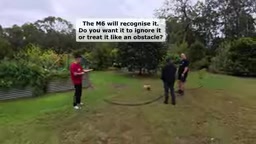
Obstacle handling is another key issue. The yard has septic pipes, a barbecue grill, stone borders, and raised garden beds. GOKO's solution offers two selectable modes: either have the M6 detect and drive over the pipes while protecting them, or treat them as obstacles to go around. Mark wants to try both.
The trickier scenario is the low-lying area in the backyard: there's an old chicken coop, a fire pit, large pine trees, and fallen eucalyptus branches, and the ground is soft and wet—once a ride-on mower gets stuck there, he has to spend two days with a manual winch to get it out. He says outright that this area may only be manageable by the X5, with the M6 handling follow-up periodic low-cut maintenance.
For Mark, the time math is clear: in summer the lawn needs mowing two to three times a week, and he spends about five hours a week just on mowing—time he could otherwise use for gardening, editing videos, or simply resting. He hopes the M6 can give that time back to him, leaving him to handle only edging and tending the vegetable garden.
The Practical Constraints Complex Terrain Places on Robot Mowers
A robot mower's passability is determined by multiple physical parameters: ground clearance affects whether it can cross tree roots and stones, tire or track type determines traction on soft wet ground, body height and sensor layout determine whether it can pass under low canopies, and the protective structure around the cutting deck relates to safety when encountering fragile infrastructure like septic pipes. Soft, low-lying wet ground is an especially demanding scenario—wheeled machines tend to sink and slip, and once stuck, heavier machines are actually harder to free. In addition, unstructured obstacles like chicken coops and temporary fencing require real-time detection and avoidance rather than reliance on pre-mapped static maps. These constraints explain why the blogger believes the same piece of land may need machines of different tonnage and chassis types working in division of labor—a single model struggles to cover all conditions from wild edges to the area around raised garden beds.
Boundary-Wire-Free Approach and Commercial Background: GOKO's Differentiators
One detail Mark kept coming back to: early robot mowers required burying wire along the perimeter, which for three acres was "an absolute nightmare." GOKO's M6 uses a boundary-wire-free approach, which directly eliminates the biggest reason he'd rejected these products for years.
Another signal that made him willing to cooperate was the company's communication skills and engineering background. GOKO's accumulated experience in commercial robotics—mining, shipbuilding, cleaning—means its tech stack didn't start from consumer-grade toys but extends downward from industrial-grade reliability. In a category still undergoing rapid iteration like robot mowers, this may be more convincing than spec-sheet padding alone.
During the Australian launch, GOKO offered early-bird discounts on the M6: $2,000 off the single-battery version and $2,200 off the dual-battery version, limited to 300 units, with 135 already sold.
The Technical Principles of Boundary-Wire-Free Navigation
Traditional robot mowers rely on boundary wire buried around the lawn's perimeter to define the work area; installation requires trenching and burying wire along the entire yard perimeter, often hundreds of meters, and the wire is prone to corrosion and being cut by gardening tools, making maintenance costs extremely high. Boundary-wire-free solutions typically combine RTK-GPS (real-time kinematic differential positioning, with centimeter-level accuracy), visual SLAM (simultaneous localization and mapping), inertial measurement units, and ultrasonic/radar obstacle-avoidance sensors, allowing the machine to build an environmental map and localize itself in real time through multi-sensor fusion. This technical approach only matured and reached the market after 2023; its challenges lie in canopy occlusion weakening GPS signals, complex terrain interfering with visual feature matching, and the real-time compute demands of multi-sensor data fusion. For large yards at the three-acre level, going boundary-wire-free isn't just about installation convenience—it means the machine can dynamically divide multiple work zones and schedule them as needed, rather than being constrained by the fixed topology of physical wire.
Not Yet Settled: Testing Has Only Just Begun
Mark's stance is clear: the experience so far is good, but he won't give a final verdict until testing is complete and he's confirmed the M6 works reliably with "robot-like precision." His standard is that the machine must be reliable enough to become second nature—something whose absence would be immediately and obviously inconvenient.
That caution is worth heeding. Robot mowers are transitioning from "novelty toy" to "practical tool," and boundary-wire-free navigation, complex terrain adaptation, and multi-obstacle handling are the core battlegrounds for this generation of products. GOKO's industrial background and the M6's on-paper specs are both impressive enough, but real-world performance in a three-acre orchard is the key to whether it can truly save someone five hours a week.
For users with large, complex yards, the M6 and X5 combination offers a noteworthy approach: use the heavy machine to clear the way and the precision machine to maintain it. But whether "it's finally time to buy a robot mower" still depends on how these devices perform among real mud, tree roots, and flocks of chickens.
One-line Summary
After five years of rejecting robot mowers, gardening blogger Mark is willing to bet on testing GOKO thanks to its boundary-wire-free approach and industrial background.
Paragraph Summary
This article tells the story of YouTube creator Mark, who owns a three-acre orchard and has turned down hundreds of robot mower partnerships over five years because early products relied on buried boundary wire and struggled with complex terrain. GOKO won him over with its commercial robotics background (mining, shipbuilding, cleaning) and the M6's boundary-wire-free approach. At its Sydney launch, GOKO introduced the M6 (retail home) and X5 (commercial heavy-duty), and Mark plans to use the X5 to clear wetland and brush edges while the M6 handles precision maintenance between fruit trees and around raised beds. The article details the obstacles the M6 must overcome: passing under fruit trees, septic pipes, stone borders, raised garden beds, and soft low-lying wet ground. Mark spends about five hours a week mowing and hopes the robot will give that time back, though he won't give a final verdict until thorough testing is done.
Related articles

On-Device LLM + ESP32: Build a DIY Calorie Reminder
A Bilibili creator open-sourced a calorie intake reminder: a phone app uses the open-source miniCPM model to locally recognize food photos and estimate calories, while an ESP32 mini screen syncs data and shows intake status with green/yellow/red rings — magnetically attachable to the fridge door for constant reminders.

Running 125B MoE on a 12GB GPU? Inside Strata's Three-Tier Cooperative Engine
Open-source C++ engine Strata runs 125B MoE models locally on 12-16GB consumer GPUs at 40-95 tokens/s. Here's how its VRAM/memory/SSD three-tier pipeline works.

Running Audio and Vision Locally with a 2B Model: LFM3 Hands-On Revealed
A blogger tests Liquid AI's LFM3 Audio 2B and Omni 2B on a MacBook Air: 2B parameters run speech and vision offline, tool calling exceeds expectations, but noise transcription and hallucination issues are evident.