GoModel: An Open-Source Self-Hosted AI Gateway Solution
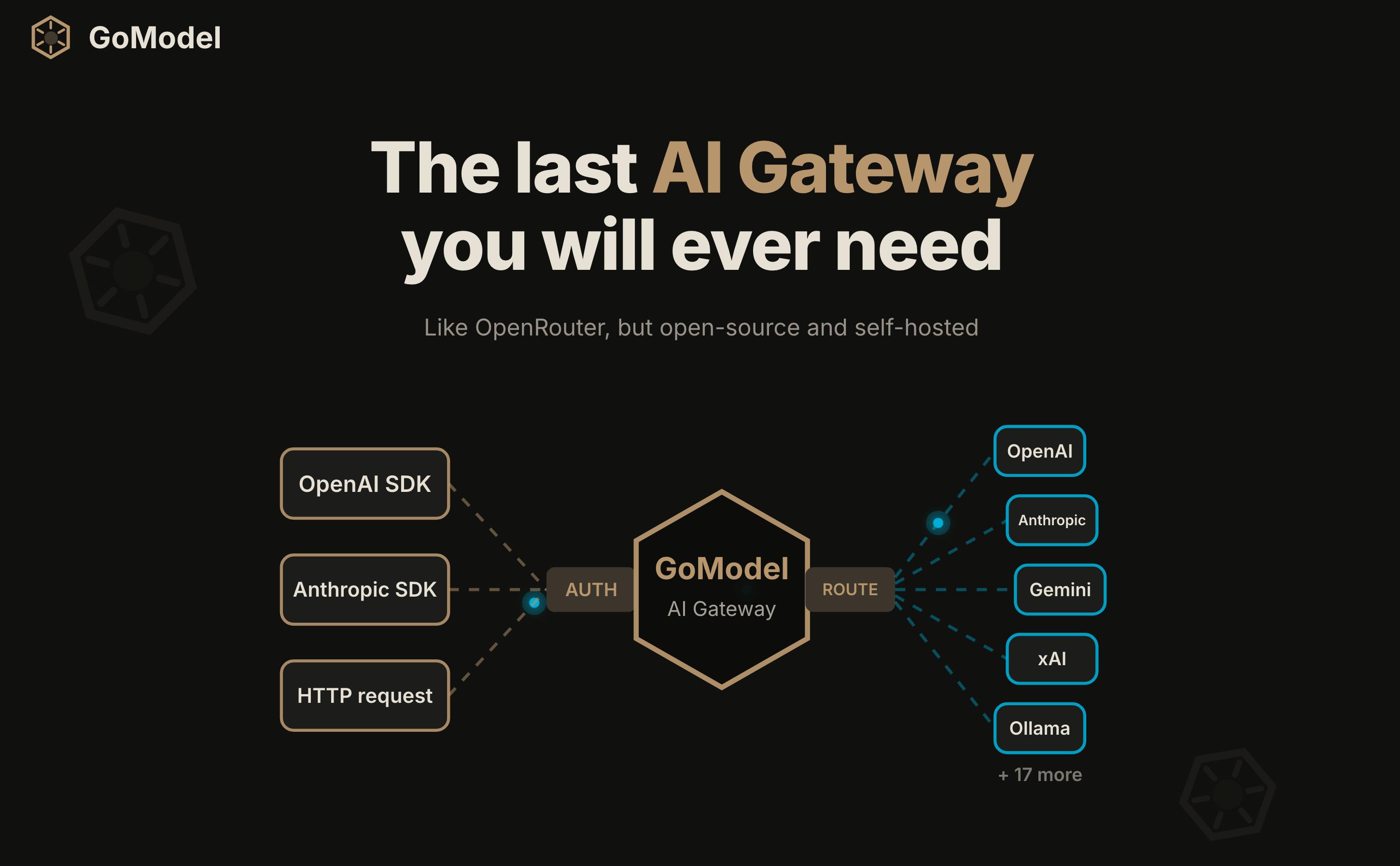
GoModel is a lightweight, self-hosted open-source AI gateway that unifies multiple LLM provider APIs.
GoModel is an open-source AI gateway written in Go, serving as a self-hosted alternative to OpenRouter and LiteLLM. It provides a unified OpenAI-compatible API for managing multiple LLM providers, with built-in budget control, smart caching, security protection, and load balancing. Its 20MB Docker image and single-binary deployment make it ideal for privacy-conscious enterprises, multi-model teams, and cost-sensitive startups.
Managing APIs from multiple LLM providers has long been a challenge for AI application developers. The open-source project GoModel, which earned 98 upvotes on Product Hunt, offers developers a lightweight, self-hosted AI gateway solution.
What is GoModel
GoModel is an open-source AI gateway written in Go, positioned as a self-hosted alternative to OpenRouter and LiteLLM. It provides a unified OpenAI-compatible API interface for all AI providers, eliminating the need for developers to write different integration code for each vendor.
To understand GoModel's value, it helps to first understand the concept of an AI gateway. An AI gateway is similar to a traditional API gateway in microservice architectures (like Kong or Nginx), but specifically optimized for LLM API call scenarios. It acts as a middleware layer between applications and multiple AI service providers, handling cross-cutting concerns such as request routing, authentication, rate limiting, and billing tracking. The main competitors in the market include: OpenRouter — a commercial AI model routing service where users access hundreds of models through its platform but pay an additional fee; and LiteLLM — an open-source proxy written in Python that is feature-rich but heavier to deploy, depending on the Python runtime and multiple system components. GoModel differentiates itself with its "self-hosted + ultra-lightweight" approach, re-implementing core functionality in Go and eliminating dependencies on external services.
The project is licensed under MIT and supports BYOK (Bring Your Own Key) mode, giving you full control over costs and data privacy. The core idea behind BYOK is that users directly use their own API keys obtained from providers like OpenAI, Anthropic, and Google, while GoModel serves only as a transparent forwarding layer — it neither holds nor manages user keys. This means all API call costs are billed directly by the provider to the user, with no middleman markup. More importantly, API keys always remain within the user's own infrastructure, avoiding the security risks of handing sensitive credentials to third-party platforms — something that has become especially critical in light of multiple API key leak incidents in recent years.
The entire service runs from a single binary, with a Docker image of just 20MB and extremely low resource consumption.
Core Features
GoModel integrates key features required for enterprise-grade applications:
Budget Control: Built-in budget management allows you to set spending limits for different projects or users, preventing unexpectedly high bills. This is particularly important for SaaS products that provide AI capabilities to external users. In practice, LLM API call costs are priced per token — for example, GPT-4 costs approximately $30 per million input tokens and $60 per million output tokens. An uncontrolled loop or a flood of requests from malicious users could generate thousands of dollars in charges within hours. GoModel's budget control feature allows administrators to set daily/weekly/monthly spending caps by team, project, or individual API key, automatically blocking requests when thresholds are reached, fundamentally preventing "bill explosion" scenarios.
Smart Caching: Identical requests return cached results, significantly reducing API call costs and response latency. In scenarios with high volumes of repetitive queries, caching delivers substantial cost savings. Caching in AI scenarios is more challenging than traditional API caching because LLM outputs are inherently non-deterministic (controlled by the temperature parameter). GoModel's smart caching typically uses an exact-match strategy: returning cached results when the model, prompt, and parameters are identical. More advanced implementations also support Semantic Caching, using vector similarity to determine whether two requests are "similar enough" to reuse cached results. In use cases like customer service chatbots, FAQ systems, and document summarization, many users ask highly similar questions, and cache hit rates can reach 30%-60%, translating directly into proportional cost savings.
Security Protection: Provides content filtering and security check mechanisms to help build AI applications that meet compliance requirements. This is critical when handling sensitive data or serving public-facing applications. Security protection typically operates at two levels: on the input side, it detects and blocks Prompt Injection attacks and filters requests containing Personally Identifiable Information (PII); on the output side, it performs harmfulness detection on model-generated content and filters out responses that violate policies. For enterprises that need to comply with regulations like GDPR and HIPAA, gateway-level security provides a centralized compliance control point.
Load Balancing: Supports load balancing across multiple model providers, automatically failing over to backup providers when a service becomes unavailable, ensuring high service availability. AI model load balancing differs fundamentally from traditional web service load balancing: different providers' models of the same class vary in pricing, rate limits, and response quality. GoModel can configure complex routing strategies — for example, prioritizing the lowest-cost provider and automatically switching to alternatives when its rate limits are exhausted, or distributing traffic by weighted ratios to spread risk. Since 2024, major providers including OpenAI and Anthropic have experienced multiple service outages, making multi-provider redundancy strategies a production necessity rather than a nice-to-have.
Use Cases
GoModel is particularly well-suited for the following developers and teams:
Privacy-Conscious Enterprises: A self-hosted solution means all API call data flows within your own infrastructure, never passing through third-party services. This is especially important for industries like finance and healthcare that handle sensitive business data. When using third-party gateways like OpenRouter, users' complete prompts and model responses pass through that platform's servers, which technically means the third party can see all interaction content. For scenarios involving patient medical records, financial transaction data, or legal documents, this data exposure is unacceptable. Self-hosted GoModel confines the entire data pipeline within the enterprise's own VPC (Virtual Private Cloud) or internal network, keeping API call logs, cached data, and audit records all within the enterprise's control, satisfying data sovereignty and localization compliance requirements.
Multi-Model Strategy Teams: A unified interface greatly simplifies the complexity of model switching and A/B testing. You can easily switch between GPT-4, Claude, Gemini, and other models without modifying business code. In real-world AI product development, a "multi-model strategy" has become mainstream practice. Different models excel at different tasks — Claude excels at long-text comprehension and code generation, GPT-4 stands out in complex reasoning, Gemini has advantages in multimodal tasks, and open-source models like Llama and Mistral offer better cost-effectiveness in specific fine-tuning scenarios. GoModel's unified interface lets developers switch between providers simply by changing the model name in the configuration, dramatically reducing the engineering cost of model evaluation and A/B testing.
Cost-Sensitive Startups: Using your own API keys instead of a third-party gateway service avoids additional middleman fees, and the budget control feature helps better manage AI spending. Taking OpenRouter as an example, it charges a percentage-based service fee on top of the model's original price. For applications with hundreds of thousands of daily API calls, this additional cost is quite significant. As a self-hosted solution, GoModel's running costs are limited to a single low-spec cloud server (thanks to the 20MB minimal image, even the lowest-tier cloud instance will suffice), resulting in significant operational savings over the long term.
Technical Advantages
Development in Go brings multiple advantages. Go (also known as Golang) is a programming language released by Google in 2009, designed specifically for building high-performance network services and infrastructure software. Core cloud-native ecosystem projects like Docker, Kubernetes, and Prometheus are all written in Go, making it an ideal choice for building gateway services. Go's Goroutine model efficiently handles large numbers of concurrent connections — a single GoModel instance can easily support thousands of concurrent API requests while consuming only a fraction of the memory required by equivalent Java or Python services.
As a compiled language, GoModel packages into a single binary, requiring no complex runtime environment installation for deployment. This means no Python pip dependency hell, no Node.js node_modules bloat, no Java JVM configuration — just copy one file to a server and run it directly. The 20MB Docker image can be pulled and started quickly; by comparison, a typical Python application Docker image usually ranges from 500MB to 1GB. This extreme lightweight design makes GoModel particularly suitable for containerized deployments and edge computing scenarios, running stably even on resource-constrained edge nodes.
The OpenAI-compatible API design allows GoModel to integrate seamlessly into existing tech stacks, reducing migration costs. OpenAI's Chat Completions API (represented by the /v1/chat/completions endpoint) has become the de facto standard for LLM interaction. Nearly all mainstream development frameworks — LangChain, LlamaIndex, Vercel AI SDK, AutoGen, and others — support the OpenAI API format as their primary interface. GoModel's implementation of this standard means developers only need to change the API Base URL from api.openai.com to GoModel's address, and existing code runs without any other modifications. This "zero-cost migration" design philosophy dramatically lowers the adoption barrier.
Community Feedback
Ranking #7 on Product Hunt with 98 upvotes indicates strong demand for this type of tool within the developer community. As a developer tool, GoModel fills a gap left by OpenRouter and LiteLLM in the self-hosted space. It's worth noting that the AI gateway sector has shown clear growth momentum recently — beyond GoModel, products like Portkey, Helicone, and Braintrust are also developing rapidly, reflecting an explosion in demand for middleware infrastructure as enterprise AI applications move from experimentation to production deployment.
For teams that don't want to depend on third-party services and need greater control, this is a solution worth evaluating. The project's GitHub activity and future development are worth watching.
Summary
GoModel provides AI application developers with a reliable gateway choice through its open-source, lightweight, and feature-complete design. Whether from the perspective of cost control, data privacy, or service stability, a self-hosted solution offers unique value. As AI applications become more widespread, infrastructure tools like this will play an increasingly important role in the developer toolchain. Just as Kubernetes is to container orchestration and Nginx is to web services, AI gateways are likely to become standard components in AI application architectures — and GoModel, with its lightweight and self-hosted characteristics, has secured a favorable position in this emerging space.
Related articles
Muse: An AI Agent That Actually Gets Things Done
Muse is a personal AI agent that goes beyond conversation to autonomously complete tasks like financial management, health tracking, and shopping. Learn how AI Agents are evolving from advisors to executors.

AlphaGenome Atlas: An AI Genomic Map Covering 9 Billion DNA Mutations
Google DeepMind launches AlphaGenome Atlas, pre-computing impact predictions for all 9 billion single-base mutations in the human genome across a 1PB dataset covering both coding and non-coding regions.
49agents IDE: Rebuilding the Development Workflow with a 2D Canvas
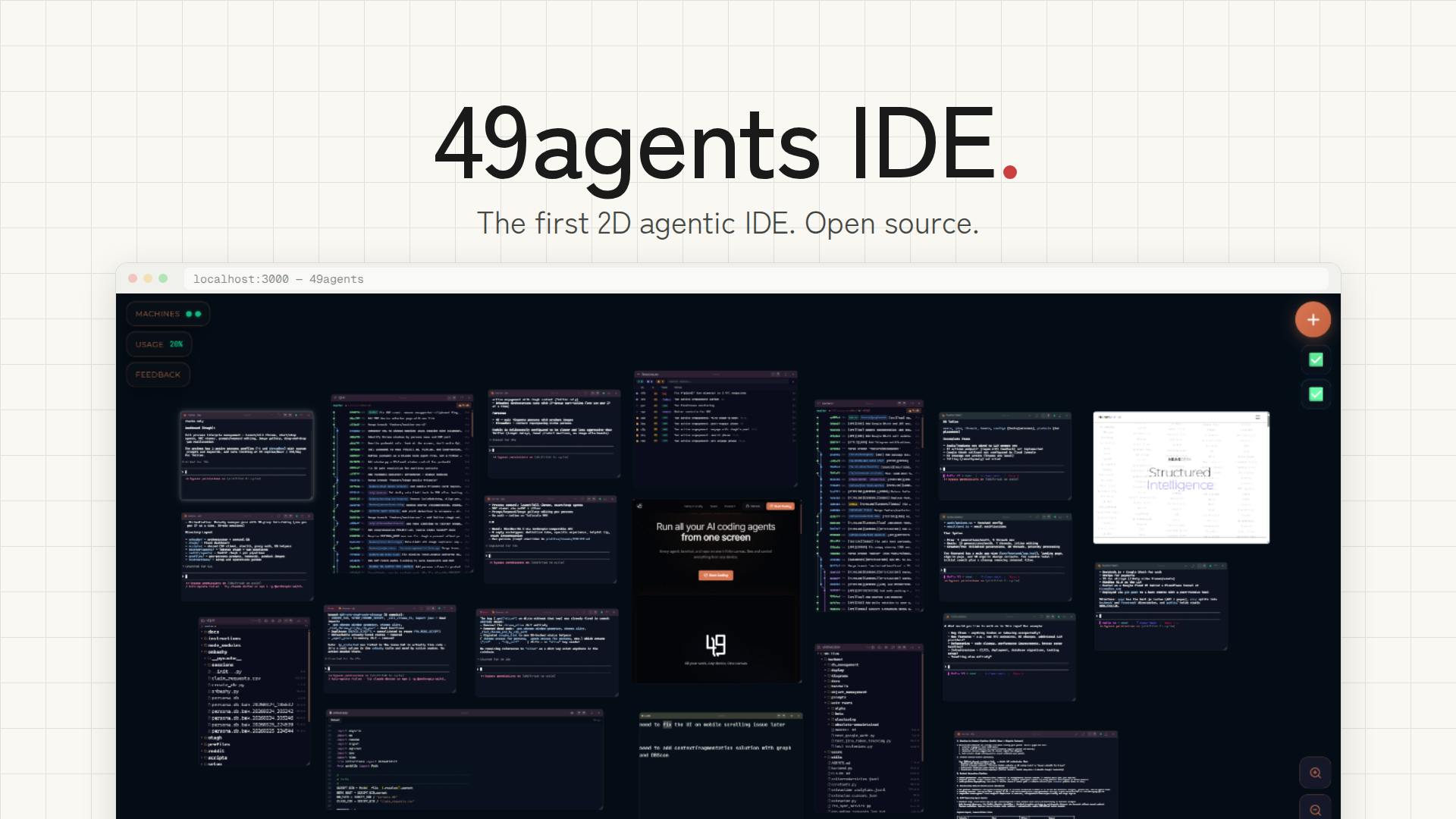
49agents IDE replaces traditional tabs with a 2D spatial canvas, solving cognitive overload in multi-project development through spatial memory and AI Agent management.