Google Account Banned for Using Gemini?
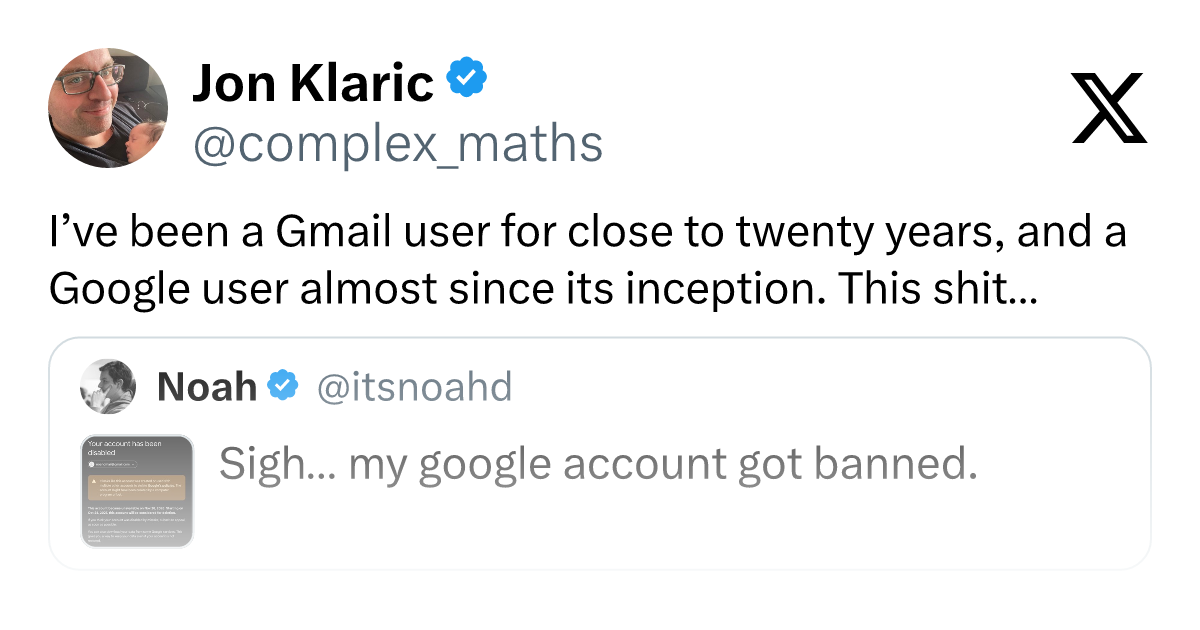
A Hacker News user reports a Google account banned for using Gemini; the exact reason remains unclear.
A user posted on Hacker News claiming their Google account was banned for using Gemini. The post received only 8 points and zero comments, sparking no discussion. Due to the lack of details, the exact cause cannot be confirmed. The article analyzes three possibilities: triggering abuse detection (e.g., mass API calls or automation scripts), violating Gemini's terms of use, and false positives or system malfunctions in risk control. It notes that relying on a single platform account carries risks and advises developers to diversify risk, avoid binding important data to one account, read usage policies carefully before use—especially clauses on automated invocation—and understand the appeal process. Overall, the incident offers limited information but reminds developers who heavily use the Google ecosystem to prioritize account security.
A user posted on Hacker News claiming their Google account was banned because of Gemini usage. The post title gets straight to the point: "Google account banned due to Gemini usage." The post received 8 points and zero comments, and did not spark widespread discussion.
Event Overview
According to information on Hacker News, a user reported that their Google account was banned after using Gemini. Since the original post provided no further details, the specific reason for the ban cannot currently be confirmed.
Gemini is a series of multimodal large language models released by Google, offered through both the Gemini web app and an API. It is worth noting that the Google account system is a unified identity credential linking Gmail, Drive, Photos, YouTube, Colab, and other services. Once an account is disabled, the user simultaneously loses access to all of the above services, not just Gemini itself. This differs greatly in scope from a simple API project ban, which is also why such incidents attract attention. Google's account penalties are typically based on the Google Terms of Service and the usage policies of each product. Disablement decisions are generally communicated via email and come with an appeal channel.
Possible Causes and Interpretations
There may be several scenarios behind this:
- Triggering abuse detection mechanisms: If a user makes a large number of Gemini API calls in a short period, or uses automated scripts, Google's risk control system may flag this as anomalous behavior and restrict the account.
- Violating the terms of use: Gemini's usage policy imposes restrictions on certain content generation and invocation scenarios. If a user crosses a line without knowing it, they may also face account penalties.
- False positive or system malfunction: Automated risk control inevitably produces false positives, and some legitimate usage may be incorrectly flagged.
Without more context, it is difficult to determine which cause applies. But this incident reminds us that relying on a single platform account carries certain risks.
"Abuse detection" in risk control systems is typically based on rate limits, behavioral patterns, and account association signals. Taking the Gemini API as an example, the free tier has quotas for requests per minute (RPM) and requests per day (RPD). Exceeding them should return a 429 error rather than directly banning the account; however, if the system detects multi-account rotation, proxy IPs used to circumvent quotas, bulk registration, or obvious automated scraping behavior, it may escalate to account-level penalties. In addition, sharing API keys, hardcoding keys into public repositories, or reselling access through unofficial channels are all common triggers. It is important to distinguish between "quota exceeded" and "policy violation": the former is technical rate limiting, while only the latter may involve disabling an account.
Implications for Developers
For developers who make deep use of the Google ecosystem (Gmail, Drive, Colab, Gemini API, etc.), account security is critical. The following measures are recommended:
- Diversify risk: Do not bind important data and services entirely to one account; consider using multiple accounts or backup solutions.
- Pay attention to terms of use: Before using AI services such as Gemini, carefully read the relevant usage policies, especially clauses about automated invocation and data usage.
- Keep appeal channels available: Understand the appeal process after an account ban so you can address issues promptly.
Multi-account strategies require attention to compliance boundaries in practice: bulk registration or account rotation to circumvent quotas may itself be judged as a terms violation, which instead increases risk. A safer approach is to use Google Cloud projects to isolate different applications, bind API calls to independent service accounts rather than your personal primary account, and set budget alerts and quota limits through the Cloud Console. At the same time, enable manual export for critical data or use Google Takeout for regular backups to avoid single points of failure. Enterprise users may also consider setting more granular access policies through the Workspace admin console.
Conclusion
At present, the information available on this incident is limited, and there has been no extended discussion on Hacker News. We will continue to follow further developments. If you have had a similar experience, feel free to share.
Related articles
GTA VI's Instagram Clone: A Time Waster That's Worth Trying
*GTA VI* includes an Instagram-like social app dubbed "a time waster but worth it." This article explores how it enhances immersion, satirizes social media, and appeals to players tired of real-world socializing.
5.0 Magnitude Earthquake Near Manhattan Beach: USGS Quick Report and HN Buzz
USGS quick report: 5.0 magnitude earthquake ~5 km SW of Manhattan Beach, CA. HN post gets 200 points, 134 comments. Key takeaways and how to read quake reports.

Cyber Monday Early Deals: Tech Offers Worth Watching
Cyber Monday deals start early as Black Friday discounts continue. We outline tech deal trends and shopping strategies to help you buy wisely this season.