Google AI Overviews' Medical Information Accuracy Is Concerning: Both Citation Quality and Grounding Fall Short

Study finds Google AI Overviews skew toward commercial sources on health questions, with weak grounding and poor completeness.
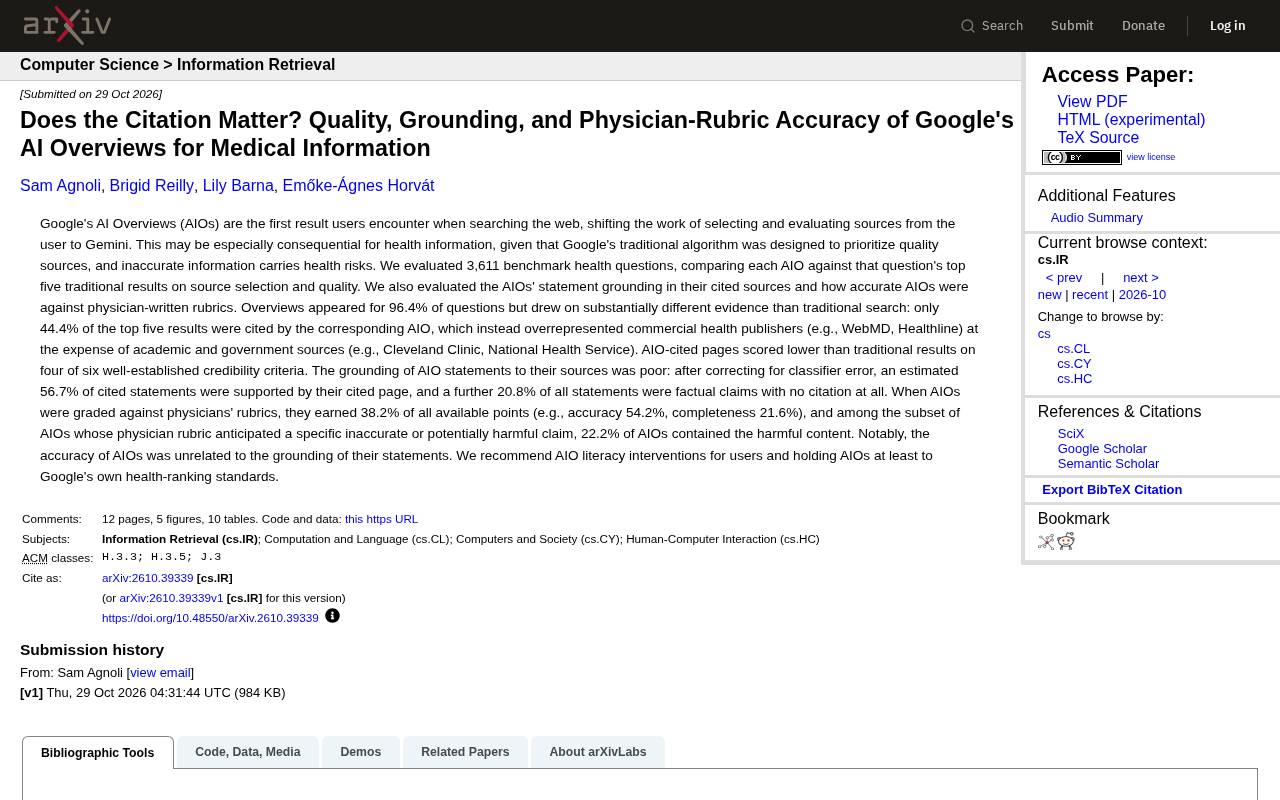
A study of 3,611 benchmark health questions found that Google AI Overviews triggered on 96.4% of queries but cited only 44.4% of top-five traditional results, over-representing commercial health media like WebMD and Healthline while sidelining sources like Cleveland Clinic and the NHS. Cited pages scored lower on four of six credibility criteria; only 56.7% of cited statements were supported by sources, and 20.8% of factual statements had no citation. Against physician rubrics, AIO scored just 38.2%, with 54.2% accuracy and 21.6% completeness. Most counterintuitively, accuracy and grounding were unrelated.
Google's AI Overviews (AIO) are becoming the first answer users see when searching, shifting the work of filtering and evaluating sources from the user to the Gemini model. In a field like healthcare, where information accuracy is highly sensitive, the implications of this shift deserve particular scrutiny. A systematic evaluation of 3,611 benchmark health questions compared AIO against the top five traditional search results for the same questions, and the conclusions are less than reassuring: AIO not only tends to cite commercial health media rather than authoritative academic and government institutions, but the "grounding" between its statements and the sources it cites is also quite weak—and, surprisingly, this lack of grounding has no correlation with AIO's own accuracy.
Study Design and Scope
The study selected 3,611 benchmark health questions as its test set, examining two subjects for each question: first, the top five results returned by Google's traditional search, and second, the AI Overview triggered by the same question. Evaluation dimensions included source selection and quality, the grounding of AIO statements within their cited sources, and the accuracy of AIO against physician-written rubrics.
AIO's trigger rate is extremely high—overviews appeared for 96.4% of questions. This means that for the vast majority of health-related queries, the first screen of content is already generated and organized by Gemini, and users receive the AI's summary before encountering traditional blue links. This coverage rate is the premise for understanding all subsequent issues: AIO is not a marginal feature but the primary entry point for accessing health information.
Benchmark health questions typically refer to a set of questions selected from authoritative medical Q&A datasets or common clinical questions that have standard answers or can be evaluated against a reference. Such benchmark sets are designed so that different systems can be tested reproducibly on the same questions, avoiding the bias introduced by researchers selecting their own topics. The 3,611 questions used in this study cover multiple health categories including symptoms, treatments, medications, and prevention, and each question has a physician-written rubric as the gold standard, allowing evaluation of both answer accuracy and completeness. The existence of the benchmark set ensures that the comparison between AIO and traditional search is based on the same questions rather than each side picking favorable cases—this is a key methodological premise of the study.
Source Selection: Commercial Media Crowding Out Authoritative Institutions
The most direct finding is that the evidence underlying AIO differs substantially from traditional search. Only 44.4% of the top five traditional search results were cited by the corresponding AIO. Instead, AIO clearly over-represents commercial health publishers such as WebMD and Healthline, while academic and government sources—such as Cleveland Clinic and the UK's National Health Service (NHS)—are relatively sidelined.
This bias contrasts with the original design intent of Google's traditional algorithm. Traditional ranking algorithms were designed to prioritize high-quality sources, and AIO's source reorganization in a sense bypasses this quality mechanism. When users read AI summaries directly on the search results page, they no longer see the ordering of original sources, and thus lose the implicit "credibility ranking" cue that existed in traditional search.
Cited Page Quality: Behind on Four of Six Criteria
The study further measured the quality of AIO-cited pages using six established credibility criteria, and found that AIO-cited pages scored lower than traditional search results on four of the six. In other words, AIO didn't just swap in a different set of sources—the replacement sources are also lower in overall quality.
This is particularly critical for health information. Commercial health media have advantages in readability and coverage, but often fall short of academic medical institutions and government health departments in dimensions such as evidence traceability, update transparency, and professional review. This drift in source structure may expose users to health advice that appears professional but actually rests on a weaker evidence base.
Weak Grounding: Over Half of Cited Statements Lack Source Support
If source quality is a question of "who was chosen," grounding is a question of "do what's said and what's cited actually match." The study used a classifier to evaluate the consistency between AIO statements and their cited sources, and after correcting for classifier error, concluded that an estimated only 56.7% of cited statements were supported by the cited pages. Another 20.8% of all statements were factual assertions with no citation at all.
This means that even when AIO provides a citation link, users cannot assume that the link actually supports that statement. A considerable portion of content is in a state of "citation in name but not in substance," and another one-fifth of factual statements have no citation at all. For medical information that requires rigorous traceability, this grounding gap is a real risk.
Grounding is a core concept in evaluating generative AI systems, referring to whether each factual statement in a model's output can be explicitly supported in the sources it cites. A "well-grounded" answer means that when a reader clicks the citation link, they can directly see the original text supporting that statement; "weak grounding" may involve a cited page that is related to the statement's topic but does not contain that specific assertion. Grounding is different from accuracy: accuracy measures whether the answer is correct, while grounding measures whether the answer has a source and whether the source actually supports it. The study used a classifier to judge the consistency between statements and cited sources and corrected for the classifier's own error rate, precisely to distinguish "having a citation" from "having an effective citation."
Physician Scoring: Accuracy Above Half, Completeness Severely Lacking
The study scored AIO using physician-written rubrics, and AIO received only 38.2% of all available points. Breaking it down, accuracy was 54.2% and completeness only 21.6%. The low completeness score indicates that AIO tends to give brief, conclusion-style answers, whereas health questions often require context such as preconditions, applicable populations, and risk warnings—elements that are easily omitted in a compressed overview.
More concerning is the proportion of harmful content. Among the subset of AIOs where the physician rubric expected a specific inaccurate or potentially harmful statement, 22.2% of AIOs did indeed contain that harmful content. In other words, when the question itself contains a "trap" that is easy to get wrong, AIO fell into it in more than one-fifth of cases.
Physician-written rubrics are scoring standards pre-defined by clinicians for each benchmark question, typically listing the key information points that must be covered for that question, common errors, and potentially harmful statements. During evaluation, researchers score the AIO's answer item by item against the rubric, rather than having a single physician give an overall impression-based evaluation. The advantage of this method is that it is reproducible and decomposable: the accuracy score reflects the ratio of correct to incorrect information in the answer, and the completeness score reflects how many of the rubric's required key points the answer covered. The rubric also flags certain questions as "expected to be prone to a specific inaccurate or harmful statement," allowing the study to separately tally AIO's performance on "trap questions."
A Counterintuitive Finding: Accuracy Is Unrelated to Grounding
The most intriguing point in the study is that there is no association between AIO's accuracy and the grounding of its statements. This result overturns an intuitive assumption—that the more reliable the cited source and the better the citation matches the statement, the more accurate the answer will be. In reality, AIO may cite unsupportive sources yet give a correct answer, or cite seemingly relevant sources yet reach an incorrect conclusion.
This finding has direct implications for product improvement: simply improving citation display or citation coverage may not improve answer quality. Grounding and accuracy are more like two dimensions that need to be optimized separately, rather than two sides of the same problem.
Recommendations and Implications
The researchers offer two recommendations. First, conduct AIO literacy interventions for users to help them understand the source selection logic and limitations of AI Overviews, and to treat overviews as a starting point rather than an endpoint. Second, require AIO to meet at least Google's own ranking standards for health information—since traditional search has a quality control mechanism, there is no reason AI Overviews should not be subject to the same constraints.
For ordinary users, a practical approach is: when seeing health advice in an AIO, proactively click the citation links to verify the original text, and pay particular attention to factual statements that have no citations. For product teams, this study suggests that source structure, grounding verification, and completeness of expression are three independent directions for improvement, not something that can be solved with a single adjustment.
One-line Summary
Study shows Google AI Overviews skew toward commercial media on health questions, with weak grounding and poor completeness; accuracy is unrelated to grounding.
Paragraph Summary
A systematic evaluation of 3,611 benchmark health questions compared Google AI Overviews (AIO) with the top five traditional search results. AIO triggered on 96.4% of questions but cited only 44.4% of the top five traditional search results, over-representing commercial health media such as WebMD and Healthline while sidelining academic and government sources like Cleveland Clinic and the NHS. AIO-cited pages scored lower on four of six credibility criteria; after correcting for error, only 56.7% of cited statements were supported by their sources, and 20.8% of factual statements had no citation at all. Against physician rubrics, AIO scored only 38.2%, with accuracy at 54.2% and completeness at 21.6%, and in the subset expected to contain harmful content, 22.2% did indeed contain harmful content. The most counterintuitive finding is that there is no association between accuracy and grounding, suggesting that citation coverage and answer quality need to be optimized separately.
Related articles

Cursor AI in Practice: Weighing Efficiency Gains Against Costs in an AI IDE
An in-depth look at Cursor AI IDE's interface layout, four modes (Agent/Plan/Debug/Ask), model selection, and Git context integration, with hands-on demos weighing subscription costs against going direct to Claude.

Free Landing Page Design Rules Library: A Practical Guide for Claude Code and Cursor
A free landing page design skill for Claude Code and Cursor: MIT licensed, nearly 9,000 stars, asks about offer/audience/action before planning 12 sections with hard font and spacing constraints.

Cursor Keeps Writing Wrong Code? The Problem May Be Context, Not Prompts
Cursor keeps writing wrong code? The problem may be context, not prompts. Learn how to supply relevant files, full error messages, and expected results, plus a plan-first, small-step, test-driven workflow to reduce AI coding errors—while remembering code review remains the developer's job.