Google AI Search Connects Drive and Wallet, Taking Personalization a Step Further

Google AI Mode connects Drive and Wallet, turning personalization into an ecosystem moat for AI search.
Google brings Personal Intelligence into Search's AI Mode and rolls it out in the Gemini app, letting search call on documents in Google Drive and personal data like tickets and cards in Google Wallet to give context-aware answers. This marks AI search shifting from generic answer quality to answer ownership: Drive provides content-type data and Wallet transactional data, together extending scenarios from looking up information to getting things done. The integrate-once, use-everywhere strategy strengthens Google's product synergy but amplifies privacy concerns over permission granularity, data retention, and misreading personal info, shifting competition from models to ecosystems.
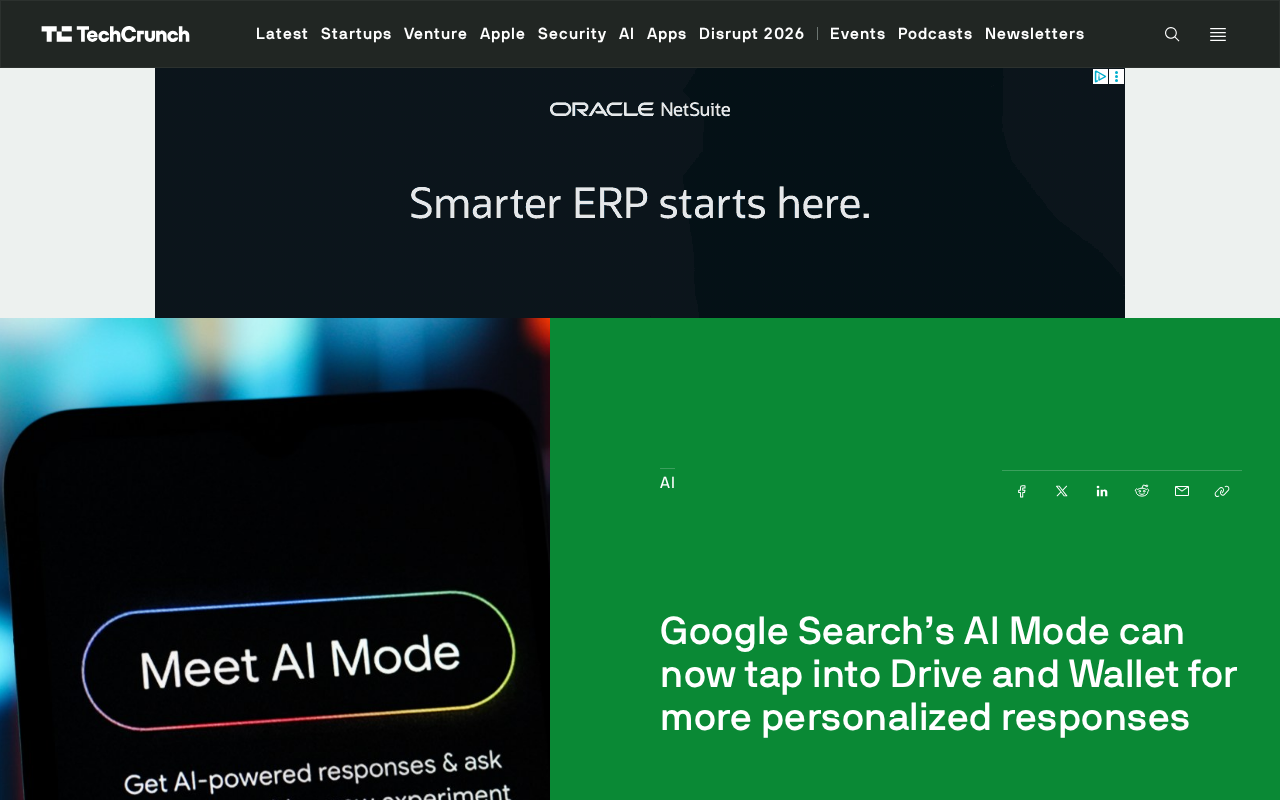
Google is turning "personalization" into its AI search moat. The latest development: Google Search's AI Mode now connects to Google Drive and Google Wallet, letting users directly pull in their personal cloud files and wallet information from the search box to get answers better tailored to their own context. Google categorizes this capability under "Personal Intelligence in AI Mode" and has extended it to the Gemini app as well.
From "generic answers" to "your answers"
Over the past year, competition in AI search has centered on answer quality and response speed, with results from various products looking largely similar. Google's latest move points to a different dimension: the sense of "ownership" in answers. By bringing Personal Intelligence into AI Mode, Google makes search no longer rely solely on public web pages but instead incorporate documents and spreadsheets users have already stored in Drive, along with tickets, cards, and other information in Wallet, into the context. In other words, AI Mode begins to answer "based on my files, how should I handle this" rather than just "how is this usually handled."
The significance of this shift is that, for the first time, a search engine systematically treats "personal data" as raw material for retrieval and reasoning. This is precisely where Google's advantage lies—Drive and Wallet are already the infrastructure for daily storage and payments for a huge number of users, the data is already within the ecosystem, and the cost of integration is far lower than asking users to re-upload or authorize third-party services.
AI Mode is the conversational search experience Google has rolled out in Search, where users can pose more complex, multi-turn questions in natural language, and the Gemini model generates integrated answers rather than returning ten blue links. It coexists with traditional search in the Search interface, positioned to handle open-ended queries that require reasoning. Personal Intelligence is Google's extended name for this capability, whose core is letting the model read personal data as context under user authorization, so that answers are based on the user's own files and transactional information rather than relying solely on public web pages. Understanding these two concepts helps grasp that the "personalization" discussed in this article is not personalization at the level of recommendation ranking, but personalization at the level of reasoning input.
What roles Drive and Wallet each play
The integration logic of the two data sources is not the same. Drive leans toward "content-type personal data": documents, notes, contracts, and spreadsheets stored by users can all serve as the basis for AI Mode's reasoning, suitable for tasks like "help me summarize last quarter's project records" or "find the renewal clause in the contract." Wallet leans toward "transactional personal data": receipts, orders, cards, and other information can help AI Mode answer questions related to spending, travel, and credentials.
Together, AI Mode can cover scenarios extending from "looking up information" to "getting things done." This is also the point Google emphasizes in its official statements: leveraging the wealth of user data already within the ecosystem rather than building a new personal data entry point from scratch.
Google Wallet is Google's digital wallet app, mainly used to store payment cards, transit cards, event tickets, boarding passes, membership cards, and other credential-type information, and is deeply tied to Android devices and the Google account system. Unlike a simple payment tool, it is closer to a "credential aggregator," so its data naturally carries time, location, and transaction attributes. Google Drive is Google's cloud storage and office suite foundation, hosting documents, spreadsheets, slides, and PDFs. The difference in data form between the two—one leaning toward structured transactional credentials, the other toward unstructured document content—determines that AI Mode needs to adopt different parsing and retrieval strategies after integration, and also explains why their combination can cover a continuous range of scenarios from "looking up information" to "getting things done."
Simultaneous rollout in the Gemini app
Personal Intelligence does not only serve search. Google has also brought this capability to the Gemini app, meaning the same set of personal data context can be reused across the two entry points of search and conversation. For users, this reduces the cost of repeatedly describing needs across different products; for Google, it allows AI capabilities to form synergy within its own product matrix rather than each fighting separately.
This "integrate once, use across multiple endpoints" strategy also explains why Google chose Drive and Wallet as the first targets for deep integration—they are both high-frequency and naturally tied to the Google account system, enabling quick validation of the practical value of personalized AI.
The boundaries and concerns of personalized search
The higher the degree of personalization, the harder it is to avoid privacy and permission issues. Letting AI read Drive files and Wallet information essentially expands the range of data the model can reach. Google packages this capability as "Personal Intelligence," emphasizing active user authorization and contextual use, but in actual experience, permission granularity, data retention, and the risk of AI misreading personal information still require clear answers at the product level.
Another point worth watching is the competitive landscape. When search answers begin to depend on personal data, latecomers trying to replicate this experience need not only model capabilities but also personal data entry points of comparable scale. This shifts competition in AI search partly from "model comparison" to "ecosystem comparison," and Google clearly hopes to pull this competition onto a battlefield where it excels.
Permission granularity refers to how finely users can control the scope when authorizing third parties or AI to access personal data—for example, whether to authorize the entire Drive or only a specific folder, or whether to allow reading only or also writing. The finer the granularity, the stronger users' sense of control over data exposure, but the more cumbersome the authorization process. In AI search scenarios, permission granularity directly affects whether the model can call personal data within the minimum necessary scope. Related to this is the data retention issue: when the model processes personal files, whether the content is used for training, how long it is retained on servers, and whether users can audit and delete it are all key indicators of privacy compliance. The design quality of these mechanisms often determines user trust more than "whether personal data is integrated" itself.
Conclusion
AI Mode's integration with Drive and Wallet is a step by Google to turn personalization from a feature selling point into infrastructure. It may not immediately change users' search habits, but it sets a clear direction: future search answers will be composed of public knowledge and personal data together. For users, the trade-off between convenience and privacy will be amplified simultaneously; for the industry, the moat of AI search is shifting from models to ecosystems.
One-line Summary
Google AI Mode connects Drive and Wallet, turning personalization into an ecosystem moat for AI search.
Paragraph Summary
Google brings Personal Intelligence into Search's AI Mode and simultaneously rolls it out in the Gemini app, enabling search to call on documents in users' Google Drive and personal data such as tickets and cards in Google Wallet to deliver answers tailored to their own context. The article notes that this marks a shift in AI search from competing on generic answer quality to the "sense of ownership" of answers. Drive leans toward content-type data and Wallet toward transactional data; together they extend scenarios from looking up information to getting things done. The "integrate once, use across multiple endpoints" strategy strengthens synergy across Google's product matrix but also amplifies privacy concerns around permission granularity, data retention, and misreading personal information. The competitive focus thus shifts partly from model capability to ecosystem integration, making it hard for latecomers to replicate personal data entry points of comparable scale.
Related articles

Nothing CMF Buds 2A Drops to $17.89 on Black Friday: A New Low for ANC Earbuds
Nothing CMF Buds 2A wireless earbuds Black Friday deal: just $17.89 on Amazon, about $11 off retail and a record low. ANC earbuds at an entry-level price.

When AI Creation Gets Accused of "Spitting": Hacker News Heats Up Over the Glaude Controversy
A Hacker News post, "Spitting in the Face of Glaude," sparks debate on AI creation transparency and attribution ethics. This analysis examines the blurred creator identity behind the controversy and offers practical advice for AI content production.

Akai Embraces Custom Firmware: MPC Sample 1.4 Lets Users AI-Program Their Sampler
Akai embraces the modding community with MPC Sample 1.4 firmware, supporting vibe-coded custom firmware and effects. We analyze the impact of this open strategy on music hardware and AI-assisted programming.