Google and Xreal Launch Aura Glasses: 95g Lightweight Design at $1,099

Google and Xreal's Android XR glasses Aura launch at $1,099 with a 95g lightweight design and split architecture.
Google and Xreal's jointly developed Android XR glasses Aura are now on sale at $1,099, below prior market expectations. Weighing just 95 grams, the product uses an architecture of glasses plus a split compute module, offloading computing and cooling burdens to achieve wearing comfort, and supports multiple virtual screens for mobile productivity and immersive entertainment. The article argues that its competitive logic isn't spec-stacking but differentiating against Meta through lightweight form factor and Android XR platform openness—though actual display quality, multi-screen interaction, and battery life haven't been disclosed, and platform ecosystem maturity and cable-induced mobility limits remain open questions. Overall, it marks Android XR's transition from platform concept to concrete hardware.
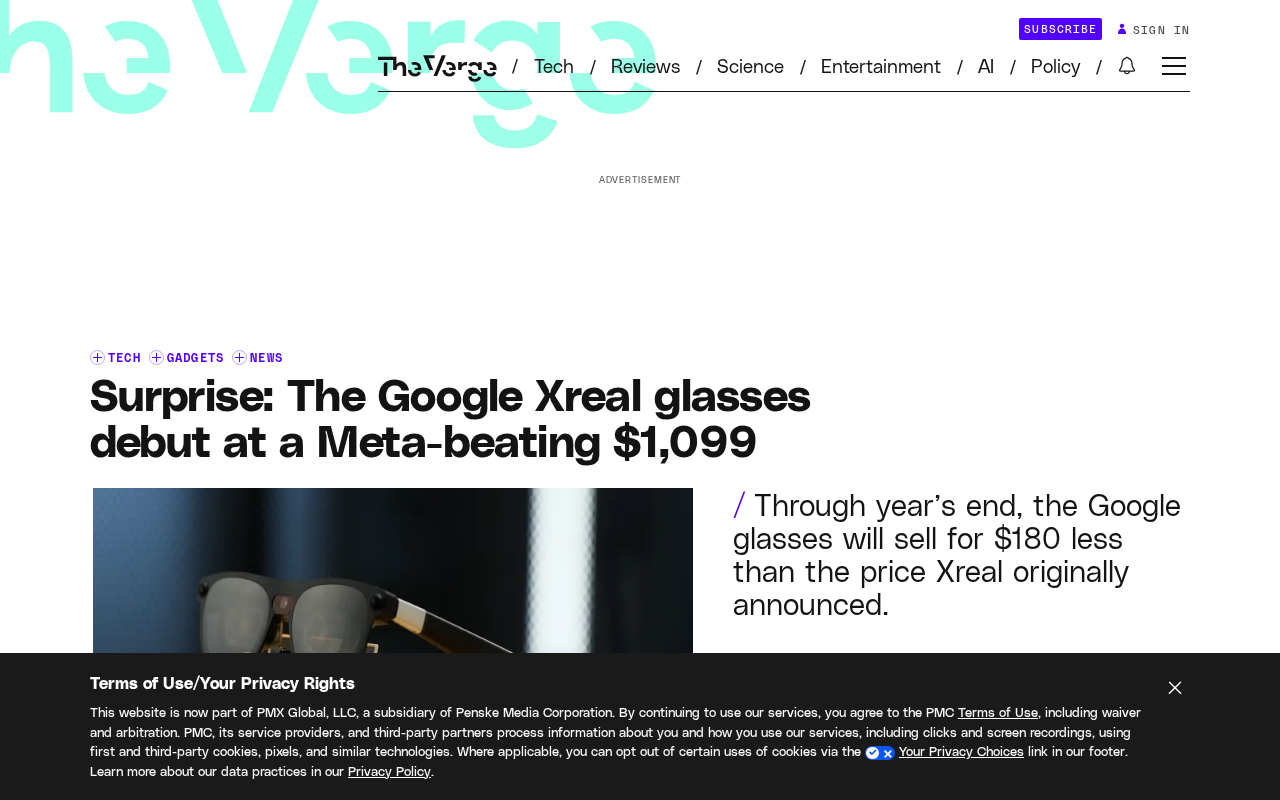
Google and Xreal's jointly developed Android XR glasses, Aura, are now officially on sale at $1,099. That's lower than previously expected—and in an environment where consumer electronics are broadly getting more expensive, a product dropping in price before launch is itself a telling signal.
Product Positioning: A Lightweight Android XR Solution
Aura keeps its weight at 95 grams, a figure that puts it among the lightweight contenders in its XR category. It uses a split design: the glasses themselves handle display and sensing, while computing tasks are offloaded to an Android XR compute puck connected via a cable. This architecture lets the glasses end slim down while the external module delivers the full Android XR experience.
The device supports multiple virtual screens, meaning users can open several application windows simultaneously in their field of view, targeting mobile productivity and immersive entertainment scenarios. Compared with all-in-one headsets, the split approach trades off between wearing comfort and battery life, and the 95-gram weight shows Xreal made targeted optimizations to the optical modules and structural design.
Android XR is the extended reality operating system platform led by Google, officially released in late 2024 and positioned similarly to Android on phones—an open platform for headsets and glasses. Its core idea is to reuse Android's existing app ecosystem and developer tools so existing apps can adapt to XR scenarios at low cost, while Google provides underlying rendering, spatial tracking, and multi-window management. Unlike Meta's Horizon OS, which follows a self-built closed-loop path, Android XR emphasizes open collaboration, with hardware brought to market by manufacturers like Samsung and Xreal. The maturity of this platform directly determines how many native XR apps Aura can call upon, and it's also a key variable in competing with Meta's ecosystem.
Split computing (compute puck) is an architectural approach widely adopted by lightweight XR glasses in recent years: stripping the battery, SoC, cooling, and other weight and heat culprits out of the glasses body and into an external module connected by cable. The benefit is that the glasses end only needs to retain the display optical engine, sensors, and a small amount of driver circuitry, pressing weight down to near that of ordinary glasses; the cost is that users must carry or place an extra module, with mobility limited by cable length. This approach is essentially a trade-off between "wearing comfort" and "complete wireless freedom," while all-in-one headsets like Apple Vision Pro chose the opposite path.
Multiple virtual screens on XR devices refers to presenting multiple independently placeable and scalable virtual display windows simultaneously in the user's field of view—like "carrying multiple monitors with you." The technical challenges lie in spatial anchoring (windows maintaining stable positions as the head moves), low-latency rendering, and input interaction across multiple windows (eye tracking, gestures, or external keyboard and mouse). Multi-screen capability is a core metric for judging whether an XR device can handle mobile productivity, but the actual experience depends heavily on the platform's multitasking scheduling and app adaptation.
Pricing Strategy: $1,099, Lower Than Expected
According to official information released by Xreal and Google, Aura is priced at $1,099 and officially goes on sale today. The original report used the word "surprise" to describe this pricing—the price dropped rather than rose before launch, contrasting with the current trend of electronics getting more expensive.
At $1,099, Aura sits in the upper-mid range of the XR market. Considering it runs on the Android XR platform and comes with an independent compute module and multi-screen display capability, the competitiveness of this pricing lies in the fact that users aren't buying a simple display accessory but a complete XR computing terminal. The "Meta-beating" reference in the report is also clear—at the same price point, Aura seeks to differentiate itself on portability and platform openness.
Competition with Meta
"Meta-beating" in the headline is a key clue to understanding this product. Meta has been in XR for a long time, with a product line covering multiple price points from entry-level to high-end. Aura enters at $1,099, combined with its 95-gram weight and the Android XR ecosystem; its competitive logic isn't about stacking specs but about form-factor differentiation: using a combination of lightweight glasses plus a compute module to avoid direct comparison with traditional headsets on size and weight.
However, public information is currently limited, and specific data on Aura's actual display quality, multi-screen interaction smoothness, and compute module battery life have not yet been disclosed. These dimensions will determine whether it can truly deliver on the "beating Meta" claim rather than remaining marketing talk at the pricing level.
Meta's product lineup in the XR market can be roughly divided into two lines: one is VR all-in-ones represented by the Quest series, focused on immersive gaming and content, with prices ranging from a few hundred dollars at entry level to high-end models; the other is smart glasses launched in partnership with Ray-Ban, focused on lightweight design and everyday wear but with limited display capability. The "lightweight glasses + full XR computing" segment where Aura sits falls precisely between the two, seeking to retain the comfort of glasses form factor while providing display and multitasking capability close to a headset. Only by understanding this product matrix can one see that the "Meta-beating" claim targets not a single competitor but Meta's overall coverage across different price points and form factors.
Several Questions Worth Watching
The maturity of the Android XR platform's app ecosystem is a key variable for Aura's long-term performance. The platform is led by Google and can theoretically draw on the Android app system, but the number of apps optimized for XR scenarios remains unknown.
The cable connection of the split design is also worth discussing. An external compute module solves weight and heat issues at the cost of freedom of movement during use—contrasting with product philosophies that pursue complete wireless freedom. Xreal's choice of this path suggests it judges that at the current stage, users are more sensitive to wearing comfort than tolerant of cables.
Whether the $1,099 price includes the compute module and whether there are different configuration versions were not clarified in the original information; before purchasing, refer to the complete specifications on official channels.
Overall, Aura's launch sends a clear signal: Android XR is moving from a platform concept to concrete hardware, and the combination of lightweight design and reasonable pricing is the Google camp's first card to play in establishing a foothold in the XR market.
One-line Summary
Google and Xreal's Android XR glasses Aura go on sale at $1,099, featuring a 95-gram lightweight design and split architecture.
Related articles

Will GitHub Die? Open Source Maintainer Burnout and the Collaboration Crisis in the AI Era
Lex Fridman podcast discussion on open source maintainer burnout and GitHub's predicament: massive pull requests overwhelm core maintainers, and AI worsens code bloat. Using math journal peer review and Poincaré conjecture verification as analogies, the article analyzes why verification in knowledge production must be deliberately slow, and how open source communities can avoid the failure mode of maintainers exiting.

Stop Building Cookie-Cutter AI Websites: 3 Tools That Transform Your Coding Agent
Three tools that boost AI coding agents: FFmpeg skill for local video editing in Claude Code and Cursor, Hallmark's 50 design themes to fix cookie-cutter AI sites, and Jailbreaks' 25+ model prompts.

How America's Gerontocracy Squeezes the Younger Generation
Americans over 55 hold nearly three-quarters of national wealth, alongside an 80-year-old president and elderly congressional leaders. The Atlantic's Idrees Kahloon explains how gerontocracy drives up housing costs, squeezes opportunities for the young, and explores zoning reform and child poverty reduction as practical fixes.