Google Co-Scientist Helps Discover Genetic Factors That Reverse Cellular Aging

Google's Co-Scientist AI tool helps scientists discover novel genetic factors that reverse human cellular aging
Biologists leveraged Google's AI tool Co-Scientist to successfully discover novel genetic factors capable of reversing human cellular aging through literature mining, candidate factor prioritization, and experimental design optimization. This validates a new research paradigm of 'AI-driven hypothesis generation + wet lab validation,' marking AI's evolution from data analysis tool to research collaborator in life sciences, with the potential to dramatically accelerate anti-aging drug development.
AI-Driven Anti-Aging Research Achieves a Key Breakthrough
Aging — a biological puzzle that has confounded humanity for thousands of years — is now being approached with entirely new solutions in the AI era. Recently, biologists leveraged Co-Scientist, an AI tool developed by Google, to successfully discover novel genetic factors capable of reversing human cellular aging, opening a fast track for anti-aging research.
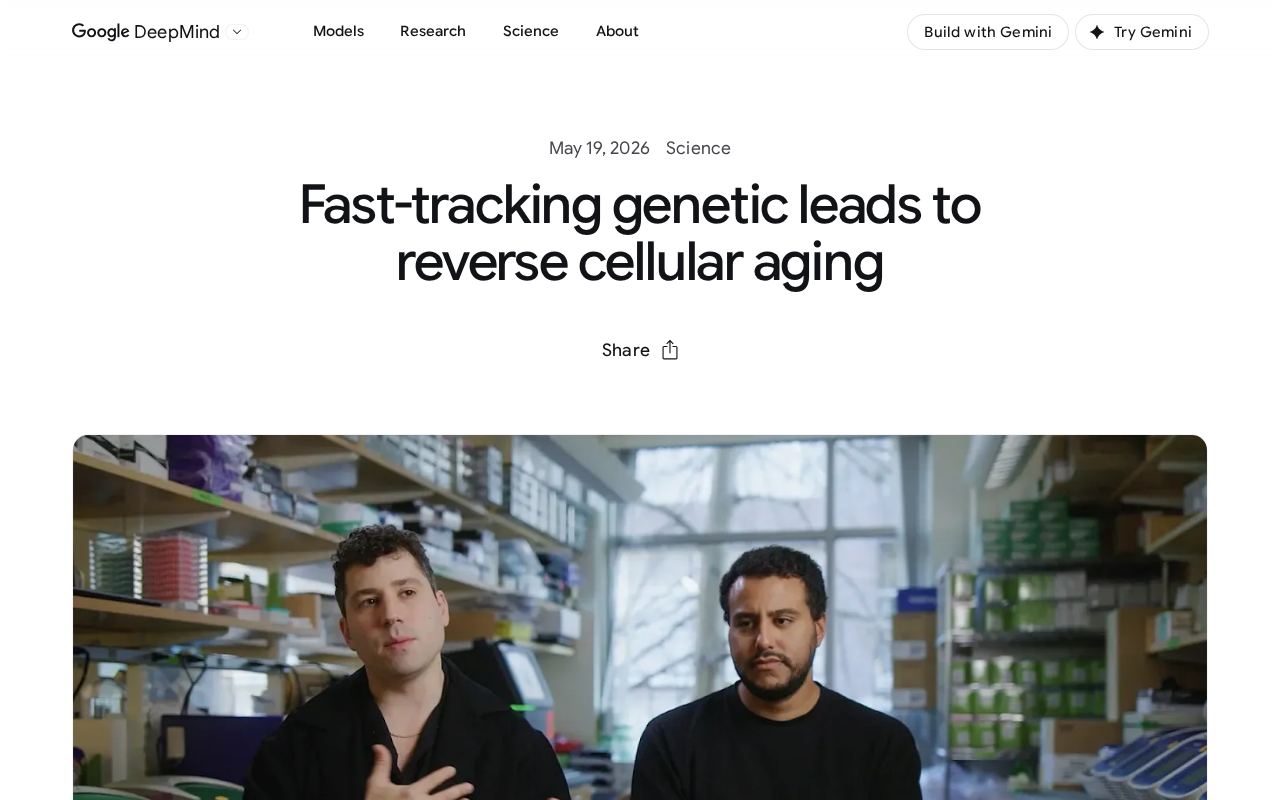
The core breakthrough of this research lies in the fact that AI is no longer just a tool for assisting data analysis — it has become a genuine participant in the generation and validation of scientific hypotheses, dramatically shortening the cycle from genetic clues to experimental verification.
What Is Google Co-Scientist? How Does It Assist Scientific Research?
Co-Scientist is an AI scientific research assistant launched by Google, specifically designed to accelerate scientific discovery. Built on Google's Gemini large language model, it employs a multi-agent framework that includes sub-agents dedicated to literature retrieval, hypothesis generation, critical evaluation, and experimental design. This architecture closely mirrors the collaborative division of labor in real research teams — different "role" agents challenge, supplement, and verify each other, completing literature synthesis and hypothesis screening in hours that would take human teams months. Unlike traditional literature search tools, Co-Scientist possesses the following core capabilities:
- Integrating massive biomedical literature to extract potential research leads
- Generating scientific hypotheses, proposing new directions that researchers may not have considered
- Evaluating experimental feasibility, helping researchers prioritize the most promising candidate factors
In this cellular aging reversal study, biologists used Co-Scientist to rapidly identify key gene targets associated with cellular rejuvenation from vast troves of genetic data — a process that could have taken months or even years using traditional methods.
Reversing Cellular Aging: From Mechanistic Understanding to Experimental Validation
Core Mechanisms of Cellular Aging
Cellular senescence refers to cells ceasing division and entering an irreversible state of growth arrest. Senescent cells don't quietly "retire" — instead, they continuously release dozens of pro-inflammatory cytokines, chemokines, and proteases into the surrounding microenvironment, forming what is known as the Senescence-Associated Secretory Phenotype (SASP). This chronic low-grade inflammatory state, termed "inflammaging" by researchers, is considered the common soil and a key driving factor for cardiovascular disease, neurodegenerative diseases, cancer, and virtually all age-related chronic conditions.
In recent years, the scientific community has shown growing interest in "cellular reprogramming" — restoring aged cells to a younger state. The discovery of Yamanaka factors proved that cell fate can be reversed: Japanese scientist Shinya Yamanaka discovered in 2006 that introducing four transcription factors — Oct4, Sox2, Klf4, and c-Myc (collectively known as OSKM) — into somatic cells could reprogram them into induced pluripotent stem cells (iPSCs), an achievement that earned him the 2012 Nobel Prize in Physiology or Medicine. However, the OSKM combination carries significant cancer risk in anti-aging applications, making the search for safer, more precise alternative reprogramming factors the most critical bottleneck challenge in the field.
How Co-Scientist Accelerated Genetic Factor Discovery
The research team's core challenge was finding factors that could effectively reverse cellular aging from among tens of thousands of potential gene targets. Traditional screening methods rely on large-scale laboratory experiments that are expensive and extremely time-consuming.
Co-Scientist's involvement fundamentally changed this landscape. The AI system accelerated the research process through the following steps:
- Literature mining and knowledge graph construction: Systematically analyzing existing research in aging biology, epigenetics, and cellular reprogramming
- Candidate factor prioritization: Intelligently ranking potential genetic factors based on multi-dimensional assessment
- Experimental design optimization suggestions: Providing researchers with optimal validation strategies to reduce trial-and-error costs
Ultimately, the research team conducted experimental validation based on Co-Scientist's recommendations and successfully confirmed that novel genetic factors could effectively restore youthful characteristics to human cells. These factors had not previously been a focus of mainstream research, fully demonstrating AI's unique value in uncovering scientific "blind spots."
Research Significance: AI Reshaping the Anti-Aging Research Paradigm
Driving Anti-Aging Drug Development
The significance of this research extends far beyond discovering a few new gene targets. It validates an entirely new research paradigm: a closed-loop model of AI-driven hypothesis generation + wet lab experimental validation. Wet lab experiments refer to physical chemistry and biology experiments conducted in real biological systems — including cell culture, gene editing, protein detection, and more — as opposed to computational "dry" experiments. No matter how elegant an AI-generated hypothesis may be, it must ultimately undergo rigorous wet lab validation, because the complexity of biological systems far exceeds the descriptive capacity of any existing computational model. It is precisely this closed loop of "AI rapidly narrowing the search space, wet experiments precisely locking in answers" that constitutes the most promising research acceleration paradigm today, with the potential for the following far-reaching impacts:
- Reducing research costs: Minimizing ineffective experiments and concentrating resources on the most promising directions
- Accelerating anti-aging drug development: Potentially shortening the time from target discovery to preclinical validation by several fold
- Breaking through cognitive limitations: AI can discover genetic clues that human researchers overlook due to cognitive biases
The Upgraded Role of AI in Life Sciences
From AlphaFold predicting protein structures to Co-Scientist assisting in the discovery of genetic factors that reverse cellular aging, AI's role in life sciences is evolving from "data analysis tool" to "research collaborator." This evolutionary trajectory deserves deeper understanding: AlphaFold2, released by DeepMind in 2020, predicted protein 3D structures with near-experimental accuracy, solving the "protein folding problem" that had puzzled structural biology for 50 years. It publicly released over 200 million protein structures and was named Science's 2021 Breakthrough of the Year — marking the first time AI achieved a decisive breakthrough on a core fundamental problem in life sciences. Co-Scientist represents a further leap in AI capabilities: from "answering known questions" to "posing new questions and generating new hypotheses." This shift means that future biological breakthroughs will increasingly depend on deep human-machine collaboration.
However, it's worth emphasizing that AI currently still plays an assistive role — final experimental validation and scientific judgment still require human scientists. Co-Scientist's core value lies in dramatically improving the efficiency of the "data-to-hypothesis" stage, rather than replacing the entire research process.
Outlook: Future Pathways for AI-Accelerated Anti-Aging Research
This research paints an exciting picture: with the power of AI, humanity may achieve a much deeper understanding of aging mechanisms within the next decade and develop truly effective anti-aging interventions.
From cellular rejuvenation in the laboratory to clinically viable anti-aging therapies, numerous challenges remain — safety assessment, long-term efficacy validation, and ethical review are all indispensable steps. But there is no doubt that AI is making this path shorter and clearer.
In the race of scientific discovery, speed often means everything. The successful application of Google Co-Scientist demonstrates that AI can not only accelerate the resolution of known problems but also help scientists ask the right questions — and this may be the most critical step in advancing anti-aging research and life sciences as a whole.
Key Takeaways
- Biologists used Google's Co-Scientist tool to successfully discover novel genetic factors capable of reversing human cellular aging
- Co-Scientist dramatically shortened the cycle from genetic clues to experimental validation through literature mining, candidate factor ranking, and experimental design suggestions
- The research validates a new paradigm of 'AI-driven hypothesis generation + wet lab validation,' with the potential to reduce research costs and accelerate drug development
- AI's role in life sciences is evolving from data analysis tool to research collaborator, though final validation still requires human scientists
- This breakthrough lays an important foundation for developing clinically viable anti-aging interventions in the future
Related articles
New Species Discovered in New York's C…
New Species Discovered in New York's Central Park? Inside the Urban Insect Hunting Project
Scientists set up insect traps in NYC's Central Park and Prospect Park to discover unknown species. With 90% of Earth's species still unnamed, urban biodiversity research is becoming a new trend in ecology.
The Full Story of the Higgs Boson Disc…
The Full Story of the Higgs Boson Discovery: An Insider's Account of the 'God Particle'
A Fermilab physicist's insider account of the Higgs boson discovery: the transatlantic race with CERN, behind-the-scenes details of the 2012 announcement, 14 years of verification, and the true origin of the 'God Particle' name.
 Research
SciMDR: How a 7B Small Model Rivals GPT-5 in Scientific Reasoning
Yale and other institutions introduce SciMDR, a two-stage data synthesis pipeline enabling a 7B model to match GPT-5 level performance in scientific literature comprehension.