Google DeepMind May Have Achieved RSI Recursive Self-Improvement — A Potential Turning Point for AI

Google may have achieved AI recursive self-improvement while Kimi K2.8 and Astra updates reshape the frontier model race.
Several major developments are reshaping the AI industry. Google DeepMind is rumored to have achieved Recursive Self-Improvement (RSI), potentially enabling AI to autonomously train the next generation of AI — which could dramatically accelerate Gemini 4's capabilities. Moonshot AI surprised the community with Kimi K2.8, matching K3 performance while addressing the overthinking problem with multi-tier reasoning modes and 1M token context. Meanwhile, OpenAI's GPT-6 Astra faced a "capability regression" controversy traced to misconfigured inference engines and legacy skill conflicts — fixed within 36 hours, with a full week of quota restored for all paid users.
The AI landscape has been buzzing with a string of major developments recently, pushing the industry toward a new inflection point. Google is rumored to have achieved Recursive Self-Improvement (RSI), Moonshot AI quietly dropped a preview of Kimi K2.8, and OpenAI's GPT-6 Astra went through a brief but turbulent "capability regression" controversy. Taken together, these events suggest the frontier model race is entering a more nuanced — and more consequential — phase.
A note of caution: much of what's covered here is based on leaks and community analysis, not official confirmations. Readers should exercise their own judgment.
Google DeepMind May Have Achieved RSI — Potentially the Biggest Technical Inflection Point Yet
According to credible leakers, Google DeepMind may have formally achieved RSI (Recursive Self-Improvement) — the ability for AI agents to autonomously enhance their own capabilities. The reports point to a checkpoint labeled "RSI Model" that was allegedly discovered within the Google Vertex platform.

What makes this rumor particularly compelling is how closely it aligns with known public signals from Google leadership. Reports indicate that Demis Hassabis is now channeling most of his energy toward AGI, while Sergey Brin is described as "extremely invested" in both RSI and AGI, actively redirecting resources to push RSI research forward. Google has previously spoken publicly about using "agentic loops" to recursively evaluate and optimize models, and DeepMind has described RSI as a core pillar of its investment thesis.
The leaker also raised a persuasive observation: Google's recent Flash series has been iterating at an unusual pace, with Gemini 3.7 and 3.8 releasing within roughly a month of each other. Without some kind of internal acceleration mechanism, that cadence is hard to explain. Internal task lists reportedly contain entries labeled "RSI model" and "live RL," which appear to corroborate earlier claims about RSI progress.
The central hypothesis is this: Google may have an internal system in which AI evaluates, trains, and improves the next AI — essentially "training the trainer." If this feedback loop has been meaningfully advanced internally, the much-anticipated Gemini 4 could deliver a capability leap that far exceeds public expectations. None of this is confirmed, of course, but if true, it may represent a landmark moment for Google AI.
Recursive Self-Improvement (RSI) is a foundational concept in AI safety and capability research. It refers to an AI system's ability to autonomously modify or optimize its own algorithms, architecture, or training processes — continuously improving performance without direct human intervention. The core challenge lies in the stability of the feedback loop: each round of self-improvement becomes the input for the next, theoretically enabling exponential acceleration. This is precisely why early AI safety researchers like Nick Bostrom identified RSI as a potential trigger for an "intelligence explosion."
In practice, RSI isn't a binary on/off state — it exists on a spectrum. Known "weak RSI" techniques already in use include: AI-generated synthetic training data, models evaluating their own output quality (as in the reward models used in RLHF), and AI-assisted code generation to accelerate model development itself. Google's previously disclosed "agentic loops" fall into this category of incremental RSI. If the rumored "RSI Model" represents a stronger form — where AI autonomously designs and executes full training experiments — that would mean human engineers are systematically removed from the improvement loop, a milestone with major implications for both capability and safety.
Kimi K2.8 Drops Unexpectedly: Performance on Par with K3, Thinking Efficiency Sharply Improved
Moonshot AI's Kimi K2.8 preview appeared quietly inside Kimi Code, with a gradual rollout to subscribers. The release caught many off guard — few had expected a new model at this point.
According to the documentation, Kimi K2.8 performs at a level comparable to K3, but delivers "more efficient thinking." It supports a context window of up to 1 million tokens, accepts image and video inputs, and offers three reasoning modes: low, high, and max.
The efficiency improvement may be the real story here. While Kimi K3 is one of the strongest open-source models available today, it has a well-known pain point: it spends too long "thinking" before responding, and tends to over-reason even on simple tasks — a frustration for many users. If K2.8 can match K3's performance while dramatically cutting inference time, its practical value could actually surpass K3 in real-world use.
The naming convention is also worth noting. Going from K3 "back" to K2.8 — releasing a newer model under a smaller version number — is unusual in the industry and reflects Moonshot's unconventional approach to versioning.
The "more efficient thinking" that Kimi K2.8 emphasizes targets a widespread pain point in the reasoning model space: overthinking. Powerful reasoning models like DeepSeek-R1 and Kimi K3 were trained to generate long chains of thought (Chain-of-Thought) to improve accuracy on complex tasks — but this also leads them to spend enormous amounts of tokens "thinking" even on simple questions, slowing responses and significantly increasing inference costs.
Common technical approaches to addressing overthinking include: dynamic compute budgets (adaptively allocating reasoning steps based on problem difficulty), distillation (transferring capabilities from large reasoning models to smaller ones), and multi-tier reasoning modes (like K2.8's low/high/max options). The multi-tier approach lets users and developers manually trade off speed against accuracy, making it particularly useful for differentiating resource allocation across task types in production environments. If K2.8 achieves a better balance between efficiency and performance, it will directly strengthen its commercial competitiveness in API-driven use cases.
GPT-6 Astra "Capability Regression" Controversy: Configuration Issues, Not Intentional Downgrade
Over the past few days, a wave of reports claimed that GPT-6 Astra had degraded in quality since its launch. Looking at the community-shared comparison demos, the skepticism wasn't entirely unfounded.

Users compared Astra's output on launch day versus more recent results using identical prompts and inference settings: the launch version was noticeably more photorealistic, sharper, and stronger at generating complex 3D scenes, while some newer outputs looked flatter, more "synthetic," and generally inferior. The community quickly declared Astra had been "nerfed," questioning why frontier labs consistently seem to weaken models after the initial hype has died down.
But OpenAI's investigation told a different story. After reviewing user reports on X, they identified several real issues: legacy skills built for older models were triggering too frequently, sometimes preventing Astra from properly checking its own outputs; an optional context management experiment was causing premature stops or responses to old messages, estimated to have affected approximately 4,000 to 5,000 users; and most critically, misconfigured inference engines were causing quality degradation for a subset of Astra traffic.
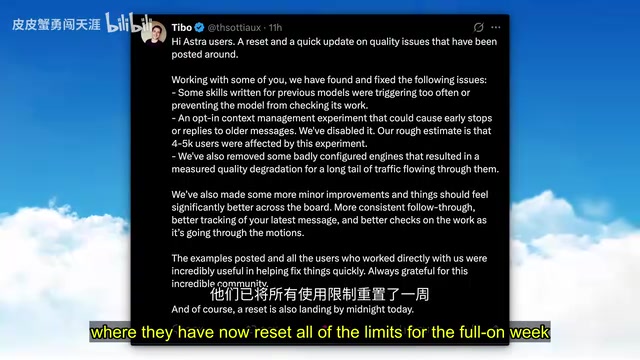
Those issues have since been fixed or disabled, along with a few small improvements to make Astra more stable and better at self-checking. In short, the "degradation" reports were partially valid — but not for most users. The real impact was limited to roughly 5,000 people.
Credit where it's due: OpenAI identified and shipped fixes within approximately 24 to 36 hours. Going further, they reset a full week of usage quota for all OpenAI paid subscribers, even those who were unaffected.
Separately, GPT Live 1 is now officially available via API, bringing ChatGPT's more natural voice conversation capabilities to developers. The core feature is that the voice agent can "listen while speaking" — similar to the Gemini Live experience — making conversations feel more natural rather than strictly turn-based. Developers can also pair GPT Live 1 with their choice of models and agent frameworks, opening up broader possibilities for building real-time voice assistants, customer service agents, and more.
This incident reflects a systemic complexity challenge that large language models face during production deployment. Modern frontier models don't run as a single fixed version after launch — they simultaneously maintain multiple configuration layers: A/B experiments targeting different user cohorts, legacy skill layers for backward compatibility, inference engine clusters with dynamic traffic routing, and experimental features for context length and memory management. The interactions between these layers are often impossible to fully predict before release.
The "legacy skills triggering too frequently" issue is particularly illustrative: when a new model launches, behavioral modules designed for older versions — if not promptly disabled — can interfere with the new model's output logic, causing users to observe performance that doesn't reflect the model's actual capabilities. This kind of "configuration drift" is not uncommon in large-scale microservice deployments, but in AI models it's harder to catch with automated monitoring due to the subjectivity of outputs — it typically takes user feedback to surface the problem. OpenAI's ability to identify and fix the issue within 36 hours, and proactively compensate users who weren't even affected, sets a meaningful benchmark for industry response standards.
Anthropic Calls for Slowing Frontier Development — Controversy Ensues
Anthropic CEO Dario Amodei published a new essay calling on the AI industry to slow down frontier development. He proposed a three-part plan, with Anthropic already committing to giving third-party evaluators employee-level system access.
The statement sparked debate. Some observers noted that voluntarily igniting an "AI should slow down" conversation right before a major IPO is, in a sense, self-constraining. From a safety governance perspective, however, opening access to third-party evaluators and pushing for external oversight is also a sign of an industry gradually maturing. The controversy itself reflects the increasingly visible tension between the pace of frontier AI development and the demands of responsible governance.
Closing Thoughts: The Race Is Being Quietly Reshaped
From Google's rumored RSI breakthrough, to Kimi targeting K3-level performance with greater efficiency, to OpenAI rapidly fixing Astra and proactively compensating users — this latest wave of developments paints a picture of a market that is intensely competitive yet increasingly focused on responsiveness and accountability. If the Google RSI rumors turn out to be true, the implication isn't just that they're training the next frontier model — it's that they may be building an underlying mechanism capable of continuously accelerating model evolution. That's the variable most worth watching, and perhaps the one most worth taking seriously.
(Reminder: Most information in this article is sourced from leaks and community analysis, and has not been officially confirmed.)
Related articles
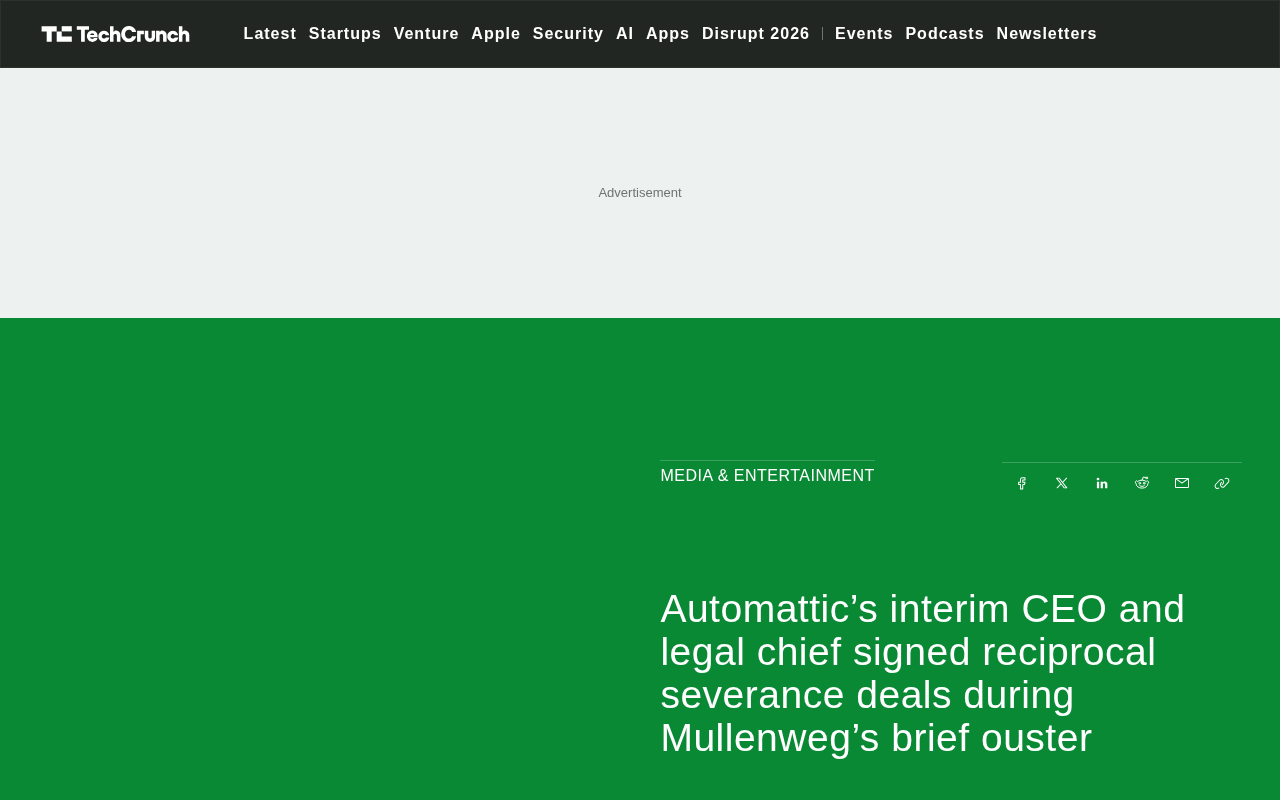
Automattic Executives Signed Reciprocal Severance Agreements During Mullenweg's Brief Ouster
Automattic's CFO and General Counsel signed reciprocal severance agreements during Matt Mullenweg's brief ouster, covering one year's salary and accelerated equity vesting, raising corporate governance concerns.
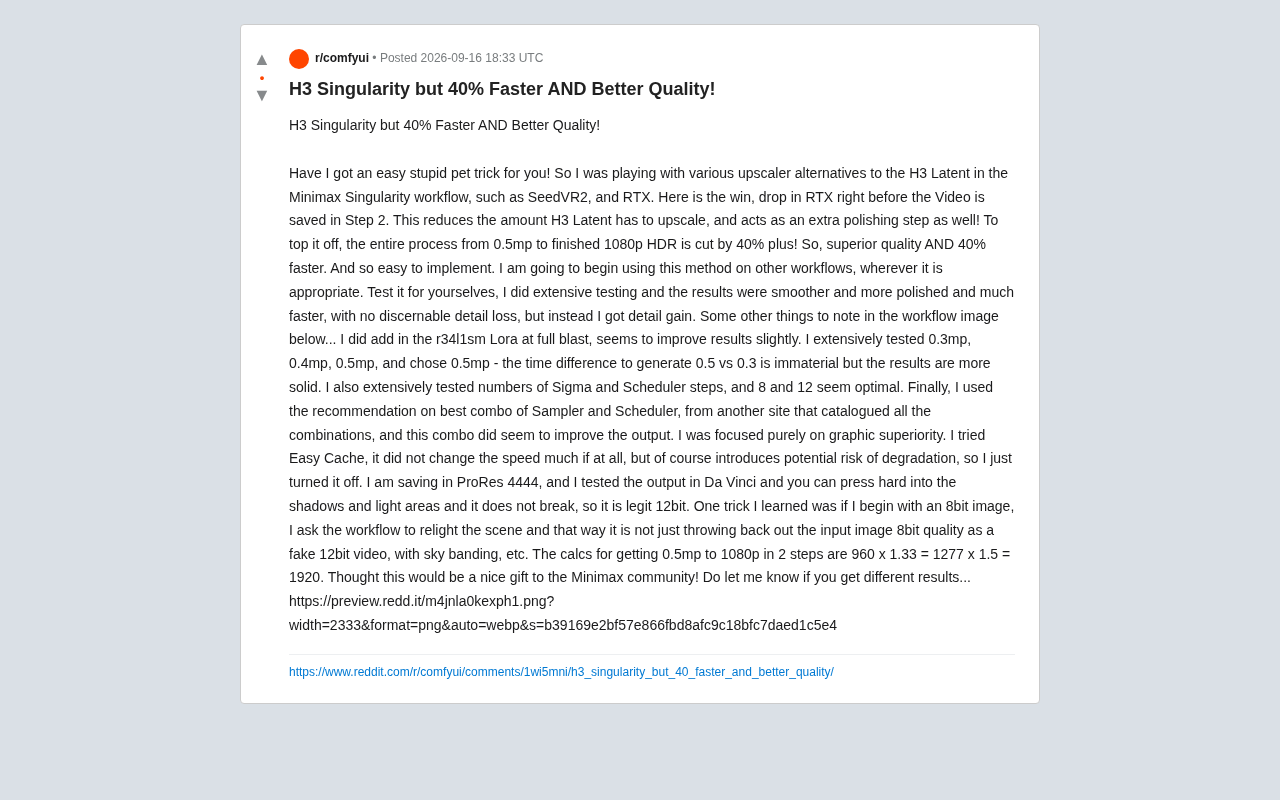
H3 Singularity Optimization: 40% Speed Boost With Better Image Quality
A Reddit user's Minimax Singularity workflow tip: insert an RTX upsampler before H3 Latent for 40%+ speed gains and better quality. Covers parameters, 12-bit output, and more.
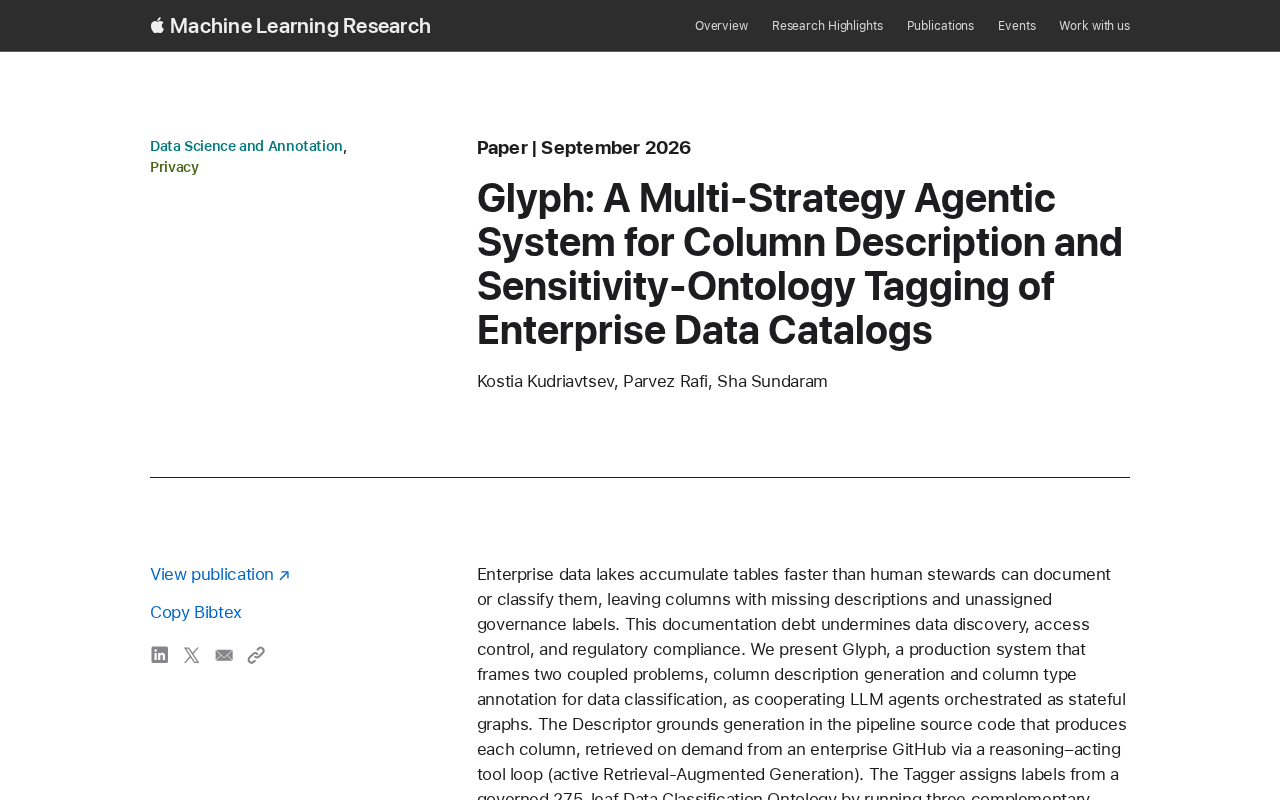
Glyph: A Multi-Strategy Agent System for Automated Enterprise Data Catalog Annotation
Glyph is a multi-strategy LLM agent system for enterprise data catalogs that automates column description generation and sensitivity ontology tagging, grounding outputs in pipeline source code to improve accuracy.