Google Gemini 4 Argon Launches: Tops Multiple Benchmarks but Raises Questions

Gemini 4 Argon tops multiple leaderboards and cuts hallucinations to 15%, but real-world performance remains in question.
Google's new foundation model Gemini 4 Argon ranks first on multiple independent leaderboards including Arena AI and Vals Dex, and demonstrates standout advantages in hallucination control (15%), 3D spatial understanding (Blueprint Bench 2 #1), and 1M-token output capacity — signaling a serious return to form. However, Bloomberg's early internal testing suggests real-world performance may not match the paper numbers, and its coding ability (ranked 8th on Code Arena) remains a relative weakness. Whether the benchmark results reflect genuine capability or benchmark gaming awaits large-scale user validation.
Google's newly released AI model Gemini 4 Argon has been making waves on social media. According to an analysis by YouTube channel TheAIGRID, this model outperforms nearly every frontier model by a significant margin on Google's published benchmarks, bringing the company — once mockingly labeled an "AI dinosaur" — back into competitive contention. But behind the impressive benchmark numbers, real-world usage feedback has thrown some cold water on the hype.
A New Foundation Model, Not a Flash Derivative
One noteworthy detail: Gemini 4 Argon is not an upgrade to Google's Flash series — it's an entirely new foundation model. It's being benchmarked directly against other frontier flagship models, not compared to mid-tier offerings like Sonnet or Haiku.
According to the video's analysis, Gemini 4 Argon demonstrates near state-of-the-art performance across multiple dimensions: knowledge work, agentic coding, science and mathematics, long-context handling, and computer operation. In a fiercely competitive landscape, achieving improvements of this breadth is genuinely surprising — especially given that Google's previous several updates were widely considered underwhelming.
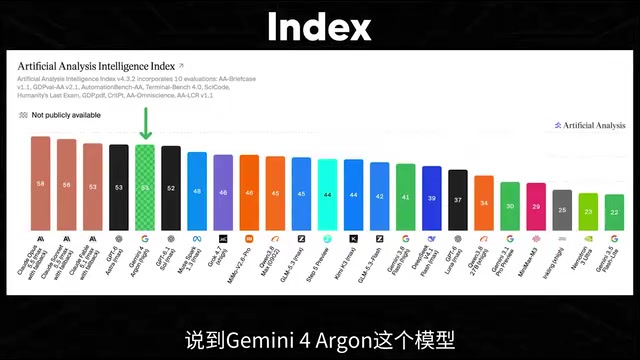
Cross-Validated by Multiple Independent Leaderboards
Rather than simply trusting Google's official claims, the analysis consulted multiple third-party leaderboards. On Arena AI's overall rankings, Gemini 4 Argon High placed first across all 29 categories, surpassing Opus, Astra, and several Meta models.
On Vals Dex — a leaderboard oriented toward real-world work scenarios — it also took first place, edging out Sonnet 5.5 and Claude Opus 5.5, both released just days earlier. On the Artificial Analysis Intelligence Index, Gemini 4 Argon also ranks firmly among the top frontier models.
That said, the analysis fairly notes that evaluations like the Text Arena carry strong subjectivity — results depend on personal preference — and Claude Opus still ties for first in the "creative writing" category. Top models often differ by only five to ten points, which could fall within the margin of error. However, Gemini 4 Argon shows jumps of roughly 25 points on some leaderboards, which may suggest Google has done something genuinely different.
Price Efficiency and 3D World Understanding Are Standouts
Beyond raw performance, Gemini 4 Argon's cost-to-performance ratio has been repeatedly highlighted. While it doesn't occupy the most ideal spot on the "price vs. intelligence" quadrant, its combination of capability and relatively lower cost compared to other frontier models makes it attractive for most users.

Another underappreciated strength is 3D world understanding. According to Andon Labs, Gemini 4 Argon understands the physical three-dimensional world better than any other AI, ranking first on Blueprint Bench 2 — a benchmark that asks AI to generate floor plans from interior apartment photos — beating Opus, Astra, Fable, and others. This aligns with Google's long-term investment in robotics and 3D spatial understanding. As a company with a far longer history than OpenAI or Anthropic, Google has pursued a different trajectory toward AGI.
Additionally, Google DeepMind revealed that the model supports up to 1 million tokens of output (note: this refers to output, not the context window), meaning it can generate up to one million tokens in a single response — enabling it to handle long-chain, multi-step complex tasks more effectively. Combined with Google's consistently strong long-context input capabilities (such as processing up to an hour of video or audio), this gives it a clear advantage on long-document and multimodal tasks.
Blueprint Bench 2 is a benchmark specifically designed to evaluate AI spatial cognition and 3D reconstruction: given a set of real indoor photos, the AI must infer relative positions, estimate dimensions, and generate a floor plan with accurate proportions. This requires geometric reasoning, depth perception, and multi-view consistency — not just language pattern matching — making it a meaningful measure of whether a model truly "understands" the physical world. Google's strength here stems from years of robotics research (such as the RT-2 series) and Google Maps 3D mapping experience, representing a meaningfully different technical path from OpenAI's or Anthropic's language-model-centric approaches. The 1 million token output limit (distinct from the input context window) means the model can generate entire codebases, full reports, or multi-step plans in a single inference pass, without truncation or segmented requests.
Hallucination Rate Drops Significantly
Hallucination has long been a persistent weakness of the Gemini series. Many users have reported that Gemini frequently "misremembers" conversation history or fabricates information in the chat interface — with hallucination rates noticeably higher than competing frontier AI models.

This time, Google appears to have made meaningful improvements. On the hallucination benchmark, Gemini 4 Argon scores 15% (lower is better), making it less prone to fabrication than any current frontier model. Some recently released frontier models score significantly higher on this same metric. If this holds up in real-world usage, it would be a substantial step forward.
Hallucination refers specifically to large language models generating content that sounds fluent but is factually inaccurate or entirely fabricated — ranging from wrong facts and invented citations to misremembered conversational context. Commonly used hallucination benchmarks include TruthfulQA, HaluEval, and various open-domain QA datasets; lower scores indicate fewer hallucinations. The Gemini series has historically struggled here, tied to its early weaknesses in fact-checking and citation grounding. A score of 15% — if independently reproducible — would be a genuine breakthrough; by comparison, some recently released competing models score above 30% on the same benchmark. It's worth noting that a single hallucination benchmark cannot cover all scenarios, and domain-specific risks (e.g., medical, legal) require targeted testing for a full picture.
Benchmark Padding or Genuine Capability?
The central question naturally follows: are these impressive benchmark results a reflection of real capability, or yet another case of "benchmarking gaming" (Benchmax) — optimizing for the test rather than actual performance?
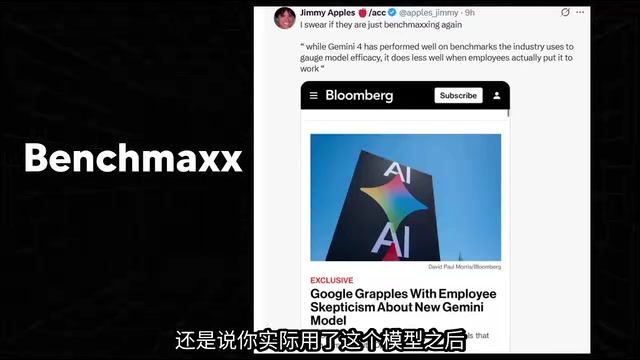
A Bloomberg report offers a cautious signal: while Gemini 4 performs well on industry benchmarks, it performed "not as well" when employees actually used it for work. Bloomberg's own preliminary user testing suggests the model may underperform in real-world scenarios compared to its headline numbers.
The analysis acknowledges this is just one report, and that the model's reputation will ultimately be shaped by end users. But the pattern of "strong benchmarks, weak real-world performance" is not uncommon in AI releases — plenty of models post impressive scores only to feel like talking to a hallucinating alien in actual conversation.
Coding capability is also a relative weak point. On the Web Dev category in Code Arena, Gemini 4 Argon ranks only eighth — just above QWEN 3.8. This doesn't mean it's bad, but it does indicate that other models are meaningfully stronger in coding — a capability critical to recursive self-improvement (RSI) — and coding has historically not been Google's strong suit.
"Benchmarking gaming" (sometimes called Benchmax) is a persistent problem in AI: if a model's training data contains substantial exposure to benchmark questions or similar question types, even without direct memorization, it can overfit to the test distribution — producing scores far better than actual usage would suggest. Academic researchers have studied this problem extensively, and organizations like Hugging Face regularly refresh benchmark datasets to combat contamination. Notably, arena-style leaderboards like Arena AI and Vals Dex — which rely on real user preference votes — are theoretically harder to game directly, since they measure subjective experience in interaction with real users rather than fixed answers. The fact that Gemini 4 Argon also leads on these leaderboards adds some credibility to its results, though it cannot entirely rule out the possibility that training data correlates with user voting behavior.
Conclusion
The launch of Gemini 4 Argon puts Google back at the table in the AI race, with particularly strong showings on composite leaderboards, price efficiency, 3D spatial understanding, and hallucination control. But the gap between benchmark glory and real-world experience still needs to be validated through broad user testing. For users already comfortable with Opus or ChatGPT workflows, whether it's worth giving Google a genuine shot may only be answerable by trying it firsthand.
Related articles

China Releases "Qiusuo" 4.0: The First Evaluation Benchmark Covering the Entire AI Industry Chain
China's CESI releases "Qiusuo" 4.0, the first AI full-industry-chain evaluation benchmark system, covering computing power, LLMs, agents, security governance, and industry applications with 16 evaluation tools and open-source code tools to solve cross-environment incomparability.

Building Your Own OpenAI-Compatible Gateway to 6 Chinese LLM Providers: Five Pitfalls Beyond the Happy Path
A developer built the He-API gateway to unify DeepSeek, Kimi, Qwen, Doubao, ERNIE, and GLM behind one OpenAI-compatible endpoint. Five real pitfalls: streaming compatibility, token billing precision, hot reload, two-dimensional rate limiting, and base_url config.

In the AI Era, a Developer's Core Value Is No Longer Writing Code
AI coding assistants make code generation easier than ever, but a developer's core value is shifting from writing code to understanding requirements and making the right trade-offs. This article explores how developers can stay irreplaceable in the AI era.