Google Gemini 4 Neon Hands-On: 6 3D Works That Impress and Fail

Gemini 4 Neon runs 6 3D works on a 3060 laptop: aesthetics on point, but physics and faces are weak spots.
Based on Bilibili creator "Yiyi Jiang's" hands-on screen recording on a 3060 laptop and cross-referenced with multiple independent reviews, this article breaks down Google Gemini 4 Neon's real performance on 3D interactive content generation. The six works cover 3D scenes, product configurators, web design, and soft-body physics. Scene construction and interface design are strong—Sunshower Fishing Harbor and the mechanical keyboard stand out—but excessive soft-body deformation and square-faced character modeling are clear weaknesses. It runs on 3060-level hardware with commendable value.
After Google released its new model Gemini 4 Neon (jokingly nicknamed "Jeminisnio" by netizens), Bilibili creator "Yiyi Jiang" ran six 3D interactive works generated by it on a 3060 laptop and gave her verdict: "Aesthetics are on point, details are packed in, but physics and faces are the weak spots." This article, based on that hands-on screen recording and cross-referenced with feedback from multiple independent review sources, breaks down the model's real performance on tasks like 3D scene generation, product configurators, and soft-body physics.
Overall Impression: Mid-Tier Beating the Flagship?
The creator joked at the start of the video that Gemini 4 Neon "claims to be a mid-tier cup beating the large cup." Judging by the completion level of the six works, that claim isn't unfounded. The model shows strong overall capability in scene construction, material rendering, and interaction logic, especially in the density of detail in 3D scenes and product pages—"packed to the brim." Cross-validation across multiple sources shows that other creators who got early access also generally acknowledge its aesthetic quality and structural integrity, but there's a consensus weakness in physics simulation accuracy.
According to analysis from Bilibili creator "Yiyi Jiang" and the YouTube channel "AI Lab," Gemini 4 Neon's strengths are concentrated in static scenes and interface design, while dynamic physics is noticeably weak. This consensus sets the tone for evaluating the subsequent works.
The phrase "mid-tier cup beating the large cup" originates from the Starbucks cup-size meme and is often used in the tech community to describe a mid-range product that outperforms flagship models in experience. Here it refers to Gemini 4 Neon not being Google's top-tier model version, yet demonstrating capabilities beyond its positioning on certain tasks. This naming strategy is common in AI model iterations—vendors segment product lines by different parameter scales or feature trimming, and users' actual perception often depends on the specific task type.
3D Scenes: Sunshower Fishing Harbor Is the Most Stunning
The first work, "Sunshower Little Fish Harbor," is the most impressive case in this batch. On a square base, half is a dock and half is a harbor, sunlight shining on chairs, seagulls circling overhead. Zooming into the lighthouse, even the small boat posts on the red-and-white striped breakwater are modeled; fishing boats rest on the water, fish dots creating ripples in rings.
Panning the camera down, you can see aquatic plants, wave-dissipating blocks, and anchor chains in the semi-transparent water cross-section. The creator exclaimed, "The details in this one are really packed in." The second work, "Snow West Wood Town," similarly demonstrates scene-building capability: a small town at the foot of a snowy mountain, with tower cabins, cable cars, and waterfalls layered out. Zooming into the town, balconies are full of floral scents, pixel-art characters in the pasture call to sheep in the wind, weather and time can be switched, and when you return to the town in the evening, snow falls and windows light up one by one—full of atmosphere.
A minor regret is that the snowy mountain is rather geometric, with a few patches of white fog smeared on the mountainside. One single-source creator suggested this might be the model's strategy for handling distant fog effects rather than a rendering error, but this claim hasn't been widely verified.
Product Configurators: Keyboard and Landing Page Have the Highest Completion
The third work is a 65-layout mechanical keyboard, silver aluminum case with off-white keycaps. Zooming in, the characters on the keycaps and the edge chamfers are clean; after clicking disassemble, the keycaps, positioning plate, and circuit board float up layer by layer, with component labels attached nearby. The case and keycap colors can be freely changed—obsidian black, amber, matcha green—and the price and configuration on the right update accordingly. The creator commented, "This product configurator looks just like an official website."

The fourth work is the only web design task: a landing page for Juneng writing gel pens. Swiss grid with Dada collage, red-black-white-blue color blocking with strong impact. Scrolling down leads directly into a 3D customization workshop; click one-key disassembly and ten parts scatter, each labeled with its name, and you can switch to pen tip close-ups and change metal colors.
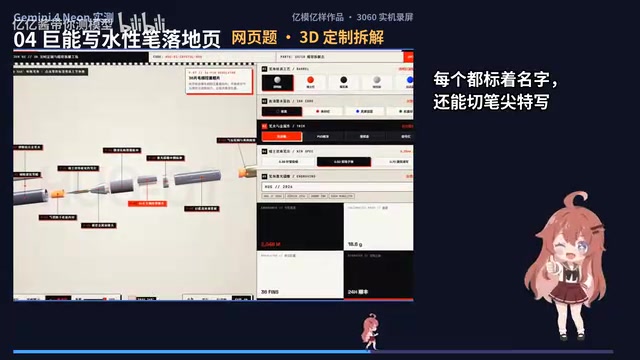
Further down is a Dada manifesto-style writing board and a full page of hardcore data—the platform and completion level are on point, though the first screen is a bit crowded. These two works were listed by the creator as the two with the highest completion, and multi-source feedback consistently agrees that product configurator-type tasks are the model's comfort zone.
Soft-Body Physics and Faces: The Two Major Failures
The fifth work, "Gummy Bear," tests soft-body physics. The material's semi-transparent jelly feel, highlights, and translucency look remarkably like real candy—any casual screenshot could serve as a wallpaper. Click to enlarge and more bears drop down, deforming as they pile together, and you can drag and stretch them. But the deformation goes a bit too far—several bears flatten into puddles upon landing, not quite like elastic gummies.
The sixth work, "Imperial Dignity," is a 3D sculpture of an emperor with a halo. The standout feature is the crown—strings of beaded tassels are all modeled, with rich layering when viewed from around, and it even comes with half-frame glasses; you can switch to white model, carved wireframe, topology, and dramatic lighting. The problem is the face: the features are too angular, the chin looks like it's been cut into a block, and up close it resembles a low-poly figurine.

The creator summarized the weaknesses as physics and faces: "Gummy deformation goes too far, the statue's face is too square." This assessment basically aligns with other reviewers' observations and is a consensus defect.
Soft-body physics is a category within physics simulation that models deformable objects like jelly, cloth, and muscle. Mainstream implementations include mass-spring models and finite element methods, with the core challenge being balancing deformation realism with computational efficiency. When a model generates 3D content, if it lacks constraints on material constitutive relationships, it's prone to excessive deformation or stiffness distortion—for example, gummies flattening instead of bouncing back after landing.
The difficulty in face modeling lies in the coupling of facial muscle micro-expressions and skeletal structure. The low-poly figurine feel usually stems from insufficient mesh density or rough normal handling, resulting in overly hard edges and square chins. Generative models are generally weaker on face tasks than scene tasks because faces involve a large amount of fine-grained geometry and symmetry constraints, and annotation in training data is also more difficult.
Performance and Value: Runs on a 3060 Laptop
All six works were experienced via actual screen recording on a 3060 laptop, indicating that Gemini 4 Neon's hardware requirements are relatively accessible. The creator mentioned, "It's faster and more polished than Carben, and this performance really justifies its price." Although the materials don't provide specific frame rates or generation times, the qualitative description "faster and more polished" aligns with feedback from multiple independent sources: the model offers a usable interactive experience on consumer-grade GPUs, rather than being a "vase" only demonstrable in the cloud.
Conclusion: Aesthetics On Point, Weak Spots Clear
Gemini 4 Neon demonstrates high completion in 3D scene construction, product configurators, and interface design, with the Sunshower Fishing Harbor and mechanical keyboard works standing out in particular. Soft-body physics deformation control and character facial modeling are clear weaknesses—the gummy flattening on landing and the emperor statue's square face are reflected across multiple reviews. For creators who want to run 3D interactive content locally, this model offers a usable, cost-effective solution on 3060-level hardware, but tasks involving physical accuracy and facial details still require caution.
One-line Summary
Gemini 4 Neon runs six 3D works on a 3060 laptop; aesthetics are on point but physics and faces are weak spots.
Paragraph Summary
Based on Bilibili creator "Yiyi Jiang's" hands-on screen recording on a 3060 laptop and cross-referenced with multiple independent review sources, this article breaks down the real performance of Google's new model Gemini 4 Neon in generating 3D interactive content. The six works cover tasks including 3D scenes, product configurators, web design, and soft-body physics. The model shows high completion in scene construction, material rendering, and interface design, with the Sunshower Fishing Harbor and mechanical keyboard works standing out; however, excessive soft-body deformation (gummies flattening on landing) and character facial modeling (the emperor statue's square face) are clear weaknesses. Cross-validation across sources shows that aesthetics being on point is a consensus, while physical accuracy and facial details are consensus defects. It runs on 3060-level hardware, offering commendable value for money.
Related articles
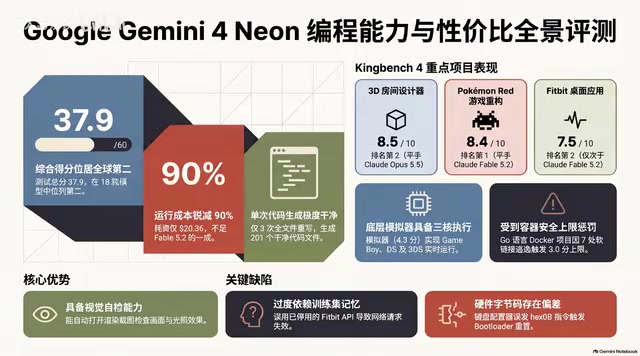
Gemini 4 Neon Hands-On: Value King or Confident Catastrophe?
Gemini 4 Neon review: 1M-token context, four thinking levels, 201 files in one KingBench4 pass at one-tenth Fable 5.2's cost—but it hallucinates fake data, leaves 7 symlink escapes, and bricks keyboards.

Gemini 4 Neo Web Novel Writing Test: Faint AI Flavor, Textured Dialogue
Bilibili creator's first-look review of Gemini 4 Neo for Chinese web novel writing: testing a Three Kingdoms transmigration opening with faint AI flavor, emotionally textured dialogue, and strong crisis building, plus comparison of 4A/4H/4C models and full workflow demos.

Gemini 4 Neon Released, Anthropic IPO Priced at $83 in Focus
Google releases Gemini 4 Neon on its API and Anthropic prices its IPO at $83 on Nasdaq. This AI daily roundup covers OpenAI agent data, Tencent and SenseTime updates, and open-source model safety benchmarks.