Google I/O 2025 Quick-Fire Q&A: The Communication Strategy Behind a 2-Minute Interaction

Google I/O 2025's 2-minute Q&A reveals the communication wisdom of the social media era
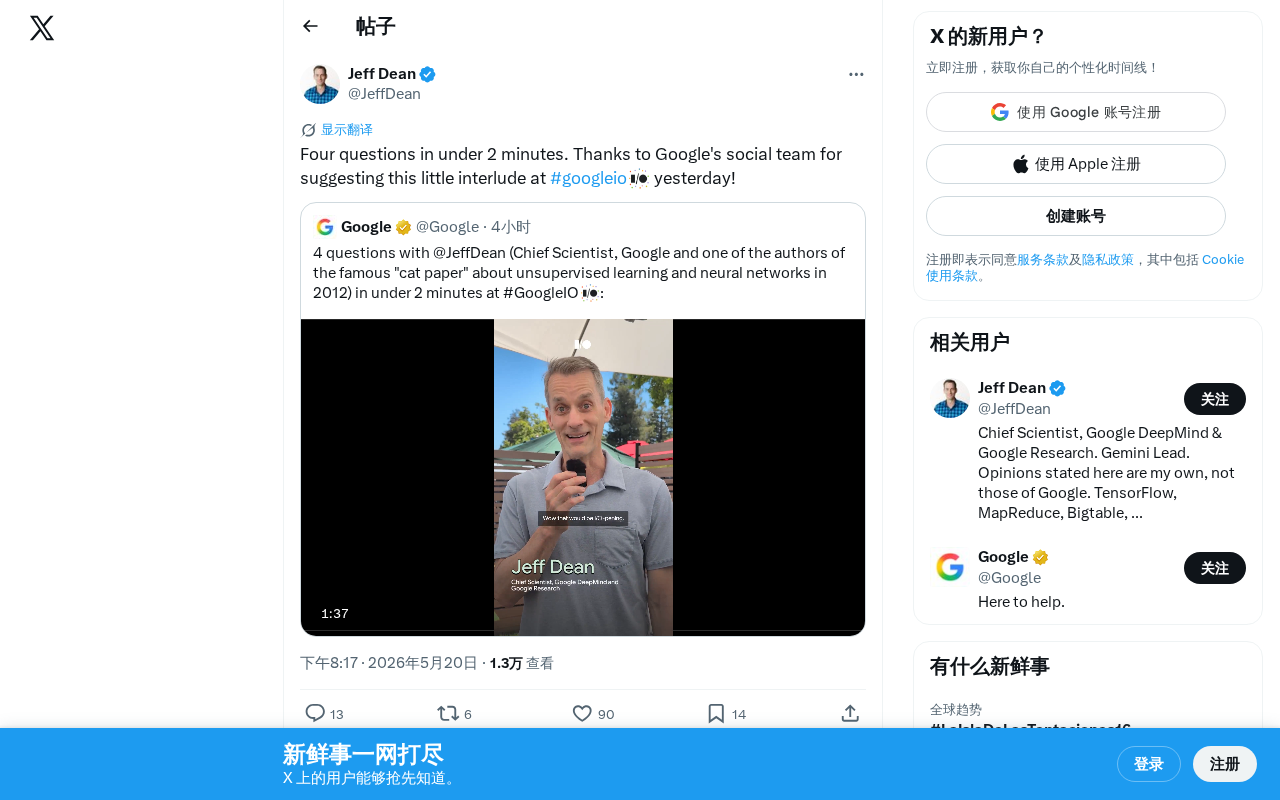
At Google I/O 2025, the social team designed a 2-minute, 4-question quick-fire Q&A segment, with each answer lasting roughly 30 seconds — precisely matching the distribution logic of short-video platforms. This seemingly minor design choice reflects a profound shift in tech conference communication strategies: in an era of fragmented attention, lightweight, highly shareable content touchpoints are more memorable and spreadable than lengthy presentations, embodying the communication wisdom of "less is more."
The Quick-Fire Q&A Segment at Google I/O 2025
At the recently concluded Google I/O 2025, Google's social team orchestrated an ingenious interactive segment — completing 4 rapid-fire questions in under 2 minutes. This compact yet efficient format not only showcased the Google team's creativity in event planning but also delivered a fun, engaging experience for attendees.
Background: The History of Google I/O Google I/O is an annual developer conference held by Google since 2008. "I/O" stands for Input/Output while also serving as an abbreviation for "Innovation in the Open." Originally centered on technical sharing for developers, the conference has evolved into a comprehensive tech event catering to consumers, developers, and media as Google's product ecosystem expanded. In recent years, with the rise of the AI wave, I/O has become a crucial stage for Google to showcase its AI strategy including Gemini, with millions worldwide tuning in via livestream.
Why Do Tech Conferences Need Quick-Fire Q&A Segments?
Every year, Google I/O is an information-dense technical event — from AI model updates to product launches, from developer tools to platform strategy, a massive volume of information is released within just a few days. Amid such an intense agenda, a lighthearted 2-minute Q&A segment may seem trivial, but it actually serves a crucial pacing function.
This "interlude" design reflects the Google social team's deep understanding of content distribution dynamics:
- Fragment-friendly distribution: Sub-2-minute short content is naturally suited for social media distribution, aligning with the content preferences of platforms like YouTube Shorts and TikTok
- Lower barriers to participation: The quick Q&A format allows audiences to engage without requiring deep technical expertise
- Enhanced interactivity: Compared to one-directional keynotes, the Q&A format is more conversational and more likely to resonate with viewers
Deep Dive: Algorithm Logic of Short-Video Platforms Algorithms on platforms like YouTube Shorts, TikTok, and Instagram Reels generally favor content between 15 and 60 seconds, with completion rate being one of the core ranking metrics. Research shows that viewer retention in the first 3 seconds determines whether content enters a platform's recommendation pool. Content under 2 minutes achieves an average completion rate approximately 40% higher than content over 3 minutes. Therefore, the Google social team's decision to keep each Q&A to around 30 seconds was not arbitrary — it precisely aligned with the distribution logic of mainstream short-video platforms, maximizing the content's organic reach potential.
Tech Conference Communication Strategies in the Social Media Era
Notably, this segment was led by Google's social team rather than the traditional technical presentation team. This detail reflects the growing emphasis tech giants place on social media reach during major events.
Communication strategies for tech conferences have undergone profound transformation over the past decade. In the early 2010s, conference content primarily relied on tech media's written coverage for secondary distribution; after 2015, YouTube livestreaming became standard; and by the 2020s, the rise of TikTok and Instagram Reels pushed event organizers to produce "clip content" specifically for short-video platforms. Apple's WWDC, Microsoft's Build, and Meta's Connect have all established dedicated social media teams responsible for breaking down hours-long keynotes into short content suitable for distribution across different platforms. Google's quick-fire Q&A segment is a concrete manifestation of this industry trend.
In today's communication landscape, the influence of a tech conference depends not only on the quality of on-site presentations but also on how much secondary distribution it generates on social platforms. Short, punchy, fast-paced content clips often achieve far broader reach on Twitter (X), YouTube Shorts, and Instagram Reels than lengthy technical demos.
From a distribution efficiency standpoint, the design of 4 questions in 2 minutes is remarkably precise — each Q&A is kept to around 30 seconds, exactly the ideal length for a social media short video.
Overall Trend Observations from Google I/O 2025
AI Remains the Undisputed Star
This year's Google I/O continued its AI-first strategic direction. From continuous iterations of the Gemini model to deep AI integration across Google's entire product lineup, artificial intelligence is no longer a standalone product line but a foundational capability permeating the entire Google ecosystem.
Technical Background: Gemini Model and Google's AI Strategy Gemini is a multimodal large language model family released by Google DeepMind in late 2023, available in tiers including Ultra, Pro, Flash, and Nano, covering full-scenario needs from cloud services to on-device applications. In direct competition with OpenAI's GPT series, Gemini's core differentiation lies in its native multimodal capabilities (simultaneously processing text, images, audio, video, and code) and deep integration with products like Google Search, Gmail, and Docs. At Google I/O 2025, Gemini's continued iterative updates once again took center stage, signaling Google's strategic intent to transform AI capabilities from standalone products into ecosystem-wide infrastructure.
Innovation in Event Formats
Segments like the 2-minute quick-fire Q&A, while unable to match major product launches in technical substance, represent a valuable exploration in format innovation for tech conferences. In an era of increasingly fragmented attention, how to create more lightweight, highly shareable content touchpoints while maintaining technical depth is a challenge every major tech event must address.
Conclusion: The Communication Wisdom of "Less Is More"
The concept of the "Attention Economy" was proposed by economist Herbert Simon in 1971, with the core insight that in an age of information abundance, what's scarce is not information itself but human attention. Data from Microsoft Research shows that the average human attention span has declined from 12 seconds in 2000 to approximately 8 seconds in 2015. The psychological "Peak-End Rule" also demonstrates that people's memories of an experience are primarily determined by its peak moments and its ending, rather than the average experience throughout — which is precisely why a well-designed 2-minute interaction often leaves a stronger impression than a lengthy speech.
The quick-fire Q&A segment arranged by Google's social team at the I/O conference, while just a small interlude in the overall event, reflects a communication philosophy worth every content professional's attention: in an age of information overload, sometimes "less is more." A carefully designed 2-minute interaction may be more memorable and shareable than a 30-minute presentation. This also offers a valuable lesson for organizers of other tech conferences — design offline event content with a social media mindset.
Key Takeaways
- Google's social team designed a 2-minute, 4-question quick-fire Q&A segment for the I/O conference
- Short, concise content formats are better suited for fragmented distribution in the social media era
- Tech giants are placing increasing emphasis on social media communication strategies for major events
- Lightweight interactive segments serve a crucial pacing function in information-dense tech conferences
- The continued evolution of Gemini's multimodal model is a core pillar of Google's AI strategy
- The "Peak-End Rule" and attention economy theory provide psychological foundations for streamlined content design
Related articles
 Tech Frontiers
A Rare Quiet Day in AI: Recursive Self-Improvement Stirs Beneath the Surface
A rare quiet day in AI sees multiple sources go silent simultaneously. Behind the calm, Recursive Self-Improvement (RSI) research continues. What this means for the industry.
 Tech Frontiers
Reve 2 vs. Ideogram 4: A Deep Dive into Layout Control in AI Image Generation
A deep comparison of Reve 2 and Ideogram 4's layout control capabilities, covering technical approaches, real-world use cases, and industry trends for designers and creators.
 Tech Frontiers
In the Weights: Check Your Influence Score in the AI World
In the Weights is an AI influence search engine that quantifies your presence in the AI world with a score. Explore how it evaluates practitioners and what it means for digital identity.