Google I/O 2026 Deep Dive: Gemini 3.5 Flash, Antigravity 2.0, and the New Subscription Tiers Explained

Google I/O 2026 unveils Gemini 3.5 Flash, the Antigravity 2.0 ecosystem, and new Google One subscription tiers.
Google I/O 2026 delivered three major highlights: Gemini 3.5 Flash tripled its pricing and excels at UI design but suffers from hallucination and sycophancy issues, making it suitable only for UI tasks; Antigravity wasn't sidelined but expanded into a full product matrix including the 2.0 App, IDE, CLI, and SDK, receiving strategic-level investment; and Google One added $100 and $200 subscription tiers, finally bridging the previous $20-to-$250 pricing gap.
Introduction
Google I/O 2026 brought a number of noteworthy updates. The biggest surprise was Antigravity—a project widely expected to be sidelined—not only surviving but evolving into a full-fledged product ecosystem. This article breaks down the conference's core highlights across three dimensions: the new Gemini 3.5 Flash model, the Antigravity 2.0 product suite, and the revamped Google One subscription tiers.
Gemini 3.5 Flash: Triple the Price, Mixed Results
Pricing Changes
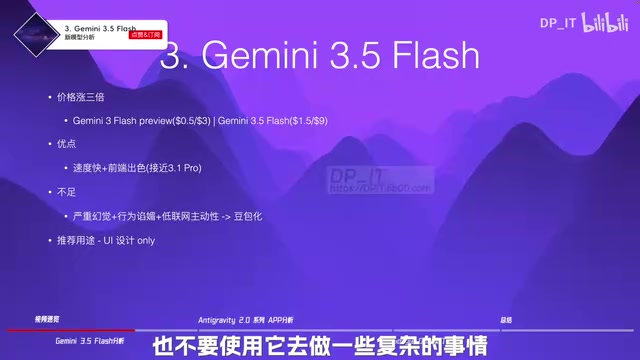
Compared to the previous Gemini 3 Flash Preview, Gemini 3.5 Flash's API pricing has tripled:
- Input price: From $0.50 to $1.50
- Output price: From $3 to $9
That's a significant increase—but whether it's worth the premium depends on real-world performance.
Strengths and Weaknesses
On the plus side, Gemini 3.5 Flash maintains the Flash series' signature fast response times while delivering impressive frontend UI design capabilities. In testing, its frontend rendering quality approaches Gemini 3.1 Pro levels—quite remarkable for a Flash-tier model.
On the downside, the issues are equally apparent:
- Severe hallucination problems
- Overly sycophantic behavior, lacking objectivity
- Extremely low willingness to proactively search the web
- The community jokes it has a "Doubao-ification" tendency
Usage Recommendations and Future Outlook
Given these characteristics, Gemini 3.5 Flash is currently only recommended for UI design tasks—not for programming or other complex tasks requiring high accuracy. Its strengths and weaknesses are too polarized, limiting its practical scope.
What's more exciting is the upcoming Gemini 3.5 Pro. Extrapolating from the Flash-to-3.5-Flash improvement trajectory, the leap from Gemini 3.1 Pro to 3.5 Pro should be substantial. Industry rumors suggest a launch around June 2026, with pricing likely in the same ballpark as GPT 5.5 (input $5/output $30) and OPS 4.7 (input $5/output $25).
Another issue worth monitoring: Will Gemini 3.5 Flash experience quality degradation over time, as we've seen before? This wouldn't be unprecedented in Google's model iteration history.
Antigravity 2.0 Ecosystem: From Single Tool to Complete Product Matrix
The Logic Behind the Product Split
The most unexpected part of this year's Google I/O was Antigravity's comprehensive upgrade. All prior signals pointed to Antigravity being marginalized, but the reality was the exact opposite—Google not only kept it alive but split and expanded it into a complete product matrix.
Antigravity 2.0 essentially extracts the Agent Manager functionality from the original Antigravity app into a lightweight standalone application. Its positioning is similar to OpenAI's Codex App, with the core philosophy being: decouple AI Agent tools from VS Code so that scenarios not requiring code editing can run more efficiently, saving memory and computing resources.

The Four Products at a Glance
For users accustomed to viewing code and using the Agent simultaneously within an IDE, the original workflow hasn't been abandoned—it's simply been renamed to Antigravity IDE. The classic layout with file explorer on the left, code in the center, and Agent panel on the right remains fully intact. It's essentially an extended form of VS Code.
Antigravity now comprises a complete four-product ecosystem:
| Product | Positioning |
|---|---|
| Antigravity 2.0 | Lightweight standalone Agent tool |
| Antigravity IDE | Full code editor + Agent integrated environment |
| Antigravity CLI | Command-line tool (replacing Gemini CLI) |
| Antigravity SDK | Developer integration kit |
Antigravity CLI has been rewritten in Go and is designed to replace the existing Gemini CLI. Google stated that the current Gemini CLI couldn't adequately handle multi-agent workflows and future agent-oriented trends. The official replacement is expected to go live on June 18, 2026.

Common Upgrade Issues
If you've recently tried upgrading to Antigravity 2.0 (whether the IDE or Agent tool version) and encountered problems, try deleting the corresponding configuration folders—the 2.0 config folder and the IDE config folder respectively. This effectively resolves most upgrade compatibility issues.
Google One's New Subscription Tiers: Filling the Pricing Gap
New Tiers and Pricing
Previously, Google One's subscription structure had an obvious gap: Plus at $8, Pro at $20, then Ultra jumping straight to $250. The new subscription system finally bridges this divide:
| Tier | Monthly Fee | Quota Multiplier |
|---|---|---|
| Plus | $8 | 2x free account |
| Pro | $20 | 4x free account |
| Ultra 5X | $100 | 5x Pro (20x free account) |
| Ultra 20X | $200 | 2x Ultra 5X (80x free account) |

Value Analysis by Tier
Looking closely at the pricing logic, several points stand out:
- Plus tier offers very poor value: $8 only gets you 2x the free account quota—almost no incentive to subscribe
- Ultra 20X has a built-in discount: Based on price alone it should be 10X, but you actually get 20X quota—essentially a 50% discount
- Ultra 5X (around $100) fills the gap between $20 and $200, becoming the new option for moderate-usage users
Summary and Recommendations
Google I/O 2026 shows that Google still harbors significant ambitions in AI, though its execution pace remains relatively conservative. Here are the key takeaways:
On Antigravity: Previous predictions about its marginalization were wrong. From the 2.0 App to IDE, CLI, and SDK—the complete lineup shows that Antigravity hasn't been sidelined at all; it's received a strategic-level upgrade.
On model selection: For UI design scenarios, the current viable options are limited to Gemini 3.1 Pro and Gemini 3.5 Flash. The latter, with its lower price and faster speed, may hold an advantage in "multi-attempt generation" workflows.
On subscription advice: For users who previously fled the Google ecosystem, if you're considering re-entry, always opt for monthly or the shortest possible subscription terms. Google's product strategy shifts frequently, and the risk of long-term commitments shouldn't be underestimated. One month of trial-and-error costs far less than being locked into an annual plan.
Related articles
 Tech Frontiers
A Rare Quiet Day in AI: Recursive Self-Improvement Stirs Beneath the Surface
A rare quiet day in AI sees multiple sources go silent simultaneously. Behind the calm, Recursive Self-Improvement (RSI) research continues. What this means for the industry.
 Tech Frontiers
Reve 2 vs. Ideogram 4: A Deep Dive into Layout Control in AI Image Generation
A deep comparison of Reve 2 and Ideogram 4's layout control capabilities, covering technical approaches, real-world use cases, and industry trends for designers and creators.
 Tech Frontiers
In the Weights: Check Your Influence Score in the AI World
In the Weights is an AI influence search engine that quantifies your presence in the AI world with a score. Explore how it evaluates practitioners and what it means for digital identity.