Google Messages Rolls Out AI Scam Protection: Cloud LLM Detects Fraudulent Texts

Google introduces cloud AI enhanced anti-fraud for Google Messages, moving scam detection from on-device to cloud and upgrading it to an Android system-level capability.
Google is rolling out an "enhanced protection" scam setting for Google Messages, migrating on-device Scam Detection to cloud AI models for broader coverage via larger models and fresher scam libraries. Rolling out over coming weeks as a gradual release, it's part of Android-level protection tools, signaling a shift from app patches to system-level capability. The cloud approach enables population-data insights but requires message content to leave the device, hence the optional toggle. The real challenge is false positive control, as the line between scams and legitimate messages is blurry.
Title
Google Messages Rolls Out AI Scam Protection: Cloud LLM Detects Fraudulent Texts
Meta Description
Google launches cloud-based AI enhanced protection for Android and Google Messages to detect and block scam texts. This article analyzes the shift from on-device to cloud architecture, system-level anti-fraud strategy, and the core challenge of false positive control.
Article Content
Mobile scam texts have become one of the most common forms of harassment for users worldwide, and Google is confronting the problem head-on with AI. According to RSS sources, Android is introducing new scam protection features for Google Messages, centered on a cloud-based AI "enhanced protection" setting designed to identify and block potential scams before users click a link or reply to a message.
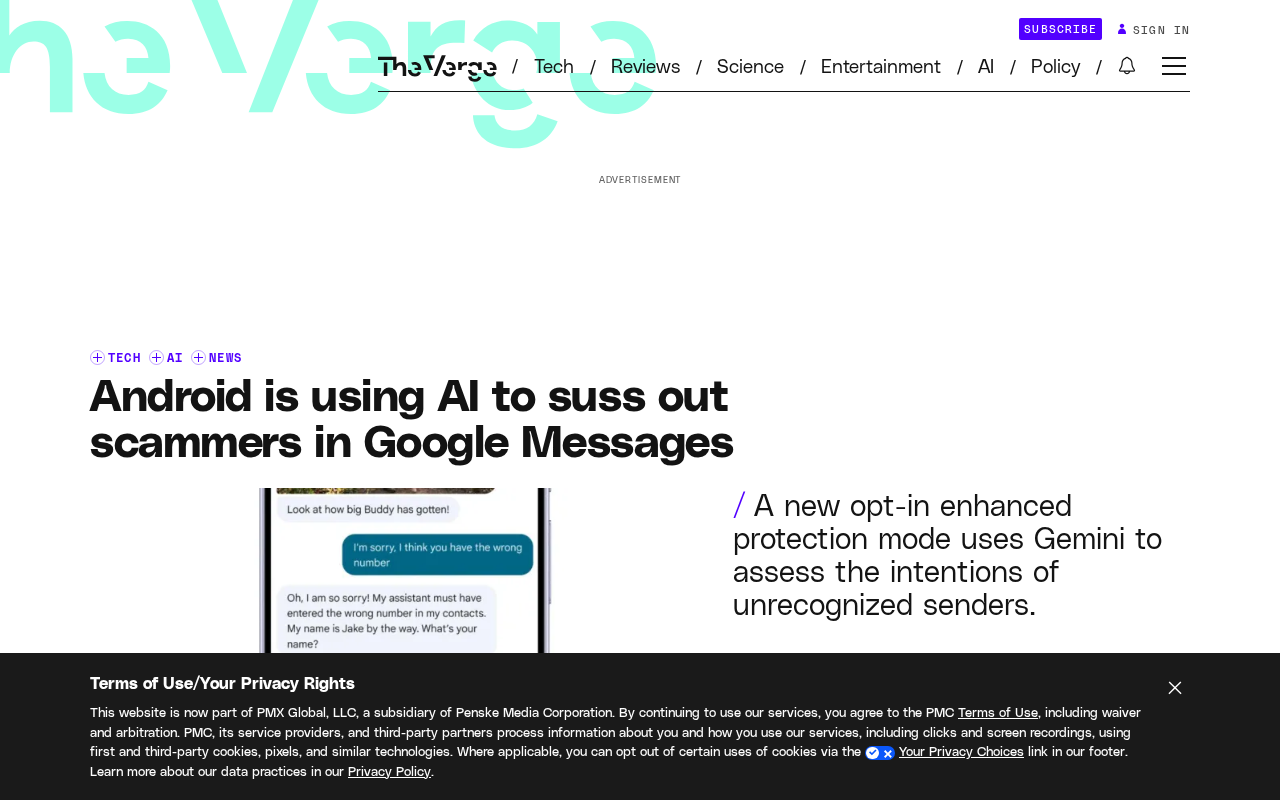
From On-Device to Cloud: The Evolution Path of Scam Detection
Google Messages' previous "Scam Detection" feature already had basic local identification capabilities, relying mainly on on-device rules and lightweight models to flag suspicious messages. But on-device compute is limited, and against constantly morphing scam scripts and new phishing templates, detection accuracy tends to suffer.
The biggest change with the new "enhanced protection" setting is moving the decision logic to the cloud. The report notes the new feature "taps into cloud-based" capabilities — meaning Google Messages can upload relevant features of suspicious messages to a cloud model for analysis, leveraging larger-scale models and a more frequently updated scam sample library to broaden detection coverage.
This architectural trade-off is worth noting. The advantage of cloud AI is bigger models, faster updates, and the ability to spot emerging scam patterns across users; the cost is that message content must leave the device, requiring privacy-conscious users to actively weigh the trade-off. Google designed this feature as an optional setting rather than enabled by default, which is itself a response to that concern.
The core difference between on-device AI and cloud AI lies in the boundary of compute and data. On-device models run locally on the phone, typically compressed to tens to hundreds of megabytes, relying on fixed rules and lightweight neural networks — the advantages being low latency, data never leaving the device, and offline availability; the drawbacks being small model capacity, updates tied to system or app releases, and lagging behind rapidly morphing scam scripts. Cloud models, by contrast, can reach billions of parameters or more, with sample libraries updated on an hourly basis, aggregating signals across users and discovering emerging scam templates. The cost is that inference requires a network connection, and message features or content must be uploaded to servers, bringing privacy and compliance costs. Google's move from the former to the latter is essentially trading privacy for detection rate — which is why the feature is designed as optional rather than default-on.
Scam Protection Is Becoming a System-Level Capability
The report also notes that this update isn't limited to Google Messages alone, but is part of "additional safeguarding tools" — a suite of protections at the Android level. This signals that Google's strategy is shifting from "patching individual apps" to "system-level anti-fraud infrastructure."
There's real-world context behind this shift. Scam texts don't only arrive through the SMS app — they also come via RCS, third-party messaging tools, and even disguised push notifications in the notification shade. If protection only lives inside Messages, scammers can simply switch channels to bypass it. Only by pushing protection down to the Android system layer can more attack surfaces be covered.
From a product cadence perspective, the "enhanced protection" setting will roll out over "coming weeks" — a gradual phased release rather than a one-shot full launch. This cadence is typically used to observe false positive rates and user feedback before deciding whether to expand coverage.
RCS (Rich Communication Services) is an upgraded protocol over traditional SMS, supporting read receipts, typing indicators, high-definition images, and group chats — features similar to instant messaging. It has been promoted by Google Messages as the default messaging protocol. Compared to SMS, RCS messages are richer, capable of carrying links and rich media cards, which also makes it a new attack vector for scammers — impersonating official brand accounts and sending phishing cards with buttons is far more convincing on RCS than plain-text SMS. This is one reason Google wants to push anti-fraud capabilities down to the Android system layer: if protection only covers SMS, scammers need only switch to RCS or a third-party messaging app to bypass it. System-level protection means interception logic can act on the chain before messages reach the notification shade, covering more entry points.
The Real Challenge of AI Anti-Fraud Isn't the Model — It's False Positives
Using large models for scam detection isn't technically difficult — what's hard is controlling false positives. The line between scam texts and legitimate marketing messages, bank notifications, or delivery alerts is extremely blurry — a message containing a link, urging a click, and carrying time pressure could be either a scam or a legitimate promotion.
If AI flags a legitimate message as a scam, users miss important information; if it's too lenient, protection becomes meaningless. This is why Google chose to make enhanced protection a toggleable setting: letting users make their own choice between security and message completeness, rather than making a uniform decision for everyone.
Cloud models have an advantage over on-device ones here — they can combine broader population data to judge whether a message template is being used for scams at scale, a kind of "herd immunity" signal that standalone models can't access.
False positives and false negatives are a pair of core metrics in scam detection. A false positive means flagging a legitimate message as a scam; a false negative means flagging a scam message as legitimate. The two trade off against each other: raising the threshold reduces false positives but increases false negatives, and lowering it does the opposite. In the SMS context, the cost of false positives is especially high — users might miss bank verification codes, delivery pickup notifications, or hospital appointment reminders, losses that are often more immediate than occasionally missing a scam text. That's why Google chose to make enhanced protection a toggleable setting, letting users weigh security against message completeness rather than imposing a uniform threshold. The advantage of cloud models is the ability to incorporate population signals (for example, whether a message template is being sent at scale) to aid judgment, thereby reducing false negatives without significantly raising false positives.
Practical Impact on Users
For ordinary Android users, the direct change from this update is: an enhanced protection option will appear in Google Messages, and once enabled, suspicious messages will be more aggressively flagged or blocked. For users who frequently receive texts impersonating banks, delivery services, or carriers, the practical value of this feature is fairly direct.
For developers and security practitioners, the more noteworthy aspect is Google's move to bring cloud AI inference into the messaging pipeline. If this architecture proves out, it will likely expand to calls, email, and even notification filtering for third-party apps, becoming a standard component in Android's fight against social engineering attacks.
AI anti-fraud won't eliminate scams, because the essence of a scam is psychological manipulation, not a technical vulnerability. But shifting the cost of detection from users to models can at least help more people avoid realizing the problem only after they've clicked that link.
One-line Summary
Google introduces cloud-based AI enhanced anti-fraud protection for Google Messages, moving scam detection from on-device to the cloud and upgrading it to an Android system-level capability.
Paragraph Summary
Google is rolling out a new scam protection setting called "enhanced protection" for Google Messages, centered on migrating the previously on-device Scam Detection to cloud AI models, leveraging larger models and a more updated scam sample library to broaden detection coverage. The feature will roll out over the coming weeks as a gradual phased release. The report also notes this isn't limited to a single app but is part of a suite of Android-level protection tools, signaling a shift from patching individual apps to system-level capability. The cloud approach can use population data to discover new scam templates, but message content must leave the device, creating a privacy trade-off — hence the feature is designed as an optional toggle. The article emphasizes that the real challenge of AI anti-fraud isn't model capability but false positive control — the boundary between scams and legitimate marketing or notifications is blurry.
Related articles

Why Does the Tesla Roadster Need to Fly? A Deep Dive into Musk's Wild Demo
Tesla's Roadster launch showed wall-climbing, upside-down driving, and flying stunts—but The Vergecast notes the demo car may lack a battery, the Rocket version is invite-only and not street-legal, and the website terms don't guarantee delivery. After nine years of delays, why does this car still need to exist?

AI Is Not a Replacement: Human-AI Collaboration Through the Lens of Factory Root Cause Analysis
Starting from factory root cause analysis, this article explains how AI accelerates evidence chain construction rather than replacing human experts, exploring the pragmatic implementation logic and business value of 'AI supporting people rather than replacing them.'

AI Agent Decision Auditing: Building an Evidence Chain in Regulated Workflows
Starting from a Reddit discussion, this article analyzes three core issues in AI agent decision auditing within regulated workflows: what fields audit records should contain, how to handle feedback latency for erroneous decisions, and how to continuously calibrate LLM judge consistency with human judgment.