Google Photos AI Virtual Closet Launches on All Platforms: Automatically Builds a Wardrobe Library from Your Photos

Google Photos' AI virtual closet launches on all platforms, automatically building a digital wardrobe from your photos.
Google Photos has officially launched its AI virtual closet feature on both Android and iOS. Inspired by the iconic computer wardrobe scene in the 1995 film Clueless, the feature uses image recognition to automatically extract clothing items from existing photos and build a visual personal wardrobe library. The move signals Google Photos' shift from a passive photo storage tool toward an active lifestyle assistant, extending its multimodal AI from face and location recognition to fine-grained clothing identification. Key details on recognition accuracy, supported categories, and potential commercial features have yet to be disclosed.
Google Photos has officially rolled out its AI virtual closet feature — inspired by the classic film Clueless — to both Android and iOS users. The feature was previously available in limited testing on Android, and its expansion to all users marks another step forward for Google at the intersection of photo management and lifestyle applications.
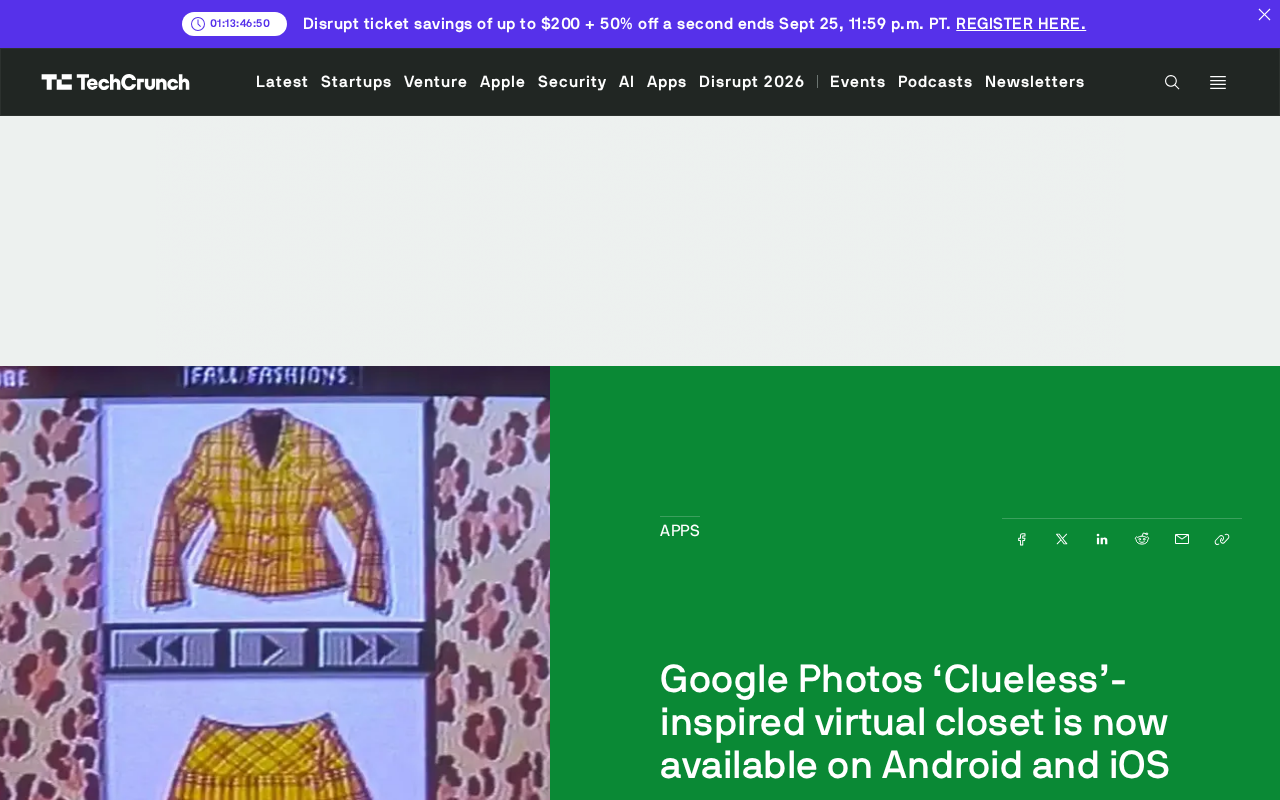
What It Does: Turning Photos into a Digital Wardrobe
The virtual closet works by using AI to automatically identify and extract clothing items from a user's existing photos, building a visual personal wardrobe library. The concept is a clear nod to the iconic scene in the 1995 film Clueless, where the protagonist swipes through tops and bottoms on a computer screen to mix and match outfits in real time. Thirty years later, what once seemed like a sci-fi fantasy is becoming reality on everyday smartphones, powered by mature image recognition technology.
For Google, this isn't just a standalone new button — it's a form of re-purposing its enormous photo data asset in the AI era. User photo libraries tend to accumulate vast amounts of everyday images containing clothing information. By applying computer vision to convert these unstructured images into structured "wardrobe entries," Google is essentially mining the latent value already sitting in users' photo libraries.
Why It Matters: From Storage Tool to Life Assistant
Google Photos has long been positioned as a photo storage and organization tool. The virtual closet represents an extension of that product philosophy: making your photo library not just a passive memory archive, but an assistant that can actively support everyday decisions. Identifying clothing and helping with outfit planning is a textbook example of applying visual recognition capabilities to concrete, real-life scenarios.
From a technical evolution standpoint, features like this rely on increasingly mature multimodal recognition capabilities — from face recognition and location identification, to now recognizing objects and clothing. Google Photos' AI has been steadily expanding toward finer-grained understanding. The virtual closet is a natural product of that trajectory.
Multimodal recognition refers to a model's ability to simultaneously understand and process different types of inputs such as images, text, and audio. In the context of clothing recognition, the system not only needs to locate garment regions within a photo (object detection), but also classify their type (top/pants/footwear), color, style, and even fabric texture — placing high demands on the visual model's fine-grained classification capabilities. Compared to face recognition, clothing recognition poses greater challenges: the same garment can look dramatically different under varying lighting, angles, and wearing conditions, and clothing deforms far more than faces. Google's expertise in this area draws partly from Google Lens, which already supports photographing a product and jumping to a shopping page. The virtual closet shares a great deal of technical overlap with Lens — essentially internalizing Lens's one-off recognition capability into a persistent wardrobe management feature within the photo library.
The Significance of Cross-Platform Availability
Expanding from Android-only to iOS means Google wants this experience to reach as broad a user base as possible, rather than staying confined to its own ecosystem. For Google Photos, which has always been known for cross-platform services, covering both major mobile operating systems simultaneously is a standard strategy for maintaining user retention — and it lowers the barrier for iPhone users to try the feature.
It's worth noting that publicly available information is currently focused on the feature's availability and its pop-culture inspiration. Official details on recognition accuracy, the range of supported clothing categories, and whether future updates might introduce outfit recommendations or shopping links have not yet been disclosed. These will be critical factors in assessing the feature's long-term value.
Google Photos' cross-platform strategy on iOS has a particular backstory: Apple's native Photos app and iCloud form a tightly integrated ecosystem, so Google needs to offer differentiated features to convince iPhone users to actively install the app and change their storage habits. Historically, Google Photos used "free unlimited storage" as its core draw; after that policy ended in 2021, the pressure to grow through user-facing innovation increased significantly. Lifestyle features like the virtual closet are precisely the kind of differentiated offering that's hard to find a direct substitute for within the Apple ecosystem — helping Google Photos establish an independent reason for iPhone users to engage with it, rather than treating it purely as a backup tool.
Takeaway
The cross-platform launch of Google Photos' virtual closet is a product move that isn't exactly revolutionary, but has a clear directional intent: it extends AI image recognition from photo organization into everyday life, while borrowing an iconic pop-culture reference to make the concept immediately intuitive for users. Whether this kind of feature can truly become a high-frequency use case will depend on the quality of the recognition experience and how deep the functionality goes. For everyday users, it's worth opening an updated Google Photos and discovering what kind of "digital wardrobe" has been hiding in your photo library all along.
Related articles

OpenAI Partners with Shield: How the Astra Agent Revolutionizes IT Troubleshooting
OpenAI and Shield launch the Astra agent, which autonomously logs into computers and legacy systems to fix IT issues in real time, 35-40% faster than traditional models, with humans involved only when judgment is needed.

iPhone Duo Battery Life Tested: One Charge a Day Is Unavoidable, and the Large Screen Is the Culprit
iPhone Duo battery test: heavy use needs at least one charge a day, and about 30% remains after 6.5 hours of screen-on time. How often the large screen is unfolded is key; a MagSafe battery pack helps, and long-term degradation is also worth watching.

Kimi K3.1 Pro Open-Sourced: 2.8 Trillion Parameters Close In on Opus
Moonshot releases the open-source MoE model Kimi K3.1 Pro, with 2.8T total parameters and 104B activated, trailing Opus 5.5 by under 1 point on Terminal Bench 4.0.