Google Pixel Tag Launched: A $30 Android Tracker Takes Aim at AirTag

Google launches the $30 Pixel Tag, giving Android users an official AirTag rival for item tracking.
Google has officially released the Pixel Tag Bluetooth item tracker, priced at $30 and directly targeting Apple's AirTag, filling the long-missing official item-tracking solution in the Android camp. The product functions similarly to the AirTag, locating lost items through Android devices and Google's finding network, with advantages in first-party system integration and network coverage. Its pricing is in the same tier as the AirTag, indicating that Google is competing on experience rather than a low-price strategy. Google's direct entry may reshape the Android item tracker market; third-party manufacturers face competition from the platform owner, but the overall finding network's user base is expected to expand. The article notes that specific network technology, battery life, and anti-stalking mechanisms have not yet been disclosed and will determine the actual experience.
Google has officially launched the Pixel Tag, a Bluetooth item tracker for Android devices priced at $30, directly targeting Apple's AirTag. The arrival of this product means the Android ecosystem finally has an official-grade item-tracking solution.
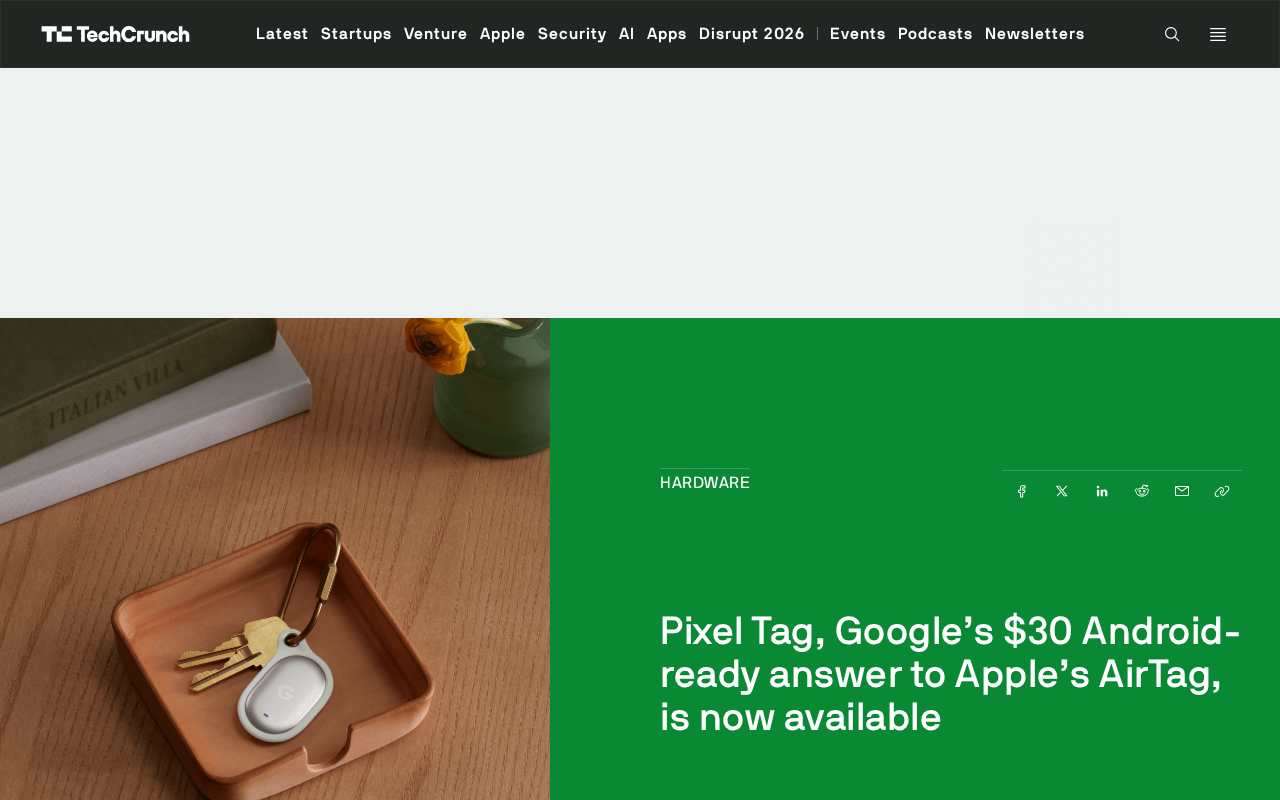
Product Positioning: The Official Answer for the Android Ecosystem
The Pixel Tag's core functionality is similar to the AirTag: attach it to your keys, backpack, or luggage, and locate lost items through your Android device. In the past, Android users could only rely on third-party products like Tile or Samsung SmartTag, which suffered from severe fragmentation and inconsistent experiences. Entering as a first-party Google product, the Pixel Tag is expected to build advantages in system integration and finder-network coverage.
The $30 price sits in the same band as the AirTag, indicating that Google does not intend to buy market share with a low price, but rather to compete head-on on experience.
Bluetooth item trackers rely on a "crowdsourced finding network": when a tagged item is not near its owner, nearby users' phones that detect the tag's Bluetooth signal anonymously report the location to the cloud, allowing the owner to see an approximate position. Apple's AirTag depends on the Find My network formed by hundreds of millions of iOS devices worldwide, and coverage density is the foundation of its positioning accuracy. The Android camp previously lacked a unified network, with third-party products operating independently and limited coverage. Google's recently built "Find My Device" network also uses a crowdsourcing mechanism and can theoretically achieve similar coverage by leveraging the massive number of Android phones—this is also the core advantage of the Pixel Tag over third-party products.
Similarities and Differences with AirTag
The two are highly similar in product logic—both are Bluetooth trackers that rely on a phone ecosystem. The difference lies in ecosystem affiliation: the AirTag is deeply tied to the Find My network and iOS, while the Pixel Tag serves Android and Google's finding system. For Android users, the significance of the Pixel Tag is not just another option, but finally having anti-loss capability on par with Apple users.
The source material does not disclose specific network technical details, battery life, or anti-stalking mechanisms of the Pixel Tag; these will be key variables determining its actual experience.
Anti-stalking mechanisms have been one of the most closely watched issues for such products in recent years. Because trackers may be maliciously slipped into someone else's bag for stalking, Apple and Google once jointly developed an industry specification: when an unknown tag moves with a user for an extended period, the system should proactively alert the user and allow them to view the tag's information or trigger a ring. In addition, the two companies are also promoting cross-platform alerts, so that iPhones can recognize Android tags and Android phones can recognize AirTags. The degree to which this feature is actually implemented directly relates to whether the product can strike a balance between convenience and privacy, and is also an important indicator for evaluating the Pixel Tag's maturity.
Impact on the Item Tracker Market
Google entering the fray itself may change the competitive landscape of the Android item tracker market. Third-party manufacturers will face direct competition from the platform owner, but at the same time Google's push may also expand the user base of the entire Android finding network, indirectly benefiting ecosystem participants.
For consumers, the choice has become simpler: Android users no longer need to compromise between compatibility and experience. Whether the Pixel Tag can replicate the AirTag's reputation depends on the coverage density of Google's finding network and the maturity of its privacy design.
The relationship between first-party and third-party players can be observed from historical experience. Samsung's SmartTag relies on the Samsung phone ecosystem but has limited functionality on broader Android devices; Tile has long depended on its own network, with coverage density falling short of platform-level solutions. After Google's entry, third-party manufacturers may pivot to niche scenarios (such as pets, luggage, and enterprise assets) or become compatible with Google's network to stay competitive. At the same time, the platform owner controls system permissions and network access points, so third parties may face structural disadvantages in alert mechanisms and background scanning, making market consolidation difficult to avoid.
Buying Advice
If you are an Android user who frequently misplaces things, the Pixel Tag is currently the official option most worth watching within the ecosystem. The $30 barrier to entry is low, but it is advisable to wait for feedback from the first batch of users, with particular attention to finding accuracy and anti-abuse tracking performance.
One-line Summary
Google launches the $30 Pixel Tag, giving Android users an official AirTag rival for item tracking.
Paragraph Summary
Google has officially released the Pixel Tag Bluetooth item tracker, priced at $30 and directly targeting Apple's AirTag, filling the long-missing official item-tracking solution in the Android camp. The product functions similarly to the AirTag, locating lost items through Android devices and Google's finding network, with advantages in first-party system integration and network coverage. Its pricing is in the same tier as the AirTag, indicating that Google is competing on experience rather than a low-price strategy. Google's direct entry may reshape the Android item tracker market; third-party manufacturers face competition from the platform owner, but the overall finding network's user base is expected to expand. The article notes that specific network technology, battery life, and anti-stalking mechanisms have not yet been disclosed and will determine the actual experience.
Related articles

Microsoft Open-Sources Token Economizer: Saving 18%-31% on AI Coding Agent Costs
Microsoft's free open-source plugin Token Economizer cuts AI coding agent costs through micro skills, tool pruning, and failure loop intervention. Tests show 18.4% to about 31% average savings with Claude Code, Codex, and more.

Running GLM-5.3 on Two DGX Stations: A vLLM Tensor Parallelism Hands-On
NVIDIA engineers show how to run the 753B-parameter GLM-5.3 locally on two DGX Stations using vLLM tensor parallelism, covering RDMA setup, launch args, NCCL checks, and performance baselines.

97KB Single-File HTML Underwater World: A WebGPU Experiment in AI Programming
A developer used a single prompt in Claude Code to generate a 97 KB single-file HTML underwater world, fully procedurally generated with WebGPU—kelp forests, a shipwreck, and fish, no images or model libraries, MIT-licensed, playable on mobile.