Google Poaches Windsurf Team, Gemini 3 Code Leaks, OpenAI Open Model Delayed: A Three-Way Battle Among AI Giants

Google poaches Windsurf, Gemini 3 leaks, OpenAI open model delayed — AI giants in full-scale competition.
Three major AI industry events this past week reveal intensifying competition among tech giants: Google acquired Windsurf's core team through a "talent poaching + technology licensing" model to avoid antitrust scrutiny; Gemini 3.0 code references leaked, signaling Google's next-gen model is imminent to compete with GPT-5 and Grok 4; and OpenAI indefinitely postponed its open model due to safety testing while facing competitive pressure from Kimi K2 and rising tensions with Microsoft. The AI industry is in full-scale competition across talent, models, and open-source ecosystems.
Over the past week, the AI industry has been rocked by a series of major developments: Google acquired Windsurf's core team through a "talent acquisition" approach, code leaks related to Gemini 3 signal the imminent arrival of next-generation models, and OpenAI's open model has been indefinitely postponed due to safety testing. While these three events may seem independent, they collectively reveal the fierce competition among AI giants over talent, technology, and ecosystem positioning.
Windsurf Changes Hands: Google's New "Talent + Licensing" Acquisition Model
From a $3 Billion Acquisition to Talent Poaching
Windsurf has been one of the hottest startups in the AI coding space in recent months. Windsurf (formerly Codeium) is an LLM-based AI coding assistant positioned between GitHub Copilot and Cursor, specializing in native IDE integration and intelligent code completion. The AI coding tools sector experienced explosive growth during 2024-2025, primarily driven by LLMs approaching junior engineer-level performance in code generation, debugging, and refactoring tasks. The AI coding tools market is estimated to exceed $20 billion by 2027, which explains why both Google and OpenAI were determined to acquire Windsurf.
Previously, OpenAI had planned to acquire Windsurf for approximately $3 billion, and the two parties had even entered an exclusive negotiation period. However, the deal ultimately fell through.
Instead, Google proposed a more flexible arrangement — rather than acquiring Windsurf outright, Google paid to recruit its key personnel, including CEO Varun Mohan, co-founder Douglas Chen, and several members of the R&D team. On the other side, Google obtained a non-exclusive license to some of Windsurf's technology, meaning Windsurf can still license its technology to other companies.
Why Not a Direct Acquisition? Avoiding Antitrust Scrutiny
This "hire talent + license technology" model isn't new. Google employed a similar strategy with Character AI last year, and Microsoft and Amazon did the same with Inflection and Adept respectively. The core logic is: avoiding the antitrust scrutiny and massive capital requirements that come with a full acquisition.
In recent years, the U.S. Federal Trade Commission (FTC) and the European Commission have maintained heightened vigilance over AI acquisitions by tech giants. The FTC has explicitly stated it is reviewing whether Microsoft's talent deal with Inflection AI and Amazon's deal with Adept constitute "de facto acquisitions" designed to circumvent review. Traditional full acquisitions require going through the Hart-Scott-Rodino (HSR) antitrust filing process, with review periods potentially lasting months or even over a year. The "talent poaching + technology licensing" model doesn't legally constitute a corporate merger, thus avoiding triggering HSR filing requirements. However, this model is also controversial — critics argue it effectively hollows out the core value of the acquired company while bypassing regulatory mechanisms designed to protect market competition.
In the current environment of increasingly strict regulation, this lightweight "quasi-acquisition" model is becoming the mainstream path for major tech companies to obtain AI talent and technology.
Windsurf's Future: Can It Maintain Growth After Losing Its Founding Team?
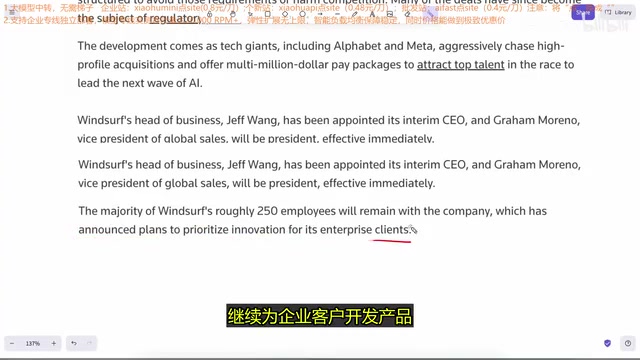
After joining Google DeepMind, Varun Mohan and Douglas Chen will focus on agentic coding projects, particularly work related to Gemini. On Windsurf's side, former business leader Jeff Hwang has assumed the role of interim CEO, Graham Marino serves as the new president, and approximately 250 employees will remain with the company to continue serving enterprise clients.
Reportedly, Windsurf's annual recurring revenue surged from $40 million to $100 million within months, demonstrating strong growth momentum. However, historical experience shows that startups often struggle to maintain their original growth trajectory after losing key leaders — Scale AI's talent drain to Meta and Inflection's poaching by Microsoft both encountered similar challenges. Whether Windsurf can break this pattern remains to be seen.
Gemini 3 Code Leaks: Google's Next-Generation AI Model Is Coming
Gemini 3.0 Flash and Pro References Found in Codebase
Google DeepMind has been researching the Gemini series of models for a considerable time. Gemini is a multimodal large language model series first released by Google DeepMind in December 2023, viewed as the successor to PaLM 2 and Bard. Gemini employs a Mixture of Experts (MoE) architecture capable of simultaneously processing text, image, audio, and video inputs. The series is divided into three tiers: Ultra (maximum performance), Pro (balanced performance and efficiency), and Flash (lightweight and fast). Gemini 2.5 Pro, released in early 2025, performed exceptionally well across multiple benchmarks, particularly leading in long-context understanding (supporting a 1 million token context window) and multi-step reasoning. The iterations from Gemini 1.0 to 2.5 primarily focused on reasoning capabilities and tool calling, while Gemini 3.0 is expected to achieve a qualitative leap in Agent capabilities and deep reasoning.
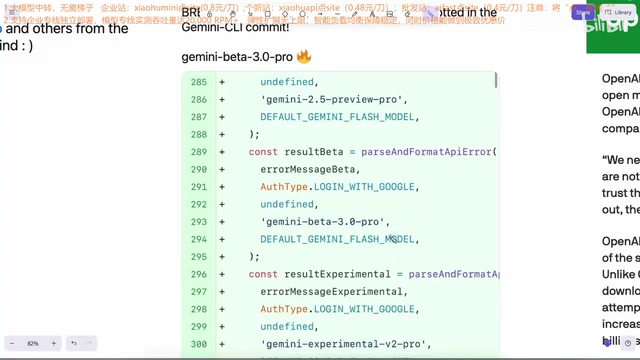
Recently, references to Gemini 3.0 Flash and Gemini 3.0 Pro have appeared in codebases related to Gemini tools, strongly suggesting that the next generation of Gemini models is about to launch, succeeding the current Gemini 2.5 Pro.
Additionally, the code mentions a model called "King4," which reportedly showed strong performance in early testing. It remains unclear whether King4 is an early version of Gemini 3 or a variant of Gemini 2.5 Pro equipped with a new "Deep Think" feature.
Deep Think Feature Worth Watching
The "Deep Think" feature has been rumored for some time and is expected to bring more advanced reasoning and chain-of-thought capabilities, particularly suited for web application scenarios.
Chain-of-Thought (CoT) reasoning is currently the core technical approach for enhancing complex problem-solving capabilities in large language models. Its basic principle involves having the model generate a series of intermediate reasoning steps before providing a final answer, similar to how humans think through problems step by step. OpenAI's o1/o3 series and DeepSeekAd-R1 are representatives of this approach. Google's "Deep Think" feature is expected to deepen this further — not only performing chain reasoning but potentially introducing Tree Search and self-verification mechanisms, allowing the model to select the optimal solution among multiple reasoning paths. This capability is particularly critical for scenarios requiring multi-step logical deduction, such as mathematical proofs, code debugging, and scientific research.
This aligns closely with Google's broader strategy — deploying Gemini widely across Chrome, Workspace, and other platforms to achieve comprehensive AI penetration.
Strategic Positioning During the Competition Window: Benchmarking Against GPT-5 and Grok 4
The timing of these leaks is crucial. Currently, several major competitors are preparing to release new models: xAI's Grok 4, OpenAI's highly anticipated GPT-5, and rumored updates to Anthropic's Claude. Gemini 3 being mentioned before these releases suggests Google is trying to keep pace with or even surpass its rivals, particularly in key areas such as coding, advanced reasoning, and research.
As of now, Google has not officially announced release plans for Gemini 3. If its early testing performance holds, Gemini 3 could represent a significant leap forward, particularly for developers and researchers seeking more powerful AI tools.
OpenAI Open Model Indefinitely Delayed: The Dilemma Between Safety and Competition
Safety Testing Falls Short, Release Date Postponed Indefinitely
OpenAI originally planned to release a new open model this summer — one that would allow developers to freely download and run locally, rather than relying on API access.
Open-weight models are AI models whose weights are publicly released, allowing developers to freely download and deploy them, in contrast to closed-source models accessed through paid API calls. Meta's Llama series is the benchmark for open models, with Llama 3.1 405B once considered the strongest open model. The core advantages of open models include: data privacy (local deployment eliminates the need to send data to third parties), customization flexibility (fine-tuning and domain adaptation are possible), and cost control (no ongoing API fees required). However, open models also pose security risks — once weights are public, anyone can remove safety guardrails or use the model for malicious purposes, which is one of the core concerns behind OpenAI's delayed release.
OpenAI has now indefinitely postponed the release, citing the need for further safety testing.
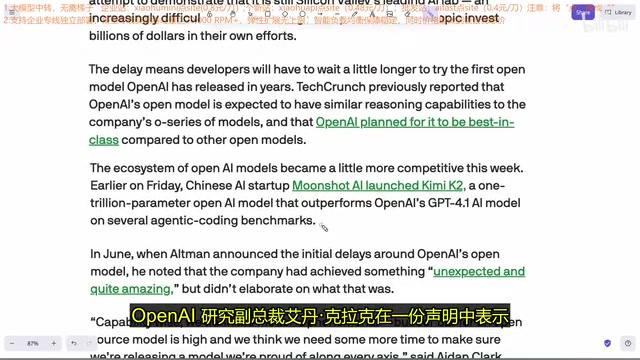
According to CEO Sam Altman, the company wants to spend more time on additional safety testing and review potential risk areas before releasing the model to the public. OpenAI's VP of Research Aidan Clark also stated that despite the model's strong performance, the company wants to ensure the product meets standards in all respects.
Competitive Pressure from Kimi K2
Competition in the open model space has intensified recently. Chinese AI startup Moonshot AI released Kimi K2, a trillion-parameter open model that reportedly surpasses OpenAI's GPT-4.1 on multiple coding benchmarks.
Kimi K2 was developed by Moonshot AI, employing a trillion-parameter MoE architecture with approximately 32 billion active parameters. Moonshot AI was founded in 2023 by Tsinghua University professor Yang Zhilin, previously known for its long-context processing capabilities (Kimi Chat supports 2 million character inputs). K2 performed prominently on SWE-bench (Software Engineering Benchmark) and LiveCodeBench (live coding benchmark), with some metrics surpassing GPT-4.1 and Claude Sonnet 4. This reflects the rapid catch-up of Chinese AI companies in the open-source domain — from DeepSeek-V3/R1 to the Qwen series to Kimi K2, Chinese open-source models are systematically narrowing the gap with American closed-source models, and even achieving surpassing performance on specific tasks.
This puts even greater pressure on OpenAI — its open model needs not only to meet its own safety and performance standards but also to stand out in fierce competition.
Chain Reaction from the Failed Windsurf Deal
You might not have noticed, but the failure to acquire Windsurf has reportedly become a point of friction between OpenAI and Microsoft.
Since 2019, Microsoft has cumulatively invested over $13 billion in OpenAI, making it the largest external investor and cloud computing partner. Under their agreement, Microsoft gained broad commercial usage rights to OpenAI's technology, including integrating the GPT series of models into Azure, Microsoft 365, Bing, and other products. However, this deep integration also creates ongoing tension: OpenAI wants to maintain its independence and strategic autonomy, while Microsoft expects to maximize its return on investment and scope of technology access. The Windsurf acquisition event is a concentrated manifestation of this tension — OpenAI attempted to independently acquire AI coding capabilities, but Microsoft believed it had the right to share all technology assets obtained by OpenAI. As OpenAI's valuation surpasses $300 billion and it plans to transition into a for-profit company, the strategic rivalry between the two is expected to further intensify.
As OpenAI's largest backer, Microsoft already has access to all of OpenAI's intellectual property, but OpenAI was unwilling to let Microsoft also control Windsurf's AI coding technology. With the Windsurf deal falling through and Google poaching key talent, OpenAI faces mounting competitive pressure in the AI coding space.
The 2025 AI Industry Landscape: A Three-Way Battle Over Talent, Models, and Open Source
From these three events, we can clearly see the AI industry engaging in fierce competition across three dimensions:
The talent war intensifies: Major tech companies are increasingly favoring "quasi-acquisition" models to rapidly bring in top researchers, rather than enduring lengthy acquisition processes. This approach both secures core talent and technology while avoiding regulatory scrutiny.
The next-generation model arms race reaches fever pitch: Gemini 3, GPT-5, Grok 4, new Claude versions… The next-generation models from various giants are almost simultaneously entering their sprint phases, with competition windows narrowing dramatically.
The open-source ecosystem battle continues to heat up: From Meta's Llama to DeepSeek and Kimi K2, open models are rapidly closing the gap with closed-source models. OpenAI's delayed open model release reflects both safety considerations and hesitation over its open-source strategy.
The second half of 2025 is destined to be anything but quiet for the AI industry.
Key Takeaways
- Google acquired Windsurf's core team and technology through a "talent poaching + technology licensing" model, avoiding regulatory scrutiny that comes with full acquisitions
- Code references to Gemini 3.0 Flash and Pro have been exposed in codebases, suggesting Google's next-generation model is imminent, potentially featuring advanced "Deep Think" reasoning capabilities
- OpenAI indefinitely postponed its open model release, officially citing safety testing, while also facing fierce competitive pressure from open-source models like Kimi K2
- The failed Windsurf acquisition has become a point of friction between OpenAI and Microsoft, reflecting the strategic importance of the AI coding space
- AI giants are engaged in comprehensive competition across three dimensions: talent acquisition, model arms races, and open-source ecosystems
Related articles
 Tech Frontiers
A Rare Quiet Day in AI: Recursive Self-Improvement Stirs Beneath the Surface
A rare quiet day in AI sees multiple sources go silent simultaneously. Behind the calm, Recursive Self-Improvement (RSI) research continues. What this means for the industry.
 Tech Frontiers
Reve 2 vs. Ideogram 4: A Deep Dive into Layout Control in AI Image Generation
A deep comparison of Reve 2 and Ideogram 4's layout control capabilities, covering technical approaches, real-world use cases, and industry trends for designers and creators.
 Tech Frontiers
In the Weights: Check Your Influence Score in the AI World
In the Weights is an AI influence search engine that quantifies your presence in the AI world with a score. Explore how it evaluates practitioners and what it means for digital identity.