Google Publishes Top 10 Gemini User Requests: Workspace Integration Pain Points and Community Reactions

Google releases top 10 Gemini user requests, exposing Workspace integration failures and alignment issues.
Google publicly shared its top 10 Gemini app user requests, sparking debate about whether the company will act on the feedback. Key pain points include poor Workspace integration — with users noting rival ChatGPT accesses Google Drive more reliably — and Gemini generating unsolicited images. Community reactions range from cautious optimism to outright skepticism.
Google Rarely Opens Up for User Feedback
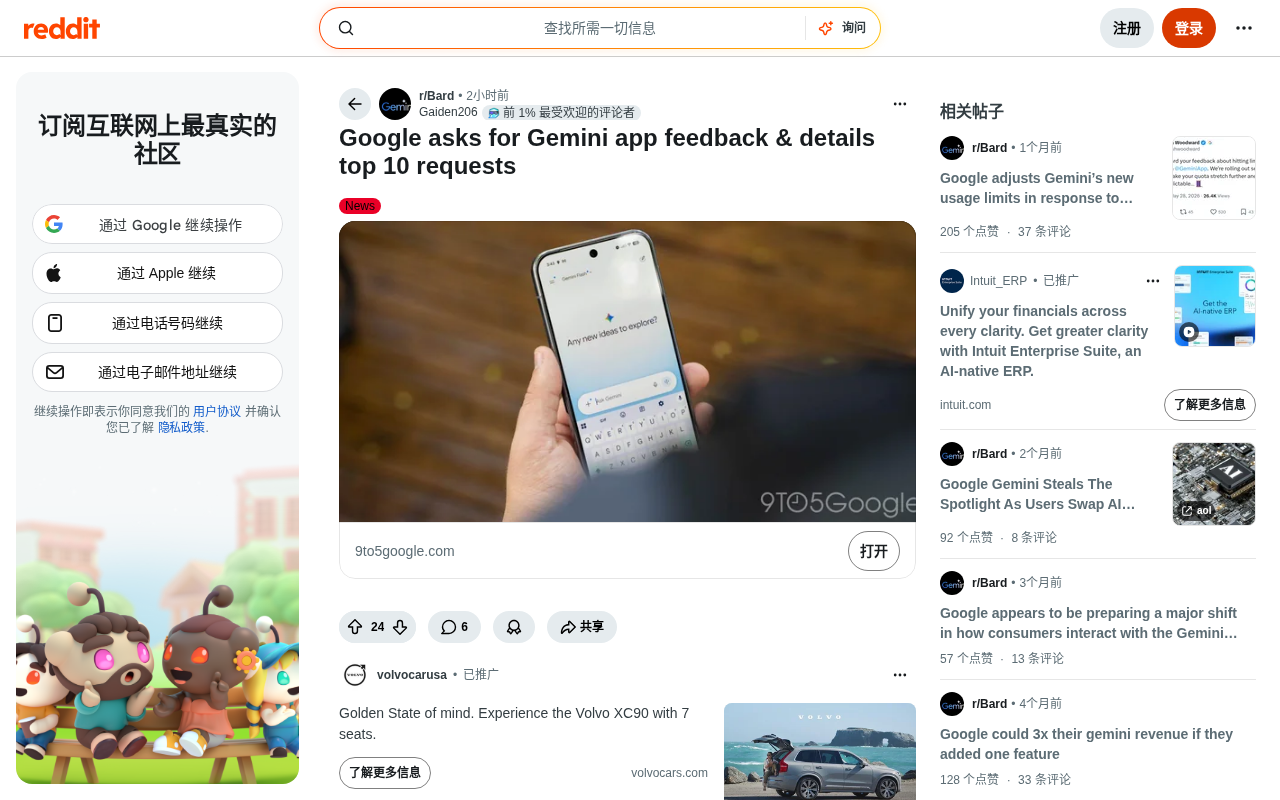
Google recently reached out through official channels to solicit feedback on the Gemini app, and in an unusual move, publicly released a ranked list of the top 10 user requests. The initiative sparked lively debate on Reddit and other communities — some praised Google for listening, while others remained skeptical about whether real improvements would actually follow.
Gemini (formerly Bard), launched in 2023, is Google's flagship response to OpenAI's ChatGPT. In the generative AI race, OpenAI established an early lead with ChatGPT and the GPT-4 series, while Anthropic earned a strong reputation with the Claude series for safety and instruction-following. Although Google's underlying models (Gemini 1.5 Pro, Gemini Ultra, etc.) perform well on many benchmarks, the product-level user experience has long been a weak point — a key reason Google has been playing catch-up.
For a tech giant being relentlessly pressured by OpenAI and Anthropic, publicly releasing a list of known shortcomings is itself a notable signal. It reflects a desire to get closer to users, while also exposing the real pain points currently plaguing the Gemini app.
Workspace Integration: The Most Painful Problem
Among all the issues raised, the most glaring is Gemini's integration with Google Workspace. One user put it bluntly: "The Google Workspace side is frankly embarrassing. I use ChatGPT to access my Google Drive more reliably than Google's own AI service."
To appreciate the weight of that statement, consider what Workspace means to Google's business. Google Workspace (formerly G Suite) is Google's cloud productivity suite for businesses and individuals, encompassing Gmail, Google Drive, Docs, Sheets, Slides, Meet, and more — with over 3 billion users and billions in annual revenue. Deep AI integration with Workspace should be Google's most significant moat over competitors like OpenAI. User data lives in Google's own cloud, so seamless access should theoretically require no complex third-party API authorization. That's exactly what makes it so ironic — and alarming — that a third-party integration with a competitor actually delivers a more reliable experience.
Why Ecosystem Advantages Aren't Translating into Better UX
There's a structural tension in Google's current AI product strategy. On one hand, Google embeds Gemini inside Workspace apps (e.g., AI writing assistance directly in Docs), pursuing an "AI as feature" approach. On the other hand, the standalone Gemini app aims to be a unified conversational assistant like ChatGPT, pursuing an "AI as portal" approach. These two paths create conflicts in R&D resource allocation, data permission architecture, and user mental models.
By contrast, Microsoft has taken a cleaner approach with the Copilot brand, covering both embedded Office 365 scenarios and a standalone assistant — unified through the Microsoft Graph API. Google's dual-track strategy has made permissions for Workspace data access in the standalone Gemini app increasingly complex, hurting the user experience.
As one user noted: "I always assumed they wanted people to use the Gemini that's embedded in Drive and other Workspace apps, but it's still very welcome to see improvement plans for the standalone app." This reflects the real internal tension Google may face: prioritize embedded AI or build a unified standalone assistant hub? The trade-offs in resource allocation and experience consistency directly shape what users feel day-to-day.
Unsolicited Image Generation: Leaving Users Baffled
Beyond Workspace integration, another recurring complaint is Gemini frequently generating images without being asked. One user suggested Google "rewrite the system prompt to stop the unsolicited image output behavior."
At its core, this is a behavior alignment problem. Modern AI assistants are typically constrained using RLHF (Reinforcement Learning from Human Feedback) and system prompts to ensure outputs match user expectations. When a model generates images without an explicit request, it suggests misaligned incentives in the system prompt design or RLHF training — the model may have been over-trained to "proactively provide rich content," causing it to overstep in text-only conversations. This kind of issue is especially common in multimodal models (those capable of handling text, images, code, and other modalities), which must make nuanced judgments about when to use which capability. Getting that judgment right is what determines how "obedient" a product feels and how much users trust it.
Small as it seems, this detail significantly affects the smoothness of daily use. Worth noting: the user who flagged this issue also called the overall list of requests "solid and on point" — suggesting Google has at least accurately identified the main problems.
Community Reaction: Hope and Skepticism in Equal Measure
The community response to Google's public outreach was sharply divided.
On the positive side, many felt that Google's willingness to publicly acknowledge issues was itself a step forward. As one user put it: "Being willing to ask for feedback is good — actually listening would be even better." Another added: "Glad to see they recognize the main problems and are listening. But now it's time to put the ego aside and take action."
On the skeptical side, some were cold and dismissive — "They're definitely not going to do anything about it" — reflecting a broader distrust of big tech companies that collect feedback but rarely act on it. That skepticism isn't unfounded; there's no shortage of precedents where major companies gathered input only to let it gather dust.
Listening Is Step One — Delivery Is What Counts
The community's core message can be summed up simply: listening matters, but action is the only proof of sincerity. Google has completed the first step — identifying and publicly acknowledging the problems. Whether it can deliver meaningful improvements in a reasonable timeframe — deeper Workspace integration, corrected model overreach, and more — will determine whether this exercise was genuine engagement or just a PR gesture.
Conclusion: Beyond Resources, Experience Is the Real Battleground
In the increasingly competitive AI assistant market, the details of user experience often decide winners and losers. Google has unmatched ecosystem resources and technical depth, but as this round of feedback makes clear, those advantages haven't fully translated into a better experience.
Publishing a top 10 request list is both an act of self-reflection and a public commitment. Users have made themselves clear: Workspace integration needs to be more reliable, model behavior needs to be more restrained, and the product needs to actually do what it's told. Whether this list becomes a concrete improvement roadmap or another piece of shelved feedback is worth watching closely.
Key Takeaways
Related articles

Why Does the Tesla Roadster Need to Fly? A Deep Dive into Musk's Wild Demo
Tesla's Roadster launch showed wall-climbing, upside-down driving, and flying stunts—but The Vergecast notes the demo car may lack a battery, the Rocket version is invite-only and not street-legal, and the website terms don't guarantee delivery. After nine years of delays, why does this car still need to exist?

AI Is Not a Replacement: Human-AI Collaboration Through the Lens of Factory Root Cause Analysis
Starting from factory root cause analysis, this article explains how AI accelerates evidence chain construction rather than replacing human experts, exploring the pragmatic implementation logic and business value of 'AI supporting people rather than replacing them.'

AI Agent Decision Auditing: Building an Evidence Chain in Regulated Workflows
Starting from a Reddit discussion, this article analyzes three core issues in AI agent decision auditing within regulated workflows: what fields audit records should contain, how to handle feedback latency for erroneous decisions, and how to continuously calibrate LLM judge consistency with human judgment.