Google Releases Gemini 4 Argon: Frontier Reasoning Capabilities Take On the Industry's Best

Google releases Gemini 4 Argon, emphasizing frontier reasoning and reduced platitudes as it returns to the center of the AI race.
Google has officially launched Gemini 4 Argon, claiming it can compete head-on with the industry's strongest models, marking the end of Google's wait-and-see posture in the frontier AI race. Argon focuses on frontier reasoning and complex workflow scenarios, targeting enterprise and professional users. Google particularly emphasizes reduced hedging, repetition, and platitudes, responding to widespread complaints about verbose model outputs. This release is both a response to skepticism about falling behind and a sign that competition is heating up further, though third-party verification is still needed.
Google has finally ended its wait-and-see posture in the frontier AI race, officially launching the highly anticipated Gemini 4 Argon model. According to the company, Argon can compete head-on with the industry's strongest models, delivering frontier reasoning capabilities in complex workflows while significantly reducing the hedging language, repetition, and platitudes common to such models.
This release marks Google's return to center stage in the large model race. For months prior, Google had been on the sidelines, watching competitors roll out new models one after another. Now, the debut of Gemini 4 Argon signals that Google is ready to engage in a head-to-head contest on the core battleground of reasoning capability.
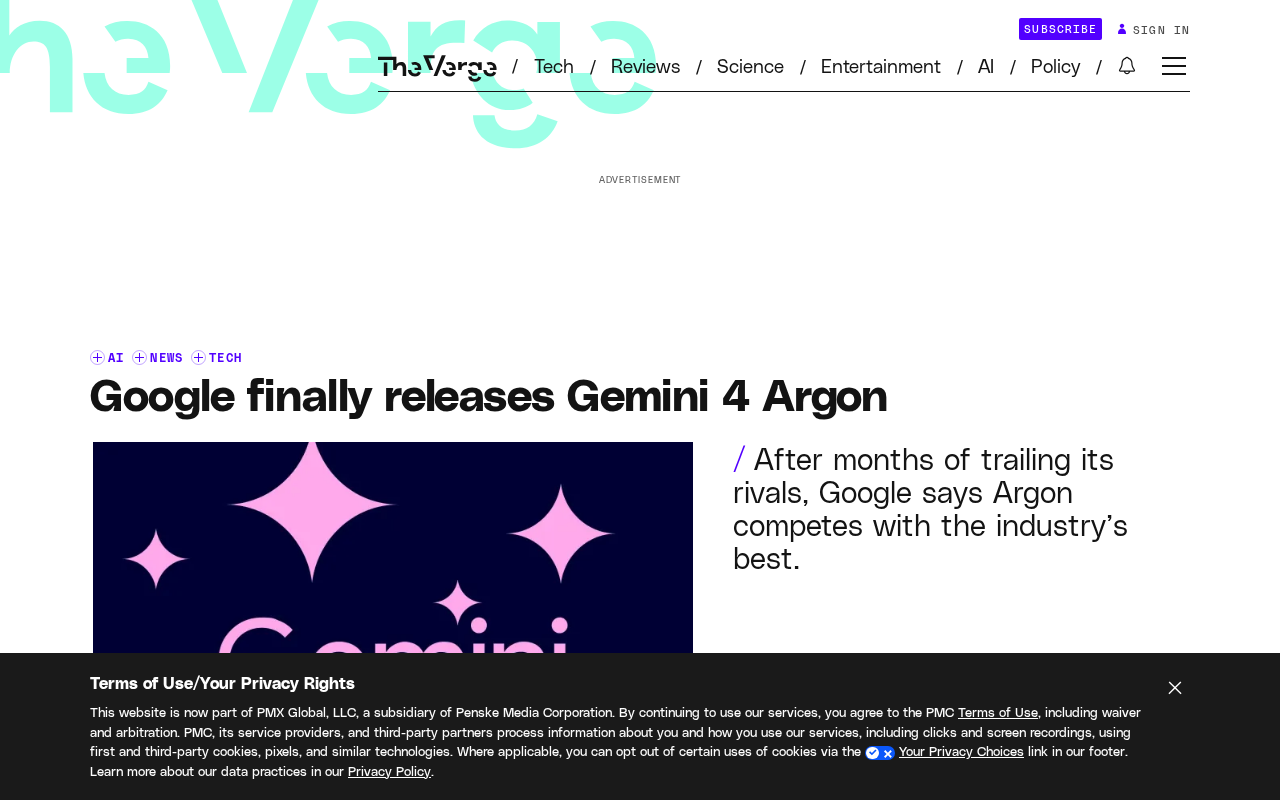
Frontier Reasoning: Argon's Core Selling Point
According to Google's description, Gemini 4 Argon focuses on "frontier reasoning and performance improvements in complex workflows." This isn't empty marketing speak—"complex workflows" typically refers to multi-step task planning, long-chain logical deduction, and scenarios requiring coordination across tools and data sources.
Over the past year, reasoning capability has become the key metric for measuring the upper limits of large models. From mathematical proofs to code generation, from data analysis to multi-agent collaboration, users are increasingly unsatisfied with models that can merely "chat"—they need models that can "get work done." Argon's timing in entering the market clearly targets the demand gap among enterprise and professional users.
Google specifically emphasizes improvements in Argon's output quality: reduced "hedging" (vague, non-committal language), repetition, and clichés. This directly addresses the pain points most commonly complained about by current large model users—verbose answers, excessive filler, and reluctance to draw clear conclusions. If Argon can truly deliver on this promise, its usability in real production environments will improve significantly.
Multi-agent collaboration refers to a paradigm in which multiple AI agents divide work, communicate, and coordinate with each other on the same task. In practical applications, one agent might handle task step planning, another might handle information retrieval, a third might handle code execution, and finally a coordinator aggregates the results. This pattern places higher demands on the underlying model's reasoning capability: the model must not only complete its own subtask but also understand the outputs of other agents, handle cross-agent consistency issues, and negotiate or arbitrate when conflicts arise. The "complex workflow" capability that Gemini 4 Argon emphasizes is largely oriented toward these kinds of multi-step, multi-role collaborative scenarios.
Reinforcement learning plays a key role in the post-training phase of large models. By designing reward functions, the training process can steer models toward certain behaviors—for example, giving concise and clear answers, reducing repetitive phrasing, and avoiding unnecessary disclaimers. If Google specifically set reward signals targeting "reduced hedging" during Argon's reinforcement learning phase, then the model would gradually learn to respond more directly during generation. This approach aligns with the widely adopted RLHF (Reinforcement Learning from Human Feedback) and RLAIF (Reinforcement Learning from AI Feedback), though the specific reward design and data mix often determine the differences in final results.
Saying Goodbye to Platitudes: Pragmatic Improvements in Output Quality
The "platitude problem" in large model responses has existed for a long time. Whether it's transitional phrases like "you might not have noticed" or "at the end of the day," or templated disclaimers, they all consume users' patience and token costs. Google explicitly directing Argon's improvements toward this area shows that its team made targeted optimizations to output style during training.
Such optimizations could come from multiple levels: cleaning of training data, rewards for concise and clear answers during the reinforcement learning phase, and adjustments to decoding strategies. Although Google hasn't disclosed specific technical details, the goal of "reducing hedging" itself suggests that Argon has done additional work on confidence calibration and instruction following.
For developers and content creators, this means lower post-editing costs. If the model can directly provide clear, usable answers rather than a pile of ambiguous options, workflow efficiency will improve substantially.
Confidence calibration refers to the consistency between a model's degree of certainty about its own output and the actual probability of being correct. Ideally, when a model gives an answer with 90% confidence, that answer should have approximately a 90% chance of being correct. The "hedging language" commonly seen in large models often stems from insufficient calibration: the model cannot accurately judge whether it truly knows the answer, so it tends to use vague language like "possibly," "perhaps," or "it depends" to avoid risk. Improving calibration typically requires introducing additional reward signals in the post-training phase, encouraging the model to give clear conclusions when it is confident and to clearly express uncertainty when it is not, rather than being uniformly evasive.
Decoding strategy refers to how a model selects output from a probability distribution when generating each token. Common strategies include greedy decoding, beam search, temperature sampling, top-k sampling, and nucleus sampling. Decoding strategy directly affects the diversity, coherence, and conciseness of output. For example, excessively high temperature or an overly broad sampling range can easily cause the model to "go in circles" and be repetitive and verbose, while overly conservative decoding can make responses stiff and lacking in information. If Google made targeted adjustments to Argon's decoding process, then compressing redundant expressions while maintaining reasoning quality is a technically feasible path.
Competitive Landscape: Google's Catch-Up and Counterattack
Google had previously fallen noticeably behind competitors in the pace of frontier model releases. Although the Gemini series continued to iterate, Google was at one point seen as lacking sufficiently impressive breakthroughs in the race for the strongest models. Argon's release is Google's direct response to that skepticism.
"Able to compete with the industry's best models"—this official phrasing reveals Google's confidence but also implicitly acknowledges that it is "catching up" rather than "leading." The real test lies in third-party evaluations and actual user experience. Benchmark scores matter, but how developers perform on real tasks is what determines a model's viability.
The focus of the current frontier AI race has shifted from "can it do it" to "does it do it well, fast, and affordably." Argon needs to find a balance among reasoning capability, output quality, response speed, and cost in order to gain a solid foothold in a fiercely competitive market.
Practical Impact and What to Watch
For users following AI tools, the arrival of Gemini 4 Argon means one more strong option. Especially in professional scenarios requiring complex reasoning, if Argon can truly deliver on its "frontier reasoning" promise, it will directly disrupt the existing landscape of tool selection.
However, there is often a gap between official promotion and real-world performance. Has Argon really reduced platitudes? Can its reasoning capability withstand the test of complex tasks? These questions require independent verification by the developer community. The information released by Google this time is relatively limited, and more technical details and benchmark data have yet to be published.
What is certain is that the frontier AI race has not cooled down—in fact, Google's move has made it even more intense. For users, intensified competition will only bring better models and faster iteration.
One-line Summary
Google releases Gemini 4 Argon, emphasizing frontier reasoning and reduced platitudes as it returns to the center of the AI race.
Paragraph Summary
Google has officially launched the Gemini 4 Argon model, claiming it can compete head-on with the industry's strongest models, marking the end of Google's wait-and-see posture in the frontier AI race. Argon focuses on frontier reasoning capabilities, targeting complex workflow scenarios such as multi-step task planning and long-chain logical deduction, aimed at enterprise and professional user needs. Google particularly emphasizes that the model reduces "hedging language," repetition, and platitudes, responding to widespread complaints about verbose and filler-heavy large model responses. This release is both Google's direct response to skepticism about falling behind and a sign that the frontier AI race is heating up further. However, third-party evaluations and developer experience are still needed to verify the gap between official promotion and real-world performance.
Related articles

A Single Prompt Triggers a Global PHP Security Storm: Is AI a Savior or a Hidden Risk?
A single AI prompt triggered a global PHP security crisis affecting Wikipedia and the Internet Archive. This article reviews the incident, analyzes the OpenAI-Amazon controversy, and explores the security paradox of lowered vulnerability discovery barriers in the AI era and developer response strategies.

When AI Is Taken Away: How Reliance on Shortcuts Undermines Your Problem-Solving Resilience
A study of 1,222 people found that after using AI to answer questions, once AI was removed, people gave up on more problems than a control group that never used AI. The article analyzes the impact of AI reliance on learning resilience and metacognition, and explores design implications for AI learning tools.

Carta and NewView Partner to Let Startup Employees Cash Out Equity Early
Carta and NewView Capital partner to simplify startup tender offers, helping employees sell equity early. Analysis of the mechanism, liquidity pain points, and impact.