Google Releases Gemini 4 Hydrogen: 2.5x Faster Without Sacrificing Intelligence

Google releases lightweight Gemini 4 Hydrogen, 2.5x faster than 3.8 Flash with intelligence surpassing the flagship.
Google has officially released Gemini 4 Hydrogen, completing the Gemini 4 family. This speed-focused lightweight model completes tasks 2.5x faster than 3.8 Flash, sets the fastest single-step record on Agent Arena at 7.3s—2.7x faster than Claude Sonnet 5.5 and 3.1x faster than GPT 6.1 So—and finishes 82% of tasks within 10 minutes. More surprisingly, its AA Intelligence Index of 54 surpasses its bigger sibling R-'s 50, breaking the notion that lightweight must sacrifice intelligence. It offers four thinking levels from Low to High with pay-as-you-need reasoning depth; pricing is $1.50 per million input tokens and $7.50 output, unified across the full context. It scores 58.8% on HLV Diamond and 71.6% on Agents Last Exam. Fully available via AI Studio, Gemini API, Gemini App, and Google Search, including Auto mode for free users.
Google has officially released Gemini 4 Hydrogen, completing the final piece of the Gemini 4 family. This lightweight model delivers impressive speed results—task completion speed is 2.5x that of the previous-generation 3.8 Flash, while unexpectedly surpassing its bigger sibling in intelligence tests.
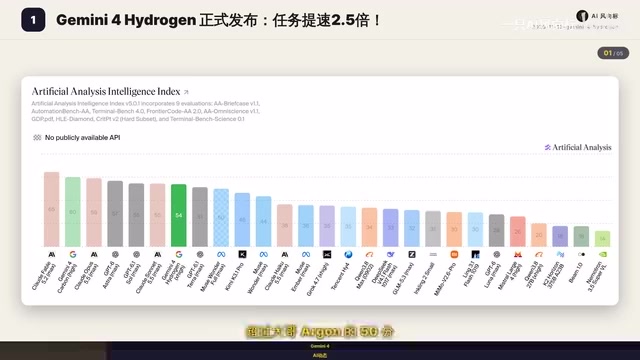
Lightweight Doesn't Mean Low Intelligence: AA Intelligence Index Beats Its Big Brother
The most surprising thing about Hydrogen is that it takes a lightweight approach, yet its intelligence level doesn't suffer for it. On the AA Intelligence Index, Hydrogen scores 54, surpassing its bigger sibling R-'s 50. This result breaks the conventional wisdom that "lightweight models must sacrifice intelligence," and shows that Google has found a new balance point in model compression and efficiency optimization.
CEO Sundar Pichai personally announced the release, underscoring how much Google values Hydrogen. The three brothers of the Gemini 4 family are now complete, forming a full matrix from lightweight to flagship.
AA Intelligence Index: A comprehensive model capability benchmark maintained by the independent evaluation organization Artificial Analysis, covering knowledge Q&A, mathematical reasoning, code generation, instruction following, and other task categories, ultimately converted into a single score from 0-100. It does not rely on vendor-reported data, but instead uses a unified question bank and standardized process to test all models under the same conditions, so it is widely used as a reference for cross-comparison. Score gaps within a few points are usually considered the same tier and need to be interpreted alongside specific sub-items and error margins; when a lightweight model surpasses a flagship with more parameters on the total score, it often means improvements in training data mix, distillation, or inference efficiency rather than mere scale effects.
Real-World Speed Test: Fastest Single Step on the Agent Arena Leaderboard
Speed is Hydrogen's headline selling point. Compared with 3.8 Flash, task completion is 2.5x faster. Third-party testing further corroborates this: on the Agent Arena real-world leaderboard, Hydrogen set the fastest single-step record at just 7.3 seconds.
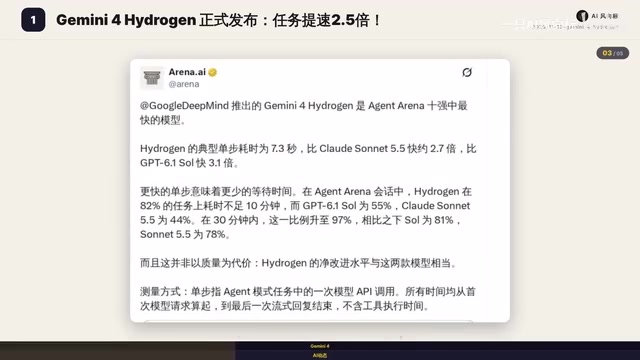
Compared horizontally with competitors, this figure is 2.7x faster than Claude Sonnet 5.5 and 3.1x faster than GPT 6.1 So. One more practical data point: 82% of tasks can be completed within 10 minutes. For Agent scenarios that require rapid iteration, this speed advantage translates directly into development efficiency.
Agent Arena and "single-step latency": Agent Arena is a public evaluation platform for agent tasks, where models complete tasks through real tool calls, multi-turn planning, and environment interaction, with the latency and success rate of each step recorded. "Single-step latency" refers to the average time required for an agent to execute one complete action (one inference plus one tool call or environment operation), not the total duration of the entire task. It reflects responsiveness in interactive scenarios better than total duration, because agent tasks often contain dozens of steps, and single-step latency gets amplified step by step. Single-step speed alone is not enough to judge superiority; it should be considered together with task completion rate and total number of turns.
Four Thinking Levels: Pay-as-You-Need Reasoning Depth
Hydrogen offers 4 thinking levels, selectable from Low to High as needed. The logic behind this design is clear—pay only for the reasoning depth you need. Use lower levels for simple tasks to gain speed, switch to higher levels for complex tasks to maintain quality, and users don't have to pay for reasoning capability they won't use.
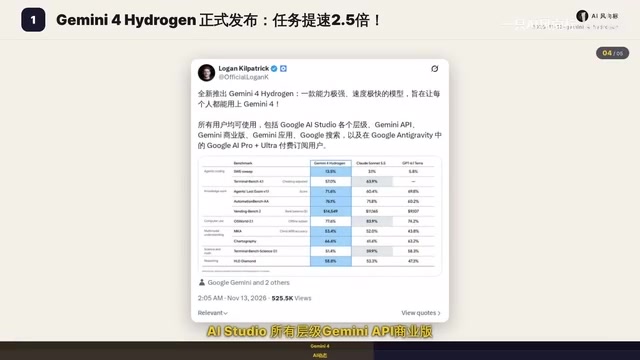
On pricing, it's $1.50 per million tokens for input and $7.50 for output, with a unified price across the full context. Combined with the lightweight model's speed, this pricing is quite competitive in cost-sensitive scenarios.
Benchmark Results and Availability
On benchmarks, Hydrogen also performs well: 58.8% on HLV Diamond, 71.6% on Agents Last Exam, and it maintains a lead over Claude and GPT 6.1 across multiple comparisons.
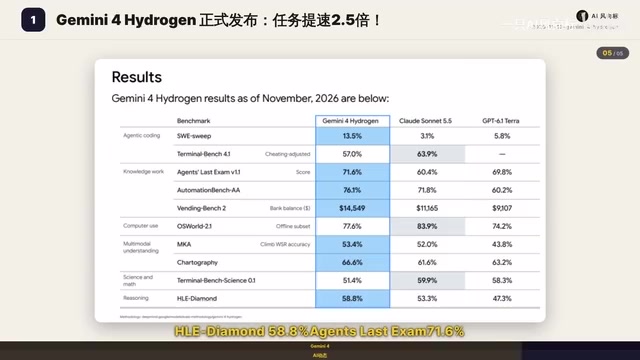
In terms of availability, it's fully open: all tiers of AI Studio, the commercial Gemini API, the Gemini App, and Google Search all support it, and free users also get access in Auto mode. To test the speed and cost math of this lightweight model yourself, just open AI Studio and select Gemini 4 Hydrogen.
HLV Diamond and Agents Last Exam: The former is a test set for high-difficulty multidisciplinary knowledge and reasoning, with questions screened to reduce the proportion of memorization-type items; a score of 58.8% is upper-middle level. The latter focuses on an agent's one-shot pass capability on long-horizon chains, tool use, and open-ended problems; 71.6% means the model can independently complete most complex tasks end-to-end without human correction. The common feature of such benchmarks is that they emphasize "getting it right the first time" rather than multiple attempts, so they better reflect model usability in real production environments—but sample sizes are relatively limited, and the fluctuation range for individual scores is also larger.
Related articles

Gemini 4 Neon Leak: A Potential Strong Contender Against Opus 5.5
A Hacker News thread suggests Gemini 4 Neon looks like an Opus 5.5 competitor. This article unpacks the product positioning behind this community signal, shifts in the top-model competitive landscape, and what it means for developers' model selection strategy.

Claude Fable 5.2's Self-Authored Short Film 'Fable' Sparks Discussion
A short film 'Fable,' credited to Claude Fable 5.2 for script, visuals, and directing, appears on Hacker News. This article analyzes the significance of full-pipeline AI creation, community reactions, and what it means for content creators.

Anthropic IPO Pricing: A Signal of AI Giants Going Public
Anthropic's IPO pricing draws attention. This article analyzes its potential impact on AI industry valuation, commercialization paths, and the competitive landscape, and highlights public-market expectations and challenges for AI companies.