Google's AI Monetization Dilemma: Behind the Slowing Growth of Search Ads

Google search queries hit a five-year high, but AI search has yet to find a monetization path, slowing revenue growth.
Alphabet's latest earnings show Google search query growth at a five-year high, but search revenue growth year-over-year fell from about 17% last quarter to 12%, and paid click growth is also decelerating. This paradox reveals that AI search experiences (like AI Overviews) improve information retrieval efficiency but may reduce users' willingness to click on ads, undermining the foundation of traditional search advertising. Meanwhile, advertiser budgets are migrating to new entry points like AI chatbots, intensifying competitive pressure. Google hasn't clarified its AI search monetization strategy, and AI's revenue contribution has yet to materialize. The article argues that how to make AI search "print money" like traditional search is an unsolved challenge for Google and the entire search advertising industry.
Google's search business is facing an awkward reality: query volume is growing, but ad revenue growth is slowing. Alphabet's latest earnings report shows that search query growth has hit a five-year high, yet search revenue growth year-over-year has slipped from about 17% last quarter to 12%. This contrast reveals a core problem: Google hasn't yet found a way to make AI as profitable as search ads.
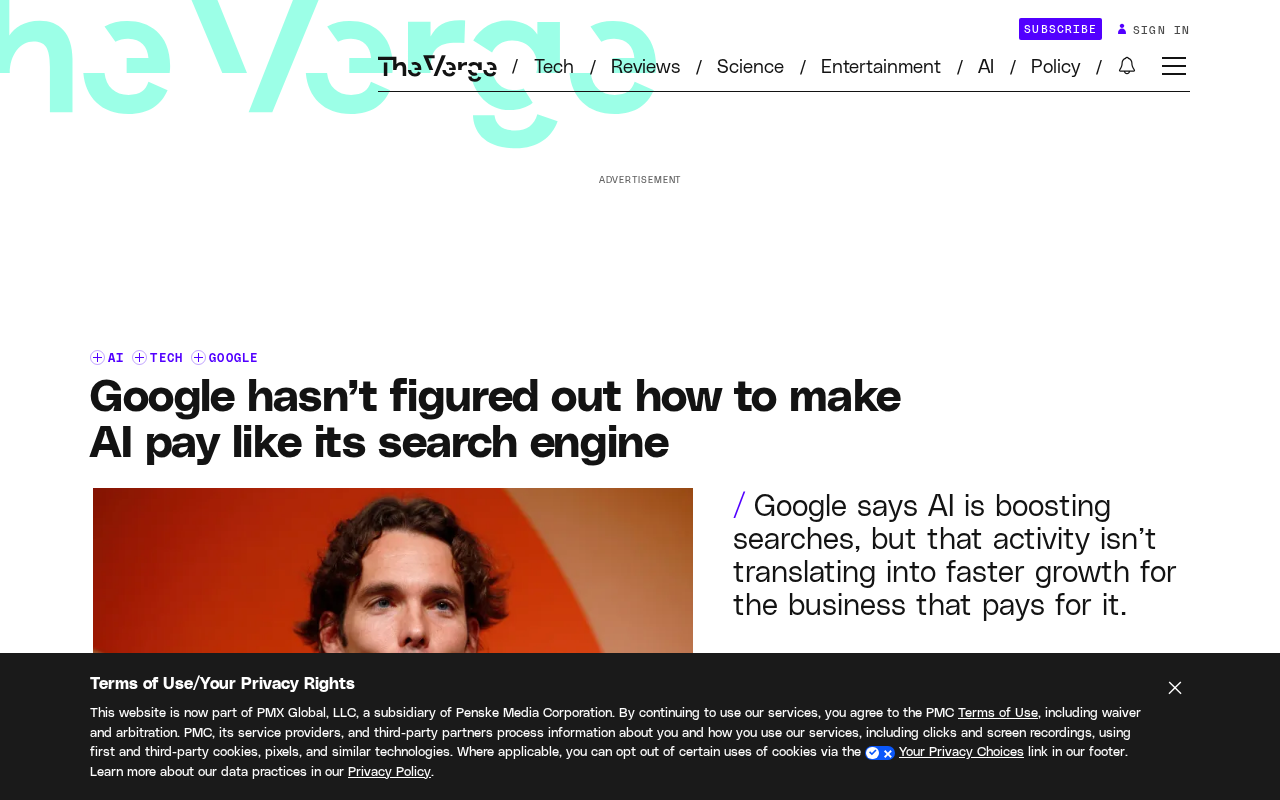
The Paradox of Surging Queries and Slowing Revenue
Alphabet revealed in its earnings report that search queries are growing at the fastest pace in five years. That sounds like good news—users still rely on Google Search. But paradoxically, search revenue growth has slowed markedly: 12% year-over-year in the third quarter, down from about 17% the previous quarter. Paid clicks (i.e., ad clicks) growth is also decelerating.
This divergence means that the additional queries aren't translating into proportional ad revenue. Users are searching more, but Google may be earning less from each search. The introduction of AI search experiences may be changing user click behavior, but it hasn't yet formed a new monetization loop.
Paid Clicks is one of the key metrics for measuring search ad performance, referring to the number of times users actually click on ad links. Alphabet, Google's parent company, discloses year-over-year changes in paid clicks in its earnings reports, along with changes in cost-per-click (CPC). Slowing paid clicks growth means the efficiency of converting ad impressions into clicks is declining; even if query volume rises, advertisers may not get the traffic they expect. This metric is highly correlated with search revenue growth: Revenue = Clicks × Cost-Per-Click. Therefore, when paid clicks growth decelerates, search revenue struggles to grow in tandem even if query volume surges.
AI Search: Better User Experience, Business Model Still Unresolved
Google is integrating AI into search—features like AI Overviews provide direct answers, reducing the need for users to click on external links. This improves information retrieval efficiency but also undermines the foundation of traditional search advertising: advertisers pay on the premise that users click on ad links.
When AI answers questions directly, users spend more time on the search results page, but their willingness to click on ads or organic results may decline. Google hasn't disclosed the specific impact of AI search on ad click-through rates, but the slowing growth of paid clicks indicates that pressure is already evident.
AI Overviews is a search feature officially launched by Google at its 2024 I/O developer conference. It uses the Gemini large model to generate a comprehensive summary at the top of the search results page, directly answering user queries and providing links to sources. Unlike the traditional "ten blue links," AI Overviews allow users to get answers without clicking into any website. The feature was initially available to all users in the U.S. and later expanded to more countries and regions. Its core value lies in improving information retrieval efficiency, but it has also raised concerns about "zero-click searches"—where users stay on the results page and no longer click on ads or organic results, thereby weakening the exposure and click base for search ads.
Advertiser Budget Migration and Competitive Pressure
The other side of slowing search revenue is the shift in advertiser budgets. With the rise of new entry points like AI chatbots, some marketing budgets may flow to other platforms. Google needs to find new ways forward for advertising in the AI era while maintaining search ad revenue.
Currently, Google hasn't detailed its monetization strategy for AI search. On the earnings call, management may face analysts' questions about how AI contributes to revenue. But at least judging from this quarter's data, AI's revenue contribution has yet to materialize.
Conclusion: Growing Pains in Transition
Google's dilemma is not unique; it is a microcosm of the entire search advertising industry amid the AI wave. Query growth proves that user demand is strong, but how to make AI search "print money" like traditional search remains an unsolved problem. For content creators and advertisers who rely on Google traffic, this means future投放 strategies may need to adapt more flexibly to changes.
Whether Google can rebuild an advertising ecosystem in AI search will determine its growth story for the next decade. For now, the answer is still on the way.
Related articles

How Accurate Are Sci-Fi's Predictions About AI?
How accurate are sci-fi's predictions about AI? Drawing on a Hacker News discussion, this article analyzes sci-fi's foresight and blind spots in AI development, arguing its true value lies in inspiring thought rather than precise prediction.

SwarmEvolve: Latent-Space Agent Swarms Accelerate Evolutionary Search
SwarmEvolve lets hundreds of low-cost agents swarm-reason in latent space, sharing info via KV caches to achieve fast evolutionary search for math and science problems—reaching in a median of 3–8 minutes the best scores other frameworks need 60 minutes for.

trainlint: Static Checks Catch ML Training Bugs That Don't Crash
trainlint is a static analysis tool that finds ML training bugs that don't throw errors, including data leakage, leftover eval mode, and softmax/CrossEntropyLoss conflicts across 14 categories. This article covers its principles, validation results, and limitations.