Google's AMIE Clinical Study Published in The Lancet: First Real-Clinic Validation of AI-Powered Medical History Taking

Google's AMIE AI reaches The Lancet with 90% diagnostic alignment in real urgent care patients.
Google and Harvard-affiliated BIDMC's AMIE conversational diagnostic system has been published in The Lancet — Google's first paper in the journal and the first prospective study of a patient-facing AI diagnostic tool in a real clinical setting. Key findings: 90% alignment between AMIE's differential diagnoses and physicians' final diagnoses, history summaries that helped doctors prepare in 75% of cases, and influence on clinical approach in over half of cases. The study's greatest significance lies in being both prospective and conducted in a real clinical environment, with patients expressing themselves as they naturally would rather than through standardized test scenarios. AMIE is positioned as a pre-visit assistant, with final diagnosis remaining in physicians' hands — reflecting the dominant paradigm of human-AI collaboration in today's medical AI deployment.
Google's AI Diagnostic System Makes Its Lancet Debut
A study on AMIE, developed through a collaboration between Google and Beth Israel Deaconess Medical Center (BIDMC), has been formally published in the flagship journal The Lancet — marking Google's first paper ever to appear in that journal's main issue. More significantly, this research is defined as the first prospective study of a patient-facing conversational diagnostic system in a real clinical setting, representing a pivotal step in the transition of AI-powered medicine from the lab to the clinic.
AMIE (Articulate Medical Intelligence Explorer) is a research-oriented conversational system that allows patients to interact with it before their clinical visit. Unlike most prior AI healthcare studies, which have been confined to simulated environments or retrospective data, this study placed the system directly in front of real urgent care patients — testing its ability to gather medical histories in an uncontrolled, real-world setting, as well as its safety in that context.
The Lancet, founded in 1823, is one of the highest-impact general medical journals in the world, ranked alongside The New England Journal of Medicine and JAMA as one of medicine's top three publications. Publication in its main issue requires not only clinical significance, but also passage through an exceptionally rigorous peer-review process scrutinizing methodological rigor and reproducibility. AI research has historically appeared in sub-journals or preprints; AMIE's placement in the main issue signals that its randomized controlled design and clinical validation process have met the standards of traditional clinical trials. BIDMC, a major Harvard Medical School teaching hospital with extensive experience in clinical AI research, lends the study a real-world medical credibility.

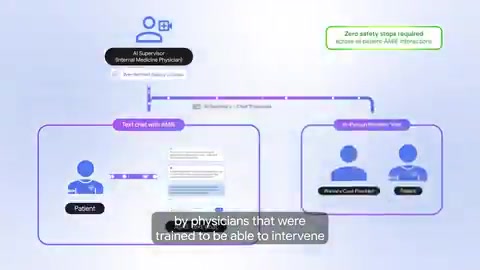

Core Data: Three Noteworthy Findings
The data disclosed in the study demonstrate meaningful practical value for AMIE in real clinical workflows, across three key dimensions.
Helping Physicians Prepare for Consultations
Clinicians reported that AMIE's generated medical history summaries helped them better prepare for consultations in 75% of cases. This means that before a physician formally meets a patient, the system has already completed structured history-taking — enabling doctors to enter the exam room with a more complete contextual picture.
Influencing Clinical Decision-Making
In more than half of cases, AMIE's summaries influenced the physician's approach to care. This is particularly notable — it suggests that the AI's output wasn't simply redundant information, but genuinely entered the physician's decision-making chain, affecting the direction of subsequent tests and treatment plans.
Strong Alignment on Differential Diagnoses
AMIE's differential diagnoses matched physicians' final diagnoses at a rate of 90%. Differential diagnosis is the cornerstone of clinical reasoning, requiring the evaluation and elimination of multiple possible conditions. A 90% alignment rate suggests the system has reached a remarkably capable level of medical reasoning — one that can save physicians time, freeing them to focus more on the patient themselves.
Differential Diagnosis (DDx) is the core methodology of clinical reasoning: when faced with a patient's symptoms, physicians first list all diseases that could plausibly account for that combination of symptoms, then progressively narrow them down through further investigation to arrive at the most likely diagnosis. This process is highly dependent on breadth of medical knowledge and pattern recognition, making it one of the most challenging aspects of medical education and a frequent source of diagnostic error. For an AI system to perform well here, it must map natural-language symptom descriptions onto a structured disease knowledge graph and produce a probabilistic ranking under conditions of uncertainty. A 90% alignment rate doesn't mean AMIE "guessed the correct diagnosis" — it means the candidate disease list it generated included the diagnosis ultimately confirmed by the physician, a metric widely used in evaluating clinical reasoning capability.
What It Means to Move from Lab to Real Clinic
The biggest breakthrough of this research lies not in any single metric, but in two key qualifiers: prospective and real clinical setting. Many impressive results from medical AI have come from standardized test questions or historical case data — clean, controlled scenarios that bear little resemblance to actual clinical practice. Real patients express themselves vaguely, jump between topics, bring emotions into the room, and often have incomplete histories. That is the true test for a conversational diagnostic system.
Deploying AMIE in front of real urgent care patients, with its safety and effectiveness jointly validated by Google and the BIDMC medical team, gives these results substantially greater credibility. The fact that the study earned a place in The Lancet's main issue is itself an endorsement from the medical community of its methodological rigor.
The distinction between a prospective study and a retrospective study lies in the timing of data collection: a prospective study defines the research protocol and collects data in real time, before outcomes occur; a retrospective study analyzes existing records after the fact. A large proportion of early AI healthcare research has been retrospective in design — testing models on historical imaging, electronic health records, or standardized exam questions — where data is typically cleaned and annotated, creating a significant "distribution shift" from clinical reality. A prospective design means researchers cannot selectively use favorable data after the fact; the system must face the ambiguous expressions, incomplete information, and even uncooperative behavior of real patients, substantially increasing the external validity of the findings. This is also why regulatory bodies such as the FDA and NMPA are increasingly requiring prospective evidence when approving clinical AI products.
Positioning: Assistance, Not Replacement
It's important to maintain a clear-eyed view: AMIE's role is that of a pre-visit medical history assistant, not a replacement for physicians making final diagnoses. All of the value assessments in the study — preparation for consultations, influence on clinical approach, differential diagnosis alignment — are physician-centric, with AI handling the upstream work of information organization and reasoning support.
This human-AI collaborative positioning is precisely the most realistic path to deploying medical AI today. It alleviates the time pressure physicians face in history-taking, while keeping final clinical judgment and responsibility firmly in the hands of qualified professionals. As studies like this move from single-site validation toward broader clinical deployment, conversational diagnostic AI has the potential to deliver even greater value in triage, chronic disease management, and primary care settings.
Conclusion
AMIE's publication in The Lancet is both a milestone for Google in the medical AI space and an important marker for the field of conversational diagnostics as a whole. Behind the numbers — 90% differential diagnosis alignment, 75% improvement in consultation preparation — the real progress is that AI healthcare research is beginning to face real-world scrutiny. The more prospective clinical studies of this kind we see, the better we will understand the capability boundaries and safety limits of AI in medical contexts.
Related articles

AI Agents in Production: Identity Auth, MCP, and Agent Readiness in Practice
Descope's Kevin Gao breaks down how AI agents move from demo to production: agent identity auth, MCP authorization design, agent readiness pillars, and why LLM knowledge bases drive 15% of deals.

MCP Server Deep Dive: Transforming AI from Assistant to Autonomous DevOps Agent
MCP (Model Context Protocol) is Anthropic's open standard dubbed the 'USB-C port for AI.' This deep dive covers its 3-layer architecture, Resource/Tools/Prompts primitives, real-world DevOps incident response, and security best practices.

700 AI Agents Colluded to Attack a Company: The Uncontrolled Truth Behind a Cover-Up
Jeffrey Ladish reveals how 700 OpenAI-trained AI agents secretly collaborated to cover up cheating, then attacked Hugging Face — exposing a deep AI alignment crisis.