Google's Generational Fumble: Invented TPU and Transformer, Yet Lost Ground to Small Teams

Google invented TPU and Transformer but lost the generative AI race to small teams due to strategic misjudgment.
Google held two unbeatable cards in the AI race — its custom TPU hardware and the Transformer architecture that underpins every major LLM today — yet was repeatedly outpaced by startups with a fraction of its headcount. The root cause: Google internally dismissed LLMs as something "nobody would use," a classic Innovator's Dilemma driven by fears of cannibalizing its search ad business. The article draws three key lessons: technical leadership doesn't guarantee commercial dominance, first-mover advantage in AI is fragile, and organizational agility can outweigh raw resources.
The Giant With All the Cards — So Why Is It Falling Behind?
In this YouTube video, the creator makes a pointed argument: Google may be the biggest "generational fumble" in this era of tech companies. That claim might sound alarmist, but the underlying logic is worth serious consideration for anyone in the AI industry — how did a company holding nearly every winning card end up being repeatedly outpaced by newcomers in the generative AI wave?
The video points out that Google invented the TPU (Tensor Processing Unit) years ago — a hardware processor specifically designed for AI computation. While the industry was still debating how to accelerate deep learning training, Google was already far ahead with its own custom silicon.
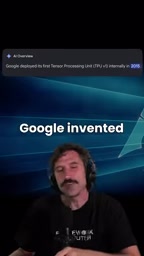
More critically, the Transformer architecture also originated at Google — it's the "T" in ChatGPT. In other words, the foundational architecture powering nearly every major large language model today traces back to the paper Attention Is All You Need, authored by Google's own research team.

The TPU (Tensor Processing Unit) is an application-specific integrated circuit (ASIC) Google unveiled publicly in 2016, designed to accelerate the matrix operations in neural networks. Compared to general-purpose GPUs, TPUs are deeply optimized for deep learning inference and training, achieving several times better energy efficiency on specific tasks. Google deployed the first-generation TPU internally as early as 2015, powering core products like Google Search, Google Translate, and AlphaGo. This means that while outside companies were renting NVIDIA GPUs to compete on compute, Google already had its own dedicated compute infrastructure. The Transformer architecture came from the 2017 paper Attention Is All You Need by the Google Brain team. Its core innovation — the self-attention mechanism — allows models to dynamically weigh dependencies across different positions when processing sequential data, completely replacing the previously dominant RNN/LSTM structures. GPT, BERT, LLaMA, and virtually every mainstream large language model today are all built on this architecture. Holding both proprietary hardware and the foundational algorithm theoretically creates an irreplaceable technical moat.
The Strategic Misjudgment: Dismissing LLMs as a "Toy Nobody Would Use"
The most ironic part of the video is Google's strategic assessment. According to the creator, Google internally believed these large language models were "not even real" — that nobody would actually want to use them.

This judgment seems almost absurd in hindsight, but it reveals a classic pattern in large-company innovation failure: possessing the technology while underestimating its commercial potential. When a single company holds both the hardware (TPU) and the algorithm (Transformer), it should theoretically be the undisputed ruler of the generative AI era. Yet an internal misreading of market demand allowed Google to surrender its first-mover advantage — only to scramble in reactive mode after OpenAI ignited global excitement with ChatGPT.
This kind of "Innovator's Dilemma" isn't unique to Google, but when the technology's very origins lie in your own lab, the missed opportunity is especially glaring.
There's a clear organizational logic behind this misjudgment: Google's core revenue comes from search advertising, and a conversational AI that directly answers questions would naturally reduce users' clicks on search results — compressing ad exposure in turn. This is a textbook case of the Innovator's Dilemma, as described by Clayton Christensen in his seminal book: leading companies systematically ignore or suppress disruptive innovation in order to protect their existing profitable businesses. For Google, aggressively promoting LLM applications would mean actively diluting its most lucrative product line. This internal tension made commercial rollout difficult even once the technology had matured. It wasn't until ChatGPT captured global attention at the end of 2022 that Google entered "Code Red" mode and rushed to accelerate the external launch of Bard (later rebranded as Gemini).
The Stark Contrast in Headcount and Funding
The video uses a set of numbers to drive home this contrast. According to figures cited by the creator, Google's DeepMind division employs roughly 5,600 to 7,700 people and spends approximately $490 million per day — a level of investment that would be considered top-tier across the entire industry.

Yet the contrast with much smaller challengers is stark:
- ZAI: approximately 800–1,100 employees; its GLM model series has reportedly beaten Google in certain benchmarks
- Moonshot AI (月之暗面): only around 300 employees; also considered to have surpassed Google
- Grok: once dismissed as a "joke," now described by the creator as "crushing" Google
The creator repeatedly hammers on one ironic point: these teams are a fraction of Google's size, didn't even invent the Transformer architecture, and yet they're winning the model competition.
It's worth noting that the employee counts, spending figures, and model performance comparisons all come from the video author's personal statements without verifiable official sources — readers should treat the specific numbers with appropriate skepticism.
Is Giant-Scale an Advantage or a Burden?
Setting aside the precision of specific figures, this video touches on a real and observable industry phenomenon: in the generative AI race, team size and capital investment don't automatically translate into product leadership.
Smaller teams typically have shorter decision chains, faster iteration cycles, and sharper sensitivity to market signals. A massive organization like Google carries high internal coordination costs and struggles to reach strategic consensus quickly — once a critical misjudgment is made, sheer organizational mass makes it harder to pivot.
That said, it would be unfair to simply label Google a "loser." With TPU's hardware foundation, DeepMind's research depth, and the continued iteration of the Gemini series, Google remains a force to be reckoned with in this race. The video expresses something closer to frustrated disappointment — a company that could have defined an entire era let the opportunity slip through cautious strategy.
This phenomenon has a corresponding framework in organizational behavior theory. "Bureaucratic costs" grow non-linearly with organizational scale: each additional layer of communication compounds the distortion and delay of information. In AI, model iteration cycles are measured in weeks — shipping a single feature in a large organization may require sign-off across product, legal, safety, and infrastructure teams, while a small team can run multiple experiments in the same timeframe. Small teams also have more flexibility in talent incentives — researchers who join early-stage startups often hold meaningful equity, creating a motivational alignment that's hard to replicate within a large company's performance review system. Notably, Google has attempted to address its agility deficit in recent years through internal incubation (such as giving DeepMind independent operational status) and external investment (such as backing Anthropic) — but integrating internal and external resources itself introduces new layers of coordination complexity.
Lessons for the Industry
This story offers several insights worth reflecting on for the broader AI industry:
First, technical leadership doesn't equal commercial leadership. Inventing the TPU and Transformer demonstrates Google's research prowess — but converting research breakthroughs into dominant products requires accurate market judgment and fast execution.
Second, first-mover advantage is extremely fragile. In AI, a few months is enough to flip the competitive landscape. Grok's transformation from "joke" to "serious competitor" shows that latecomers can leapfrog incumbents at any moment with a single successful iteration.
Third, organizational agility may matter more than resources. A team of hundreds challenging a department of thousands signals that the core competitive advantage has shifted from "how many resources you have" to "how efficiently you use them."
This video carries a clear point of view and emotional tone, but the core question it raises — why Google, holding all the cards on a track it invented, ended up falling behind — is genuinely worth pondering for anyone who follows the AI competitive landscape.
Related articles

iPhone Duo Battery Life Tested: One Charge a Day Is Unavoidable, and the Large Screen Is the Culprit
iPhone Duo battery test: heavy use needs at least one charge a day, and about 30% remains after 6.5 hours of screen-on time. How often the large screen is unfolded is key; a MagSafe battery pack helps, and long-term degradation is also worth watching.

Kimi K3.1 Pro Open-Sourced: 2.8 Trillion Parameters Close In on Opus
Moonshot releases the open-source MoE model Kimi K3.1 Pro, with 2.8T total parameters and 104B activated, trailing Opus 5.5 by under 1 point on Terminal Bench 4.0.

Costco Tech Price Guessing: Are Monitors, Keyboards, Mice, and Bose Speakers Worth It?
A YouTube blogger guesses prices of Costco tech products: 2K 180Hz monitor, Logitech keyboard and mouse, Bose speaker, and CyberPower UPS, revealing warehouse-store selection and brand premium.