Google's Mysterious Image Model Mondrian Exposed, Sonnet 4.5 to Be Discontinued

Google, xAI, Anthropic, and OpenAI release major product updates and strategic shifts in rapid succession
This article covers several major AI industry developments: Google's new image model Mondrian impresses in Arena testing with an expected May 19 release; xAI launches coding assistant Grok Build and briefly exposes a computer control feature; Anthropic plans to discontinue Claude Sonnet 4.5; OpenAI fully shuts down its fine-tuning API, believing GPT 5.5 is powerful enough; and ByteDance raises AI infrastructure spending by 25% to approximately 200 billion RMB.
Google's New Image Model "Mondrian" Appears in Arena Testing
A mysterious image generation model codenamed "Mondrian" has recently appeared in the AI Arena. The model identifies itself as coming from Google DeepMind, and industry insiders widely speculate it to be the next-generation Nano Banana model.
It's worth noting that the AI Arena (Chatbot Arena) is an open model evaluation platform created by UC Berkeley's LMSYS team. It uses a "blind battle" mechanism: users simultaneously chat with two models without knowing their identities, vote for the winner based on response quality, and employ an Elo rating system derived from chess rankings for dynamic scoring. Because its evaluation method closely mirrors real user experience, major AI companies often submit models under anonymous codenames for "warm-up testing" before official releases — Mondrian's appearance follows this established practice.
"Nano Banana" is one of the internal codename systems for Google DeepMind's image generation model series, continuing Google's tradition of naming experimental models after fruits or foods. Google's technical roadmap in image generation primarily relies on the convergence of the Imagen series (based on diffusion models) and Gemini's multimodal capabilities, having already launched commercial-grade products like Imagen 3 in recent years. The codename Mondrian references the Dutch abstract painter Piet Mondrian, famous for his geometric color-block compositions — a fitting name for an image model.
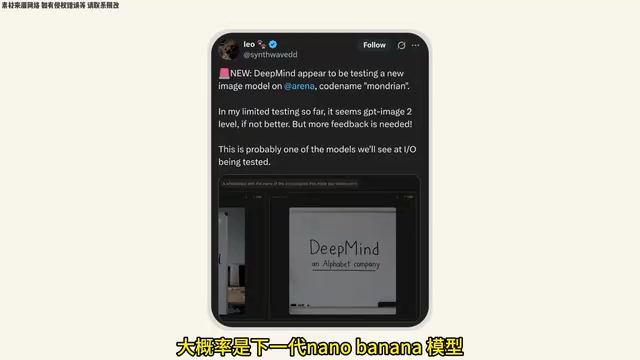
Based on feedback from users who have participated in testing, Mondrian's performance is quite impressive — its overall capability is on par with GPT's image generation model MH2, with performance even surpassing MH2 in certain scenarios. According to the current timeline, the model is expected to be officially released on May 19. If confirmed, this would represent another significant breakthrough for Google in the image generation space.
xAI Launches Coding Assistant Grok Build
Desktop-Level Coding Tool Directly Competing with Codex
xAI is about to launch a desktop-level coding assistant called Grok Build, explicitly positioned against competitors like OpenAI's Codex. Musk previewed the upcoming Grok Build Beta release last month, but it has been delayed for unknown reasons until now. Some users have already received beta access.
OpenAI Codex was one of the first commercial products to systematically apply large language models to code generation, and served as the underlying engine for GitHub Copilot. As coding capabilities across major models have improved comprehensively, AI coding assistants have evolved from simple code completion tools to "intelligent development partners" supporting full project generation, debugging, and refactoring. Current players in this space include GitHub Copilot, Cursor, Windsurf, and Devin, competing across dimensions such as code quality, context window length, and IDE integration depth. Grok Build's choice to enter via a desktop client aims to provide deeper local development environment integration, differentiating itself from purely cloud-based API solutions.
Grok Computer Feature Briefly Exposed
More notably, users discovered that a "Grok Computer" option briefly appeared on the Grok web interface. This feature supports executing tasks both locally and in the cloud, indicating that Grok is evolving toward a general-purpose computing agent. However, the feature was quickly taken down, clearly not yet ready for official release.
The Computer Use Agent concept that "Grok Computer" points to represents an important frontier in expanding AI capabilities. This technology allows AI models to operate graphical interfaces like humans — capturing screens, identifying UI elements, and simulating mouse clicks and keyboard inputs to complete complex cross-application tasks. Anthropic pioneered this with Claude Computer Use in 2024, and OpenAI subsequently released its Operator product. If Grok Computer can support both local and cloud execution simultaneously, it means xAI is building a universal task execution layer that transcends device boundaries — a strategically valuable foundational capability within its ecosystem.

From a product strategy perspective, xAI is rapidly filling out its toolchain — from conversational models to coding assistants to computer control — attempting to build a complete AI ecosystem.
Anthropic Plans to Discontinue Claude Sonnet 4.5
According to reports, Anthropic plans to discontinue the Claude Sonnet 4.5 model, with expected removal from the Claude app on May 15. However, API access will remain open temporarily, giving developers a migration buffer period.

This decision is not surprising. As newer model versions are released, the maintenance costs of older versions become disproportionate to their benefits, and gradual phase-outs are standard industry practice. Developers relying on this model need to evaluate migration options as soon as possible.
OpenAI Fully Shuts Down Fine-Tuning API
OpenAI announced a major policy change: since GPT 5.5 is already powerful enough in instruction following and format consistency, the company has decided to fully shut down its fine-tuning service API.

The specific arrangements are as follows:
- New users: Fine-tuning service is no longer available
- Existing users: Can use the service until January next year at the latest
- Deployed models: Will be discontinued alongside their base models (e.g., when GPT 5.4 is retired, fine-tuned models based on 5.4 will also be shut down simultaneously)
There is profound technical evolution logic behind this decision. Fine-tuning refers to the technique of performing secondary training on a pre-trained large model using domain-specific data. In the early GPT-3 era, it was virtually the only reliable path to achieving vertical scenario customization. However, as foundational model capabilities have leaped forward, Prompt Engineering — guiding model behavior through carefully designed input instructions — has gradually been able to replace many effects that previously required fine-tuning. The combined use of few-shot learning, Retrieval-Augmented Generation (RAG), and system prompts enables highly customized outputs without modifying model weights. OpenAI's move is essentially a commercial expression of the judgment that "base model capabilities are already strong enough." However, for vertical domains like healthcare, law, and finance that require strict output formats and specialized knowledge injection, fine-tuning still holds irreplaceable value — undoubtedly increasing uncertainty for developers in these fields.
ByteDance Raises AI Infrastructure Spending by 25%
According to reports, ByteDance plans to increase its AI infrastructure spending by 25%, bringing the adjusted total to approximately 200 billion RMB. Sources revealed that the spending increase is primarily driven by two factors:
- Strategic level: Continuing to increase investment in AI
Related articles
 Tech Frontiers
A Rare Quiet Day in AI: Recursive Self-Improvement Stirs Beneath the Surface
A rare quiet day in AI sees multiple sources go silent simultaneously. Behind the calm, Recursive Self-Improvement (RSI) research continues. What this means for the industry.
 Tech Frontiers
Reve 2 vs. Ideogram 4: A Deep Dive into Layout Control in AI Image Generation
A deep comparison of Reve 2 and Ideogram 4's layout control capabilities, covering technical approaches, real-world use cases, and industry trends for designers and creators.
 Tech Frontiers
In the Weights: Check Your Influence Score in the AI World
In the Weights is an AI influence search engine that quantifies your presence in the AI world with a score. Explore how it evaluates practitioners and what it means for digital identity.