Google's New Gemini Flagship Sweeps Benchmarks: World's Strongest AI or Just a Benchmark Chaser?

Google's new Gemini flagship leads major benchmarks but faces questions about real-world performance and a coding weak spot.
Google's latest Gemini flagship (dubbed "Gemini 4 Argon" in the video) ranked first across all 29 Arena AI categories, with standout advantages in hallucination rates (15%), long-context output (up to 1M tokens), and 3D spatial understanding per Blueprint Benchmark 2. However, the model ranks only eighth in coding evaluations, and a Bloomberg report suggests Google employees found its real-world performance disappointing. The gap between benchmark excellence and actual productivity remains the model's most pressing open question.
Google's latest Gemini flagship model (referred to in the video as "Gemini 4 Argon") has topped multiple benchmark leaderboards, sparking heated discussion across the AI community. According to an analysis by the YouTube channel TheAIGRID, this model leads nearly all other frontier models across dimensions including knowledge work, science and math, long-context tasks, and computer use. But behind those impressive benchmark scores, there remains considerable debate about how the model actually performs in the real world.
Sweeping the Benchmarks — Google Back at the Table
For a long time, Google was widely seen as a "slow-moving dinosaur" in the AI race — sitting on deep technical foundations while repeatedly being outmaneuvered by OpenAI and Anthropic in the public conversation. This latest release appears to have changed that narrative.
According to the official benchmark comparison table, this new model is not part of the lightweight Flash series, but rather a brand-new flagship "primary" model positioned to compete directly with the top frontier products from every major lab. The host of TheAIGRID emphasized that this is a model "stuffed with intelligence," not something meant to be compared against mid-tier products.
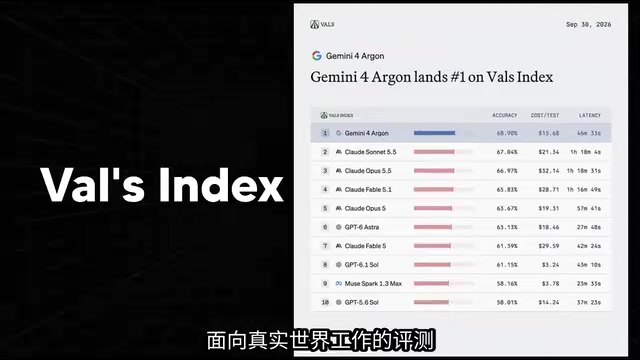
More critically, these results don't come solely from data cherry-picked by Google. On Arena AI, a third-party crowdsourced evaluation platform, the model ranked first in overall performance across all 29 categories, outpacing Anthropic's Opus series, several Meta models, and other competitors. It also topped the Values Index benchmark — which targets real-world work scenarios — beating even models that had been released just days earlier.
Price-to-Performance and Long Context: Google's Hidden Edge
Beyond raw performance, the model's price-to-performance ratio is worth noting. While it doesn't occupy the most attractive position on the "price vs. intelligence" quadrant, its overall pricing is reasonable enough that most users would realistically choose it.
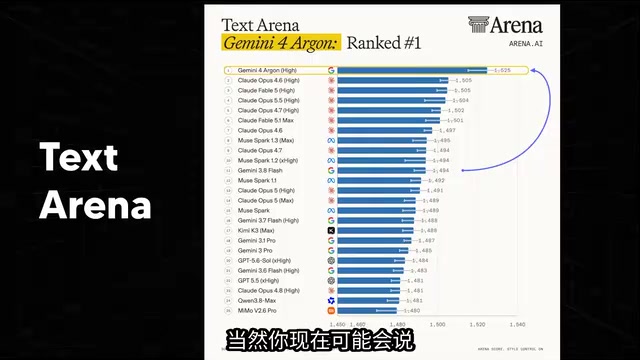
In the Text Arena, the situation gets more interesting. Top models are typically separated by only 5 to 10 points — a difference that's nearly negligible. Yet in the overall rankings, this model pulled ahead by roughly 25 points at one stage, suggesting Google has made some genuinely meaningful breakthroughs in certain areas.
Google's real competitive moat remains its long-context capabilities. The video mentions that Google DeepMind claims the model supports an "output" ceiling of up to 1 million tokens — note that this refers to the output limit, not the context window. This means a single response can generate up to approximately 1 million tokens of content, enough to handle extremely long, multi-step tasks in one shot. Combined with Google's long-standing support for processing up to an hour of video or audio input with fine-grained analysis, this puts the model in a tier that most competitors cannot realistically match in the near term.
A 1-million-token output ceiling is a concept worth unpacking. A token is the basic unit by which large language models process text — roughly, 1,000 tokens equals about 750 English words. Most models separate the "context window" (the maximum amount of information the model can take in at once) from the "output length" (how much it can generate). Typical output limits range from 4,000 to 8,000 tokens, with some high-end models supporting up to 32,000. A 1-million-token output limit means the model can generate text equivalent to a full-length novel in a single response — which is significant for agentic tasks that require generating complete codebases, ultra-long analytical reports, or extended reasoning chains. Tasks won't be cut off mid-way due to output truncation, substantially reducing the failure rate in multi-step automated workflows.
Coding Still a Weak Spot, but 3D World Understanding Surprisingly Strong
Not every dimension is a runaway win. In coding evaluations, the model's performance is relatively underwhelming — according to the Coderino Web Dev leaderboard, it ranks just eighth, barely edging out Qwen 3.8. Given that coding is widely viewed as a critical capability on the path toward "recursively self-improving superintelligence," this gap shouldn't be dismissed. The host himself acknowledged that he has never felt Google's models were meaningfully better at coding than competing products in actual use.

In one unexpected area, however, Google demonstrated outright dominance. According to third-party Blueprint Benchmark 2 testing, this model's understanding of the physical 3D world surpasses every other AI — the benchmark requires models to generate a floor plan from interior photos of an apartment. It outperformed multiple models including Astra, achieving state-of-the-art results in three-dimensional spatial understanding. This aligns with Google's long-term investment in robotics and world models, and reflects a fundamentally different vision for AGI compared to OpenAI and Anthropic.
Blueprint Benchmark 2 is a third-party test specifically designed to evaluate AI spatial reasoning. Its core task requires models to infer and draw a proportionally accurate floor plan based solely on interior photographs — typically multi-angle images of an apartment or room. This challenges image recognition, perspective reasoning, geometric relationship modeling, and structured output simultaneously, far exceeding the difficulty of simple image description or object detection. Google's lead here is closely tied to its long-running work in robotic perception — accurately understanding 3D physical space is foundational to robot navigation and manipulation. This "embodied intelligence" advantage represents a distinctly different AGI pathway compared to OpenAI's focus on code generation and dialogue reasoning, or Anthropic's emphasis on safety alignment, suggesting real divergence in how each lab envisions the road to general intelligence.
Hallucination Rates Drop Sharply — But Real-World Experience Remains in Doubt
Hallucination has been one of the most persistent criticisms of Google's models. Whether it's confusion across chat history, fabricated answers to general questions, or errors quietly introduced into internal reasoning chains, past versions of Gemini have frequently frustrated users.
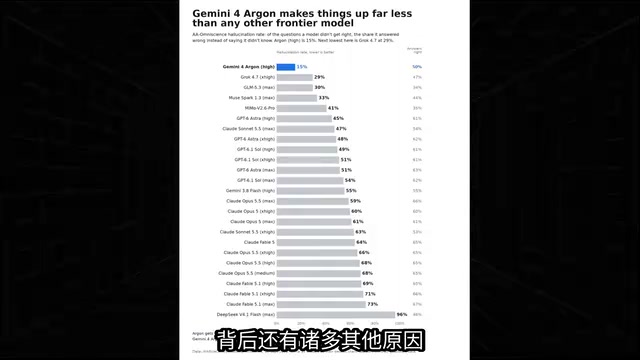
The improvement this time is notable. On hallucination benchmarks, the model scored 15% (lower is better), well ahead of the much higher fabrication rates typical of most frontier models. This suggests Google has made targeted optimizations toward reliability.
That said, whether benchmark scores translate into real-world experience remains the central open question. A Bloomberg report noted that despite the model's strong performance on industry benchmarks, when Google employees actually used it in their day-to-day work, it performed "not that well." TheAIGRID's host was measured in his response — he noted this was only an initial claim from Bloomberg, while also acknowledging that there's a long history of "benchmark hero, experience letdown" cases in AI, likening some past experiences to "talking to an alien that keeps hallucinating."
Hallucination in large language models refers specifically to a model confidently generating content that is factually incorrect — including fabricated citations, invented names or places, or errors quietly embedded in a reasoning chain. This problem stems from the fundamental nature of language models: they predict the most statistically likely next token rather than retrieving verified facts. Hallucination benchmarks (such as SimpleQA or FaithDial) typically measure the "fabrication tendency" by having models answer factual questions with known correct answers and tallying the error rate. A score of 15% means roughly 15% of answers in the test set contain factual errors — lower is better. It's worth noting that different hallucination benchmarks vary significantly in question type and difficulty, so cross-benchmark comparisons of a single number have real limitations; always confirm the test sets are consistent when comparing hallucination data from different sources.
Benchmark Champion or Genuine Productivity Tool?
Ultimately, whether this model is a "paper champion" propped up by benchmarks or a reliable assistant that can genuinely integrate into everyday AI agentic workflows is a question that only large-scale end-user testing can answer.
Google's combined advantages — long context, 3D spatial understanding, lower hallucination rates, and competitive pricing — have undeniably brought it back to the front of the pack. But the coding shortfall and the gap between benchmark performance and real-world experience serve as a reminder that there's still a meaningful distance between ranking first on a leaderboard and being called the world's strongest AI — a distance that only real-world validation can close.
(Note: This article is based on analysis from the single source YouTube channel TheAIGRID. Model naming and some benchmark figures mentioned in the video may contain transcription errors; please refer to official Google releases for authoritative information.)
Related articles

Gemini 4 Argon Hands-On: AI Builds Board Games, Constructs Temples, and Trains Robots Autonomously
Gemini 4 Argon hands-on roundup: AI autonomously builds a desk racetrack and temple in Blender, writes a ray tracing engine, trains a humanoid robot to sink 7 shots, plus API pricing and developer access.

The Magic Octagonal Coin: Why Only 9% of People Can Predict Its Flip?
Only 9% of people can correctly predict the Magic Octagon coin flip. This article explains its spatial rotation mechanism, common cognitive pitfalls, and a new hypothesis based on Relevance Theory, exploring the limits of human spatial reasoning.

Sam Altman: AI Is Entering the Era of Scientific Discovery — Math Breakthroughs Will Replicate in Biology and Energy
Sam Altman says AI is entering the era of scientific discovery — math breakthroughs will replicate in biology, materials science, and energy to help develop new drugs and energy sources.