Google Tests Gemini Feature That Calls Businesses on Your Behalf

Google is testing Gemini's ability to call businesses for users, starting with U.S. Pixel 11 paid subscribers.
Google is testing a new feature that lets its AI assistant Gemini call businesses on behalf of users for tasks like reservations, business hours, and pricing. Building on the earlier Duplex project, this capability is now integrated into the Gemini platform. The initial rollout is limited to U.S.-based Pixel 11 owners with paid Gemini subscriptions. Key challenges include AI transparency during calls, accuracy of information relay, and future scope. It marks a significant step toward AI assistants executing real-world tasks, not just answering questions.
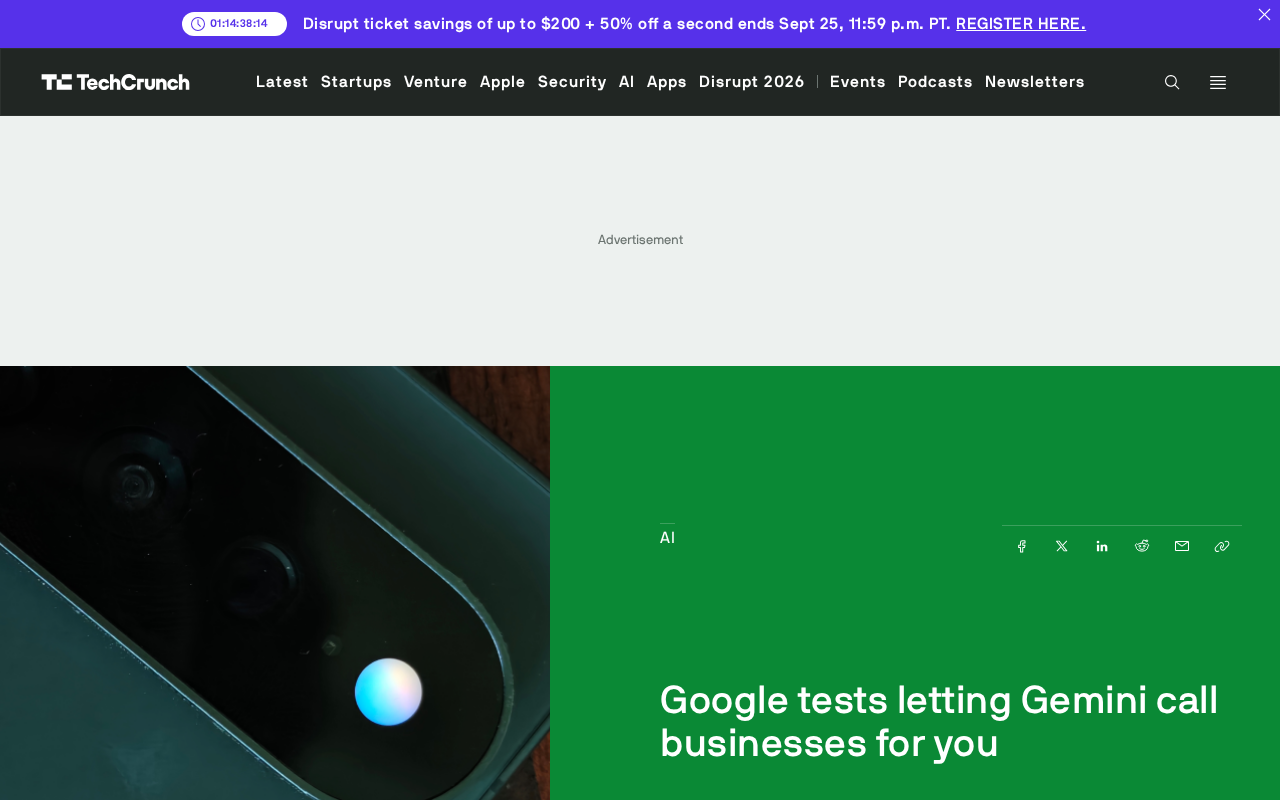
Google is testing an imaginative new feature: letting its AI assistant Gemini make phone calls to businesses on behalf of users. This means that in the future, when you want to make a restaurant reservation, ask about business hours, or confirm service pricing, you may no longer need to pick up the phone yourself — just hand the task to Gemini.
What It Does: Letting AI Handle the Chore of Calling
Calling a business sounds simple enough, but for many people it's a minor daily frustration — waiting on hold, being transferred repeatedly, explaining your needs over and over. Google's AI-powered call feature targets exactly these scenarios.
According to Google, users will be able to ask Gemini to call a business, have the AI handle the conversation, and then report back the results. This capability echoes Google's earlier work on the Duplex project — the idea of having AI complete phone interactions in a near-human way — but this time it's been integrated into the unified Gemini assistant platform.
Google Duplex was an AI phone technology unveiled at Google I/O 2018 that could place calls using highly realistic speech — including filler words like "um" and "uh" — to complete tasks such as restaurant reservations and salon bookings. Duplex was widely praised on a technical level, but it also sparked ethical controversy: many people on the receiving end didn't know they were talking to an AI. Google subsequently required Duplex to identify itself as an automated system at the start of calls in certain regions. The feature was later folded into Google Assistant, and the new Gemini calling capability can be seen as a continuation and upgrade of that technology on a next-generation AI platform. Whether it has learned from past missteps and can do better on transparency remains a key question.
Availability: A High Bar to Clear
Based on what Google has disclosed, the initial rollout is quite limited. The AI calling feature will first be available only to users who meet all of the following criteria:
- Own a Pixel 11 phone
- Are located in the United States
- Have a paid Gemini subscription
Three requirements stacked together means this is more of a small-scale capability test than a broad public launch. Tying new features to the latest flagship hardware and paid subscriptions is consistent with Google's longstanding strategy — using premium devices and higher-tier subscriptions as proving grounds for cutting-edge AI capabilities.
Why Pixel and Paid Subscriptions?
Restricting the feature to Pixel 11 and paid Gemini subscribers reflects several considerations. The latest flagship phones typically carry more powerful on-device processing and the newest OS versions, making them better suited for deeply integrated AI features. Meanwhile, paid subscribers represent the core user group Google relies on to validate the commercial value of AI features and gather high-quality feedback. This gradual rollout approach also helps Google manage risk before expanding access more broadly.
Key Questions Worth Watching
As compelling as the concept is, AI-powered phone calls still face a number of real-world challenges.
First, there's the question of call experience and transparency. When AI places a call on a user's behalf, whether the person on the other end knows they're talking to an AI has always been a contentious issue with this type of technology. Duplex previously sparked debate over whether AI should proactively disclose its identity.
Second, accuracy and reliability matter. For AI to understand a business representative's spoken language over the phone, handle unexpected follow-up questions, and relay information back accurately is no small feat — any breakdown along the way could lead to misunderstandings or real-world consequences.
Finally, there's the question of scope. The feature currently targets the specific scenario of contacting businesses, and it's unclear whether it will eventually expand to handle more complex phone tasks.
On the transparency front, some U.S. states have already enacted relevant regulations. California's BOT Disclosure Act, for example, requires automated accounts to identify themselves when interacting with users — though the law primarily targets online contexts, and its applicability to AI phone calls remains contested. The Federal Communications Commission (FCC) has also been discussing whether to regulate AI-automated calling behavior. This means that as Google rolls out the Gemini calling feature, it will need to navigate compliance frameworks at both the state and federal levels — not just polish the technology — which may be one reason the feature is being tested only in the U.S. and only at small scale for now.
Takeaway
Google's experiment with having Gemini make calls on users' behalf marks another step in AI assistants evolving from answering questions to actually carrying out real-world tasks. While the initial rollout is limited to paid Gemini subscribers in the U.S. with a Pixel 11, it clearly signals the role Google wants Gemini to play — not just answering questions, but genuinely getting things done for you. As testing progresses, whether this feature can strike the right balance between experience, transparency, and reliability will determine how far it ultimately goes.
Related articles

AgentCore in Practice: Connecting Custom Tools and MCP Servers to Agents
DebuggerCafe tutorial shows how to connect custom tools and MCP servers to Amazon Bedrock AgentCore agents, covering tool contract design, MCP reuse, and production concerns.

816B Parameters Scores Only 39? The Real Cost-Effectiveness of the Open-Source LLM Parameter Race
Meta's 816B Muse Spark Open scores just 39 on Artificial Analysis, while 180B Qwen3.8-Flash-Next scores 40. This article analyzes 11 open-weight models' parameters vs. scores, exploring the real impact of activated parameters, quantized size, and deployment cost.

Aerial Manipulators: The Next Step for Drones from 'Seeing' to 'Changing'
Starting from a Reddit discussion, this article analyzes the technical challenges, potential applications, and deployment bottlenecks of aerial manipulators, exploring the key challenges for drones moving from environmental perception to physical manipulation.