Gotchas When Working with Public CHIME/FRB Baseband and Breakthrough Listen Raw Data (Plus a Lightweight ML Detector)

Public FRB data harbor channel and band reversal traps; a lightweight ML detector excels on synthetic data but generalizes poorly to real data.
This article summarizes two key anomalies a developer found while using CHIME/FRB baseband and Breakthrough Listen Parkes Vela public data: CHIME's channel frequency order is opposite to the textbook dispersion formula, requiring a negative sign for dedispersion; BL data have an inverted band, and only beam-3 contains the Vela signal. The developer also designed a lightweight ML detector (16 coherent dedispersion filters + small CNN) that achieved 93–98% detection at 1% false alarm on synthetic data, far exceeding a generic CNN's 70%, but localized only 5–6 of 10 real pulses, comparable to catalog-DM dedispersion. The article emphasizes empirical verification of physical conventions before using public data and highlights ML generalization challenges on real data.
Introduction
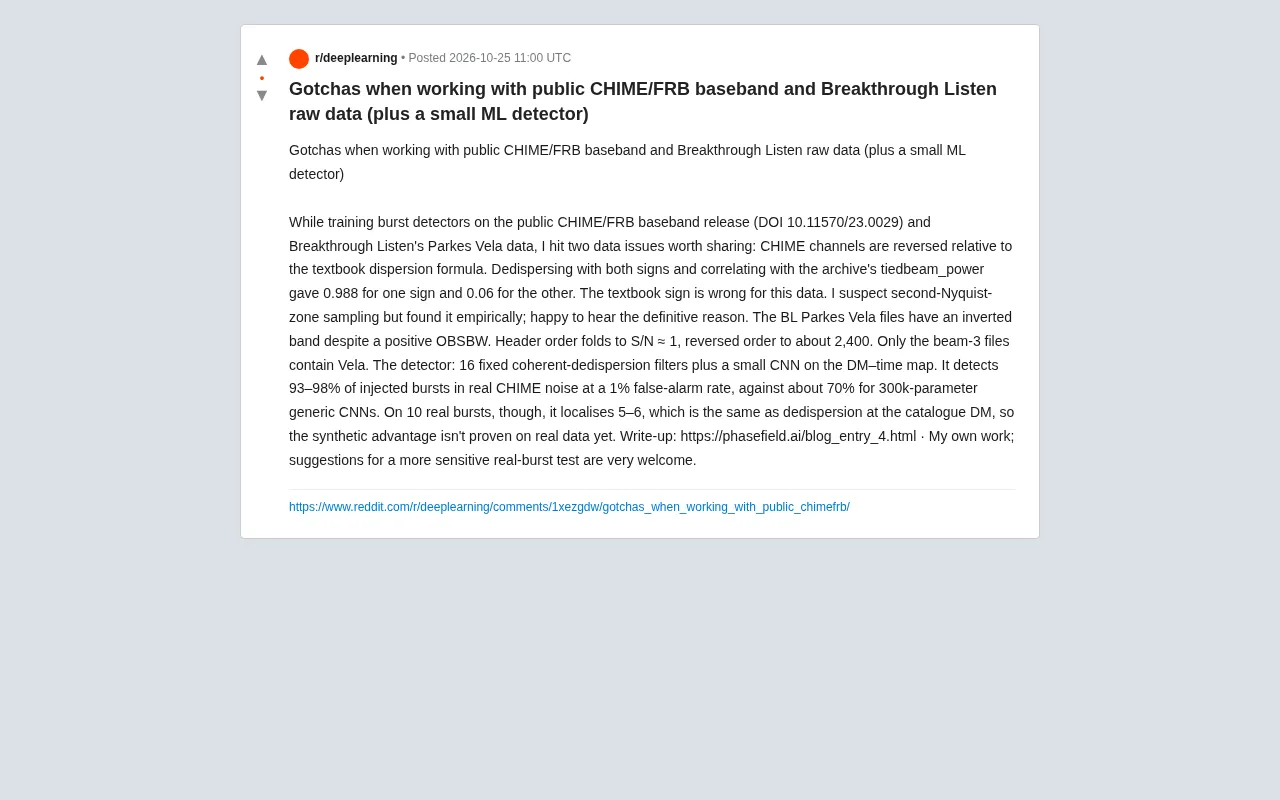
Fast radio burst (FRB) research in radio astronomy relies heavily on the correct handling of public datasets. However, data from different telescopes often contain subtle "gotchas" in format and physical conventions. Recently, while training an FRB detector, a developer working with CHIME/FRB baseband public data (DOI 10.11570/23.0029) and Breakthrough Listen's Parkes Vela data discovered two critical data anomalies and designed a lightweight machine learning detector. Their experience, shared on Reddit, sparked discussion. This article summarizes the core findings and analyzes their implications for future research.
Fast radio bursts (FRBs) are radio transients lasting only a few milliseconds, with dispersion measures (DMs) typically far exceeding the Galactic contribution, suggesting an extragalactic origin. The CHIME/FRB telescope, with its wide field of view and broad frequency band, has become a primary FRB detection instrument. Its baseband data records raw voltage samples, preserving complete phase information, making it ideal for high-precision dedispersion and polarization analysis. Breakthrough Listen uses telescopes such as Parkes for high-sensitivity observations, and its raw data are often used in pulsar and FRB studies. While public data lower the barrier to research, differences in conventions regarding hardware sampling, beamforming, and other stages can introduce pitfalls. Understanding this background is essential for correct data usage.
Channel Reversal Issue in CHIME/FRB Baseband Data
Phenomenon and Verification
When processing CHIME/FRB baseband data, a counterintuitive phenomenon emerges: the channel frequency order is opposite to the direction of the textbook dispersion formula. The developer performed dedispersion using both positive and negative signs, then correlated the results with the tiedbeam_power (a power reference) provided in the archive. The results showed that one sign yielded a correlation coefficient as high as 0.988, while the other gave only 0.06. This means that for this public dataset, the dispersion formula with the opposite sign to the textbook must be used for correct dedispersion.
Possible Causes
The developer speculates this may be related to second Nyquist zone sampling but has not found a definitive official explanation. This finding reminds us: before processing any radio data, always empirically verify the physical conventions rather than blindly applying formulas. Public data documentation may not always note such hardware-related details.
Second Nyquist zone sampling is a concept in digital signal processing: when the sampling rate is below twice but above once the highest signal frequency, the signal folds in mirrored form, causing the frequency order to reverse. Radio telescopes often use this sampling method to reduce data rates, so the channel frequency order may appear reversed from the usual direction. The developer suspects the CHIME/FRB baseband data anomaly stems from this, but it has not been officially confirmed. When processing such data, one should check the spectral band direction or verify the sign convention using the dispersion signature of known radio sources.
Band Reversal in Breakthrough Listen Parkes Vela Data
Pitfalls of Header Order
Breakthrough Listen's Parkes Vela data also exhibits anomalies. Although the header's OBSBW (observing bandwidth) is positive, the actual data band is reversed. Through experimental comparison, the developer found that processing according to the header order yielded a signal-to-noise ratio (S/N) of only about 1, whereas reversing the order boosted the S/N to approximately 2400. This order-of-magnitude difference indicates that an incorrect band order completely destroys the signal.
Beam Selection Considerations
Another key detail: only the beam-3 files contain the Vela pulsar signal. This means that when using this dataset, failure to select the correct beam may yield empty results. For multi-beam observing systems, identifying the beam containing the signal is a fundamental preprocessing step.
Multi-beam observing systems (such as Parkes' 13-beam receiver) can cover different sky regions simultaneously, with each beam recording data independently. Signals typically appear only in specific beams, so preprocessing requires determining the target source's beam from observing logs or quick imaging. Selecting the wrong beam may yield pure noise, leading to missed detections. For strong sources like the Vela pulsar, the correct beam can be quickly located by checking signal strength across beams, but weak sources require more careful beamforming and source-matching strategies.
Lightweight ML Detector: Synthetic Data Advantages and Real-Data Challenges
Detector Architecture and Performance
The developer designed a small machine learning detector consisting of 16 fixed coherent dedispersion filters followed by a small CNN operating on the DM–time map. In tests with injected real CHIME noise, the detector achieved a 93%–98% detection rate for injected pulses at a 1% false alarm rate, whereas a generic CNN with about 300k parameters achieved only about 70%. This demonstrates that a filter bank plus lightweight CNN architecture tailored to FRB signal characteristics offers significant advantages on synthetic data.
Limitations on Real Data
However, when tested on 10 real pulses, the detector could only localize 5–6, comparable to direct dedispersion using catalog DMs. The developer candidly admits that the synthetic-data advantage has not yet been proven on real data. This result highlights a common generalization challenge for ML models in scientific data: subtle differences between synthetic and real noise can degrade performance.
Synthetic data are typically generated based on idealized noise models, whereas the real radio environment contains complex factors such as radio frequency interference (RFI), non-Gaussian noise, and instrumental gain fluctuations. These factors are difficult to fully reproduce in synthetic data, leading to performance degradation on real data. Transfer learning can narrow the domain gap by fine-tuning on a small amount of real data, but care must be taken to avoid overfitting. Another strategy is to employ domain adaptation techniques so that the model learns feature representations robust to noise variations.
Implications for the FRB Research Community
Rigor in Data Processing
These two data anomalies illustrate that while public datasets are convenient, users must remain vigilant. It is recommended to incorporate data validation steps into workflows, such as checking the band direction using known sources (e.g., Vela) or confirming the dispersion sign via cross-correlation. The community should also encourage data providers to explicitly document such conventions.
Future Directions for ML Detectors
Lightweight customized models perform excellently on synthetic data, but real-data testing remains the litmus test. The developer calls for more sensitive real-pulse testing schemes, which require more real labeled data or more clever transfer learning strategies. In the future, combining physical priors (such as dedispersion filters) with data-driven methods may be a path to improved generalization.
Conclusion
FRB research depends on meticulous data processing and reliable detection algorithms. The hidden issues in CHIME/FRB and BL data remind us that empirical verification is indispensable. Meanwhile, the preliminary results of the lightweight ML detector demonstrate the potential of domain-tailored architectures, but performance on real data still needs further refinement. Openly sharing these "gotchas" and experiences is an important way to advance the community together.
Note: This article is based on content shared by a Reddit user; their blog post is available at phasefield.ai blog.
Related articles

Will GitHub Die? Open Source Maintainer Burnout and the Collaboration Crisis in the AI Era
Lex Fridman podcast discussion on open source maintainer burnout and GitHub's predicament: massive pull requests overwhelm core maintainers, and AI worsens code bloat. Using math journal peer review and Poincaré conjecture verification as analogies, the article analyzes why verification in knowledge production must be deliberately slow, and how open source communities can avoid the failure mode of maintainers exiting.
Stop Building Cookie-Cutter AI Websites: 3 Tools That Transform Your Coding Agent
Three tools that boost AI coding agents: FFmpeg skill for local video editing in Claude Code and Cursor, Hallmark's 50 design themes to fix cookie-cutter AI sites, and Jailbreaks' 25+ model prompts.

How America's Gerontocracy Squeezes the Younger Generation
Americans over 55 hold nearly three-quarters of national wealth, alongside an 80-year-old president and elderly congressional leaders. The Atlantic's Idrees Kahloon explains how gerontocracy drives up housing costs, squeezes opportunities for the young, and explores zoning reform and child poverty reduction as practical fixes.