GPT-5.3 Codex Deep Dive: From Coding Tool to Digital Colleague

OpenAI's GPT-5.3 Codex marks AI's shift from passive tool to autonomous digital colleague.
Released in February 2026, OpenAI's GPT-5.3 Codex is positioned as an "Agentic Coding Model" that breaks from traditional Q&A patterns to autonomously plan and execute complex, multi-step tasks. It fuses top-tier coding with reasoning and domain knowledge. Benchmark highlights include 56.8 on SWE-Bench Pro and 64.7% on OS World — approaching the human average of 72% — signaling AI's evolution from a coding tool into a fully capable digital colleague.
Article
On February 5, 2026, OpenAI released GPT-5.3 Codex — a new system officially described as an "Agentic Coding Model." But a closer look at its capabilities and use cases reveals that "coding" barely scratches the surface of its ambitions. This isn't a routine performance update. It may well be the pivotal moment when AI transitions from "smart tool" to "digital colleague."
From "Ask and Answer" to "Autonomous Execution": The Core Shift Behind Agentic AI
To understand GPT-5.3 Codex, one word is key — Agentic. It fundamentally overturns the old "you give instructions, I give code" interaction model.
The Technical Foundation of Agentic AI: The concept of agentic AI traces back to multi-agent systems research in the 1990s. Unlike traditional request-response models, agents possess a complete closed-loop capability: perceiving the environment, forming a plan, executing actions, evaluating results, and iterating. The core technical pillars enabling modern large language models to achieve agentic behavior include Tool Use/Function Calling, Chain-of-Thought reasoning, and long-context windows that support multi-step memory. OpenAI had already experimented with these ideas during the GPT-4 era through "Code Interpreter" and "Plugins," but those were still constrained by the ephemeral nature of single sessions. GPT-5.3 Codex's breakthrough lies in integrating these capabilities into a continuously running, self-correcting execution engine — evolving from a "single-task completer" into a "project-level goal tracker."
What does an agentic AI actually mean in practice? It can understand a broad, loosely defined goal — say, "build me a simple e-commerce website" — then autonomously plan the steps, call the necessary tools (whether that means opening a terminal to install packages or launching a browser to look up the latest API docs), and execute a complex task that might span hours or even days.
It's more like handing a project goal to a junior project manager on your team, who figures out how to move it forward and checks in with you when direction needs confirming. That's the fundamental shift from passive tool to active collaborator.
In terms of capabilities, GPT-5.3 Codex delivers three major breakthroughs:
- Capability Fusion: Combines the best-in-class coding abilities of GPT-5.2 Codex with the reasoning and domain knowledge of GPT-5.2 — essentially merging the best programmer and the most knowledgeable researcher into a single system
- 25% Speed Improvement: A straightforward efficiency gain
- Real-Time Interactive Collaboration: No more black-box mode where you submit a task and wait — it works with you in real time
Behind the Benchmarks: More Than Just Numbers
SWE-Bench Pro: What a Score of 56.8 Actually Means
SWE-Bench (Software Engineering Benchmark) was introduced by Princeton University in 2023 to fill a critical gap in existing code benchmarks. Most traditional tests (like HumanEval and MBPP) evaluate the ability to generate code from scratch, but in real-world software engineering, over 80% of the work involves understanding, maintaining, and fixing existing codebases. SWE-Bench draws from real open-source GitHub issues, requiring models to locate bugs and generate patches that pass test suites — all within the context of a full code repository. SWE-Bench Pro is an upgraded version with harder problems and broader language coverage.
SWE-Bench Pro simulates real-world software engineering challenges — fixing actual GitHub bugs across four major programming languages, with problems far more demanding than typical benchmarks. Scoring nearly 57 means the model can independently handle the full pipeline — from understanding the problem to fixing the code — on nearly 57% of real engineering issues. In many scenarios, GPT-5.3 Codex is already a highly reliable software diagnostics and repair expert, not just a toy-project assistant. This number was essentially zero in early 2023. The pace of progress is staggering.
Terminal Bench 2.0: 77.3% Operational Proficiency
This benchmark measures command-line operation skills. For an AI coding agent, this is table stakes — like a chef who must know how to use a knife. A score of 77.3% represents a highly proficient level, meaning it can automate the "dirty work" of installing software, managing files, and configuring servers.
OS World Verified: The Most Striking Result — 64.7%
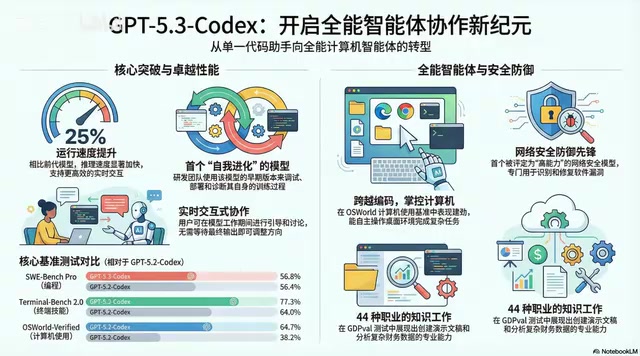
OS World is a benchmark released by Carnegie Mellon University in 2024, specifically designed to evaluate an AI's ability to complete tasks within real operating system graphical user interfaces (GUIs). It covers Windows, macOS, and Ubuntu, with tasks spanning file management, office software, web browsing, code editing, and other everyday scenarios. The technical challenge here is significant: the AI must "read" the current screen state from screenshots, plan its next action, and execute it via simulated mouse clicks and keyboard input — a fundamentally different challenge from pure text reasoning, requiring deep integration of visual understanding, spatial reasoning, and action planning. The industry had widely considered GUI operation to be a weak point for AI; Anthropic's Claude Computer Use and Google's Project Mariner are also exploring this frontier.
This may be the most important number in the entire release. OS World tests the ability to complete tasks in a graphical desktop environment — opening a folder, finding an Excel file, copying data, pasting it into a PowerPoint slide, and setting a title. This is what we do every day at the office.
GPT-5.3 Codex scored 64.7%, while the human average is approximately 72%. The gap is remarkably small. This marks the point where "computer use" capability crosses from lab demonstration into practical viability — AI's abilities have spilled beyond the world of code and text. It can now operate a regular computer the same way we do: by looking at the screen, moving the mouse, and typing on the keyboard. It no longer serves only programmers. Its general-purpose potential has expanded dramatically.
GPQA-Val: 70.9% — The "Liberal Arts Report Card"
This benchmark measures performance across knowledge work tasks spanning 44 different professions — writing business plans, analyzing market reports, creating data visualizations, and more. Its score matches that of GPT-4.2, which was specifically optimized for knowledge work. This shows that GPT-5.3 Codex has become a STEM powerhouse without sacrificing its well-rounded general knowledge capabilities.
Part One Conclusion: What we've received isn't a faster programmer — it's a fully capable digital colleague that can write code, reason through problems, understand business context, and directly operate a computer.
From Benchmarks to Real-World Output: Can the Top Student Handle Reality?
Building a Complete Game from Scratch
Given only a vague prompt (e.g., "make a racing game with different characters and maps"),
Related articles
Deep Dive into AI Agent Skill Design: …
Deep Dive into AI Agent Skill Design: Engineering Practices from Anthropic and Perplexity
A deep dive into Skill design philosophy from Anthropic's Claude Code team and Perplexity's Agent team, covering the Tax Test, Gotchas Flywheel, progressive disclosure, and Eval-First practices for building high-quality AI Agent skill systems.
Deep Dive into OpenAI's Official GPT-5…
Deep Dive into OpenAI's Official GPT-5.6 Prompting Guide: The Shift from Manual to Automatic
A deep dive into OpenAI's official GPT-5.6 Sol prompting guide: conciseness-first, outcome-oriented design, autonomy boundaries, tool routing, and reasoning intensity tuning.
 Deep Dives
Deep Dive into How OpenClaw (Open-Source Crayfish) AI Agent Works
Deep analysis of OpenClaw AI Agent internals: System Prompt, tool calling, SubAgents, Skill system, memory, and Context Engineering explained.