GPT-5.4 In-Depth Review: Native Computer Use, Unified Reasoning & Coding — OpenAI Reclaims the Throne

OpenAI launches GPT-5.4, its first all-in-one model with native computer use capability.
OpenAI has released GPT-5.4, its first general-purpose model unifying reasoning, coding, vision, and computer operation. It surpasses Claude Opus 4.6 in computer use with a 75.0% OSWorld score, matches professional-level performance at 83.0% on the GDPVL knowledge work benchmark, inherits and exceeds GPT-5.3-Codex's coding abilities, and reduces hallucination rates by 33% — marking AI's evolution from a productivity tool to an independently deliverable work unit.
The First True All-in-One Model Has Arrived
OpenAI dropped a bombshell late at night — GPT-5.4 is officially here. This isn't a simple version bump; it's OpenAI's full-scale counterattack against Gemini 3.1 Pro and Claude Opus 4.6. GPT-5.4 is OpenAI's first general-purpose model with native computer use capability, combining reasoning, coding, vision, tool use, computer operation, web search, and knowledge work — each pushed to current state-of-the-art levels.
Native Computer Use: Surpassing Claude Opus 4.6 Outright
GPT-5.4's most exciting capability is native Computer Use. It can both write code via libraries like Playwright to control a computer, and directly read screenshots, operate the mouse and keyboard — sending emails, scheduling appointments, filling out forms, running workflows. Tasks that previously required manual operation can now be completed independently by GPT-5.4.
Technical Background: Computer Use refers to an AI model's ability to directly perceive screen content and control the mouse and keyboard — essentially letting AI "work while looking at the screen" like a human. The technical approaches fall into two categories: indirect control via code (using automation libraries like Playwright or Selenium), and direct visual perception + action output (screenshot → understanding → click/type). The former relies on structured DOM, while the latter is closer to human operation but demands extremely high visual comprehension. OSWorld and WebArena are the most authoritative benchmarks in this field — the former simulates real desktop OS tasks, while the latter focuses on web interaction scenarios. Both require models to complete end-to-end multi-step tasks rather than single-instruction responses.
In core benchmark tests, GPT-5.4's performance is impressive:
- OSWorld Verified: 75.0% success rate, surpassing Claude Opus 4.6's 72.7% by 2.3 percentage points
- WebArena Verified (DOM + screenshot-driven): 67.3% success rate, ahead of GPT-5.2's 65.4%
- Online Mind2Web: Achieved 92.8% using screenshot observation alone, while ChatGPT Atlas agent mode only managed 70.9% — a significant gap
Just one month ago, Claude Opus 4.6 had just claimed the top spot on the computer use leaderboard. GPT-5.4 has already overtaken it.
Visual Perception & Document Parsing: Full-Fidelity Input
Powerful execution capabilities require even stronger general visual perception. On the MMMU Pro benchmark, GPT-5.4 achieves an 81.2% success rate without tools, notably better than GPT-5.2's 79.5%. On OmniDoc Bench, GPT-5.4 without reasoning intensity achieves an average error of 0.109, compared to GPT-5.2's 0.140.
More notably, GPT-5.4 introduces two image input detail levels for the first time — "Original" and "High":
- Original mode: Supports full-fidelity perception up to 10.24 million total pixels or a maximum single edge of 6000 pixels
- High mode: Supports up to 2.56 million total pixels or a maximum single edge of 2048 pixels
In early API testing, GPT-5.4 shows clear improvements in localization ability, image understanding, and click accuracy.
Mastering the Office Suite: Better Than Wall Street Analysts
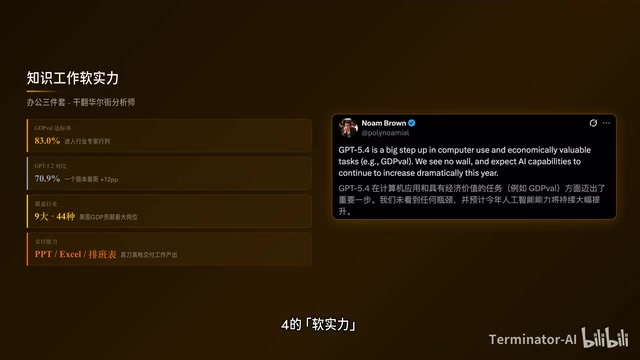
Computer use is the hard skill; knowledge work is GPT-5.4's soft power. On the GDPVL benchmark, GPT-5.4 scored 83.0%, matching or even surpassing industry professionals, while the previous-generation GPT-5.2 only managed 70.9% — a 12-percentage-point gap opened in a single version.
Technical Background: GDPVL (GDP-Verified Labor) is a knowledge work evaluation benchmark weighted by US GDP contribution. Its core philosophy is to align AI evaluation with real economic value rather than just testing academic problems. The benchmark covers 9 industries and 44 occupations that contribute the most to US GDP, requiring models to deliver directly usable work outputs — such as runnable Excel financial models, presentable PowerPoints, properly formatted medical forms, etc. This "deliverable-oriented" evaluation approach better reflects AI's replacement potential in real workplaces than traditional multiple-choice or coding problems. GPT-5.4 matching professional-level performance at 83.0% means that in entry-level white-collar work scenarios, AI assistance has upgraded from an "efficiency tool" to an "independently deliverable" work unit.
The GDPVL test spans 9 industries and 44 occupations that contribute the most to US GDP, covering scenarios like sales presentations, accounting spreadsheets, ER formatting tables, manufacturing charts, short videos, and more — all requiring AI to deliver real work outputs. GPT-5.4 can now create PowerPoints, build Excel spreadsheets, and format tables, with completion quality surpassing most professionals.
In an internal spreadsheet modeling test simulating a junior investment banking analyst, GPT-5.4 averaged 87.3%, compared to GPT-5.2's 68.4%. Humans preferred GPT-5.4-generated presentations 68.0% of the time, citing better aesthetics, richer visuals, and more efficient use of images.
33% Reduction in Hallucination Rate
GPT-5.4 is OpenAI's most fact-accuracy-focused model to date. On a de-identified prompt set containing user-flagged factual errors, compared to GPT-5.2:
- The probability of individual claims being wrong decreased by 33%
- The probability of an entire response containing any error decreased by 18%
For professional scenarios that rely on AI-generated content, this improvement is highly significant.
Reasoning + Code United: The Most Token-Efficient Reasoning Model

GPT-5.4 fully inherits GPT-5.3-Codex's programming capabilities. Users no longer need to switch between a "smart model" and a "coding model" — one model handles everything.
On the SWE-Bench Pro test, GPT-5.4 achieved 57.7% accuracy, even surpassing GPT-5.3-Codex's 56.8%.
Technical Background: SWE-Bench (Software Engineering Benchmark) is a code capability evaluation benchmark proposed by Princeton University. It requires models to fix actual bugs in real codebases based on real GitHub Issues, making it the closest programming evaluation to real engineering practice. SWE-Bench Pro is its upgraded version, introducing more complex scenarios like multi-file modifications and cross-module dependencies, with significantly higher difficulty than the original. Token efficiency is particularly critical in this context — reasoning models often require large amounts of "thinking tokens"
Related articles
 Tech Frontiers
A Rare Quiet Day in AI: Recursive Self-Improvement Stirs Beneath the Surface
A rare quiet day in AI sees multiple sources go silent simultaneously. Behind the calm, Recursive Self-Improvement (RSI) research continues. What this means for the industry.
 Tech Frontiers
Reve 2 vs. Ideogram 4: A Deep Dive into Layout Control in AI Image Generation
A deep comparison of Reve 2 and Ideogram 4's layout control capabilities, covering technical approaches, real-world use cases, and industry trends for designers and creators.
 Tech Frontiers
In the Weights: Check Your Influence Score in the AI World
In the Weights is an AI influence search engine that quantifies your presence in the AI world with a score. Explore how it evaluates practitioners and what it means for digital identity.