GPT-5.6 Deep Dive: Sol Flagship Model Performance, Weaknesses, and Competitive Analysis

GPT-5.6 Sol dominates coding and agentic benchmarks but struggles with vision recognition and hallucination.
OpenAI's GPT-5.6 is a three-model family (Sol, Terra, Luna) built for agentic, long-horizon tasks. Sol excels at complex one-shot coding and autonomous workflows, outperforms Claude Fable 5 on key benchmarks at lower cost, but shows clear weaknesses in visual recognition, medical diagnosis, and hallucination rates.
OpenAI has released GPT-5.6, a new-generation flagship model family built around agentic capabilities and long-horizon tasks. This isn't a simple version bump — it's a full model matrix targeting different use cases, paired with a redesigned desktop toolchain that aims to reshape how users collaborate with AI. This article is based on hands-on testing by overseas reviewers, covering GPT-5.6's real-world performance, capability boundaries, and competitive positioning.
What is Agentic AI? Agentic AI refers to AI systems that can autonomously plan, decompose tasks, call external tools, and iterate in a loop until a goal is achieved — as opposed to traditional single-turn Q&A. Its core architecture typically includes: a Planner, a Tool Use layer, a Memory module, and a Reflection loop. Since 2023, with the spread of frameworks like ReAct and AutoGPT, the agentic paradigm has rapidly moved from academic concept to production product. The release of GPT-5.6 marks OpenAI pushing agentic capabilities from the API layer down to consumer-facing products — users can now enjoy multi-step automated workflows without writing any orchestration code.
Three Models, Three Roles
GPT-5.6 is not a single model — it's a family of three variants:
- Sol: The largest, most capable flagship variant — and also the most expensive and slowest;
- Terra: The mid-tier model, balancing performance and cost;
- Luna: The smallest model, fastest but with lower intelligence.
Each model also supports configurable "effort" levels, ranging from standard all the way up to Ultra. In testing, the reviewer ran almost everything at the top-tier 5.6 Sol + Ultra configuration to push the model to its limits.
The access layer has also changed notably. The original Codex app has been redesigned and rebranded as the ChatGPT desktop client, available as a free download. Its interface resembles the web version of ChatGPT, but the key difference is that you can have multiple agents working simultaneously across local files and folders, save reusable "skills," and even schedule automated tasks. This signals that OpenAI is shifting its product focus from "chatting" to "getting things done."
Complex Coding Tasks: One Prompt, Done
GPT-5.6's most impressive trait is its ability to complete complex frontend projects in a single pass. The reviewer threw several high-difficulty challenges at it — all of which are fundamentally long-horizon tasks requiring goal consistency, contextual coherence, and self-correction across dozens of steps. Traditional large models often experience "goal drift" in reasoning chains beyond a few thousand tokens, gradually losing track of the original intent.
Real-Time Conversational Anime Character Web App
The task: build a role-playing web app with real-time voice conversation, featuring an anime girl character, using GPT image generation to create mouth-sync frames that get stitched into animation, and integrating Google Gemini's real-time voice model for lip-sync.
The model took 17 minutes and completed everything in a single prompt — generating the avatar, stitching the animation, and connecting the voice API. The result ran immediately with no follow-up fixes needed.
Fluid Physics Simulation from Scratch
An even more demanding test: simulate a liquid splash effect with adjustable gravity and lighting, controlled via webcam gesture tracking, and no physics libraries like Three.js allowed — everything had to be written from scratch. The model worked for 12 minutes and passed in one shot. The fluid effects were accurate, all parameters (flow energy, viscosity, vorticity, etc.) were adjustable in real time, and gesture tracking worked correctly.
This kind of test truly demonstrates GPT-5.6 Sol's value: minimal hand-holding, typically one prompt to get everything right.
Agentic Workflows: Autonomous Tool Use
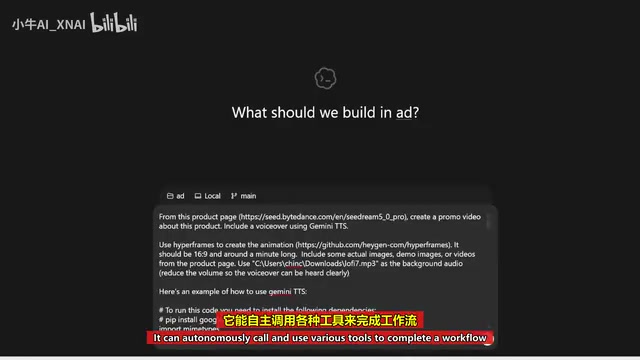
Since GPT-5.6 is designed for agentic scenarios, it can autonomously call external tools to complete end-to-end workflows. The reviewer asked it to create a promotional video for ByteDance's image model Seedream 5 Pro's landing page — using Gemini TTS for voiceover and the open-source tool HyperFrames for animation — without being told how to install the tools, only given a GitHub link and told to read the docs and configure the environment itself.
The model produced a video in 30 minutes. While the task was completed, the final quality was underwhelming: text overlapped with images, and character spacing was chaotic. It still has clear weaknesses in professional-grade visual content production.
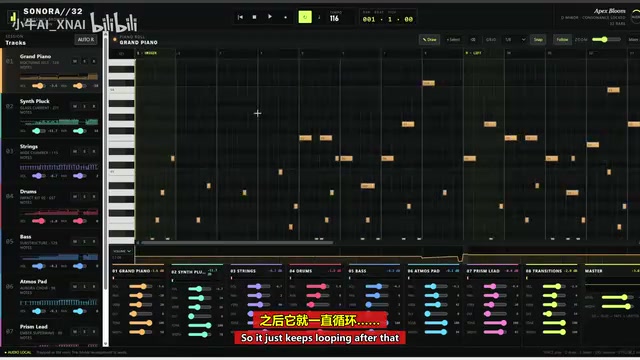
Similar shortcomings appeared in music production (output sounded mechanical) and 3D scene recreation (couldn't accurately replicate complex reference images). That said, on a Fourier transform animation task using the math animation tool Manim, it outperformed the open-source GLM 5.2 with notably better detail handling.
Vision and Medical Capabilities: Clear Weaknesses
Despite strong coding performance, GPT-5.6 stumbled repeatedly on visual recognition and medical diagnosis:
- Cancer scan recognition: Given six tumor scans, the model thought for 18 minutes and still got everything wrong — misidentifying tumors as hemorrhages, etc.;
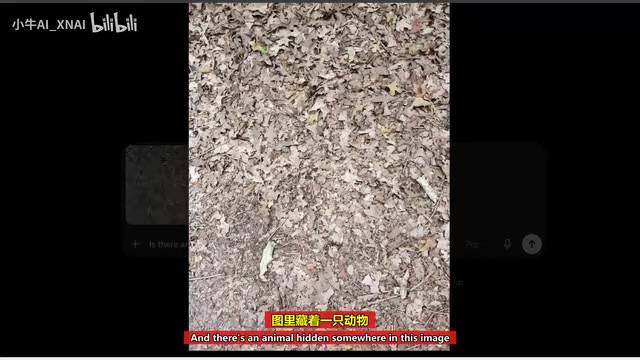
- Find the frog test: A classic visual challenge from the reviewer — GPT-5.6 thought for 13 minutes and circled the wrong location. According to the reviewer, the only model currently passing this test is Claude Fable 5;
- Hidden animal recognition: In a second test, it circled the right location but mistook a frog for a toad — partial credit at best.
The reviewer did note an important distinction: GPT-5.6 at least tries to answer biology and medical questions, whereas Claude Fable — due to strict safety guardrails — outright refuses any question touching on biology or cybersecurity. This actually makes GPT-5.6 the more viable option in those specialized domains.
Deep Research and Office Automation
In deep research scenarios, GPT-5.6 shows solid capability. The reviewer asked it to write a technical report on the molecular drivers of a specific type of leukemia. The model worked for 31 minutes and produced a complete report with sections covering molecular response glossary, driver mechanism tables, flowcharts, resistance mechanisms, and longitudinal study findings — with citations attached to every conclusion. The reviewer specifically praised it for being "not verbose like Gemini — concise and precise, answering exactly what you asked."
The newly added Work tab in ChatGPT is also worth highlighting. It supports connecting Slack, GitHub, Google Drive, Google Workspace, and other platforms, enabling agents to autonomously execute cross-platform workflows. The reviewer asked it to pull quarterly earnings reports from Alphabet, NVIDIA, and Amazon and generate a comparison slide deck. After 26 minutes, the model produced a professional presentation covering revenue growth, operating margins, capital expenditure, and forward-looking guidance.
Benchmarks: Stronger and Cheaper — But Hallucination Is a Concern
Across multiple benchmarks, GPT-5.6 Sol offers a compelling price-performance ratio:
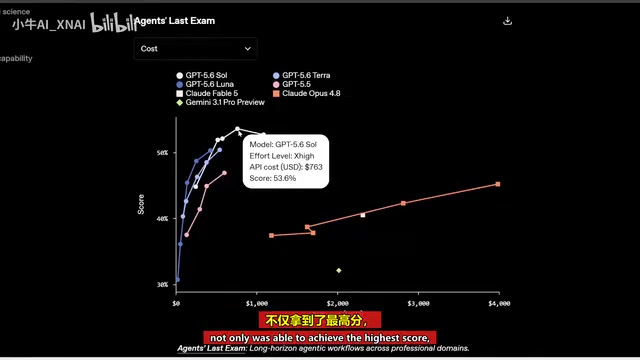
- Humanity's Last Exam (long-horizon professional tasks): Sol scored highest, at a price far below Claude Opus and Fable;
- GeneBench (long-horizon genomics): Significantly outperformed Claude Opus 4.8;
- SWE / DeepSuite (long-horizon software engineering): Sol Max ranked first, surpassing Claude Fable 5, with notably lower cost and token consumption;
- ARC-AGI-2: Sol achieved 92.5%, demonstrating emergent ability to "instantly learn new patterns";
- ARC-AGI-3: While Opus and Gemini both scored below 1%, Sol Max reached nearly 8%.
Why ARC-AGI Matters ARC-AGI was designed by AI safety researcher François Chollet to test a model's ability to "instantly learn new rules" rather than rely on memorized training data. Each problem presents a small number of input-output examples, requiring the model to infer an abstract rule and apply it to new cases. Since the problems are deliberately designed to resist brute-force memorization, ARC-AGI is considered one of the gold standards for measuring "genuine reasoning generalization." GPT-5.6 Sol scoring nearly 8% on ARC-AGI-3 — while most top models remain near 0% — is being viewed by researchers as an early signal of a qualitative shift in reasoning capability.
But there's one concern that must be taken seriously: hallucination rate. On Artificial Analysis's Omniscience hallucination metric, GPT-5.6 Sol Max scores as high as 89%, far above Claude Fable's 55% and the open-source GLM 5.2's 28% (note: this reflects the error rate on that specific benchmark question set, not average daily hallucination rate).
Why Can Stronger Models Have Higher Hallucination Rates? Hallucination refers to when a large model generates content that is factually nonexistent or incorrect, presented with high confidence. The root cause is that language models are fundamentally probabilistic text prediction systems — they lack genuine knowledge verification mechanisms. Notably, stronger reasoning ability can sometimes produce more "confidently wrong" outputs — what's called "confident hallucination." This means stronger reasoning ability and lower hallucination rates don't necessarily correlate. In fact-sensitive scenarios, users still need to pair these models with RAG (Retrieval-Augmented Generation) or manual verification to manage risk.
Additionally, OpenAI has officially disclosed that GPT-5.6 is now being used to accelerate its own internal R&D, running throughout the development cycle — validating the recursive acceleration trend of "AI-assisted development of the next generation of AI."
Availability and Conclusion
On access: the ChatGPT web version currently limits GPT-5.6 to paid users; in ChatGPT Work and Codex, free users can access the mid-tier Terra model; paid users can unlock the full Sol, Terra, and Luna lineup with customizable effort levels; the model is also available via API.
All things considered, GPT-5.6 is one of the most capable models available today — more cost-effective and faster than Claude Fable 5, requiring almost no hand-holding, and able to work autonomously for hours toward a goal. Its coding and agentic capabilities are genuinely impressive, but it has clear weaknesses in visual recognition, medical diagnosis, and hallucination control. For developers prioritizing price-performance and long-horizon automation, Sol is well worth serious attention — but for high-accuracy-critical scenarios, careful cross-validation remains essential.
Key Takeaways
Related articles

Disaster and Glory of the Apollo Program: The History We Must Revisit Before Returning to the Moon
From the fatal Apollo 1 fire to Apollo 8's daring lunar orbit to Apollo 11's successful landing—revisiting the disasters, fears, and compromises of the Apollo program and their lessons for today's return to the Moon.
Netflix Trust Exercise Turns Into Firing Trap: Where Are the Boundaries of Corporate Trust?
A Netflix employee was fired after sharing private info in a trust exercise. We analyze the risks of corporate trust exercises and how employees can protect themselves.

AMD CDNA5 Architecture Deep Dive: Technical Evolution and the AI Computing Competition Landscape
Deep analysis of AMD's CDNA5 architecture covering Chiplet packaging upgrades, HBM memory evolution, and low-precision compute optimization, examining how AMD challenges NVIDIA's AI chip dominance.