GPT-5.6 Exposed: Codex Logs Reveal Internal Testing, Anthropic Enterprise Adoption Surpasses OpenAI for the First Time

Anthropic enterprise adoption surpasses OpenAI for the first time as GPT-5.6 internal testing is revealed.
The AI competitive landscape shifts dramatically: Anthropic's enterprise adoption reaches 34.4%, surpassing OpenAI's 32.3% for the first time after quadrupling in one year. OpenAI responds with a two-month free Codex migration plan, while GPT-5.6 is discovered in internal Codex logs already in testing. Anthropic raises Claude Code limits by 50% to intensify the developer battle. Open-source model Mimo V2.5 Pro approaches closed-source performance on front-end coding, as fierce competition makes enterprises and developers the biggest winners.
The AI industry has been hit with a series of blockbuster developments: GPT-5.6 appears to have entered internal testing at OpenAI, Anthropic's enterprise adoption rate has surpassed OpenAI for the first time, and Claude Code usage limits have been significantly increased. This article breaks down these key developments and examines the latest shifts in the AI competitive landscape.
Anthropic's Enterprise Adoption Surpasses OpenAI: A Historic Reversal at 34.4% vs. 32.3%
According to the RAMP AI Index updated on May 13, a landmark milestone has arrived: 34.4% of enterprises are now using Anthropic, while OpenAI's enterprise adoption stands at 32.3%. This means Anthropic has officially overtaken OpenAI in enterprise market adoption.
The RAMP (Revenue and Adoption Metrics Platform) AI Index is one of the authoritative data sources for tracking enterprise-level AI tool adoption. It measures market penetration of various AI vendors by analyzing software procurement data, contract information, and actual usage patterns across thousands of enterprises. Unlike consumer-side user counts, enterprise adoption rates better reflect the depth of AI commercialization, as enterprise customers typically represent higher willingness to pay, longer contract cycles, and deeper product integration.
What's even more noteworthy is the growth velocity—Anthropic's enterprise adoption has quadrupled over the past year, with its Annual Recurring Revenue (ARR) reaching approximately $44 billion, far exceeding OpenAI's performance over the same period. ARR is a core metric for measuring business health in the SaaS industry, representing the total subscription revenue a company can expect over the next 12 months. Rapid ARR growth typically indicates high customer retention and strong new customer acquisition momentum. These figures demonstrate that enterprise recognition of the Claude model series is climbing rapidly, particularly in coding assistance and enterprise application scenarios where Anthropic has established a clear reputation advantage.
OpenAI Strikes Back: Free Codex Promotion and GPT-5.6 Internal Testing Revealed
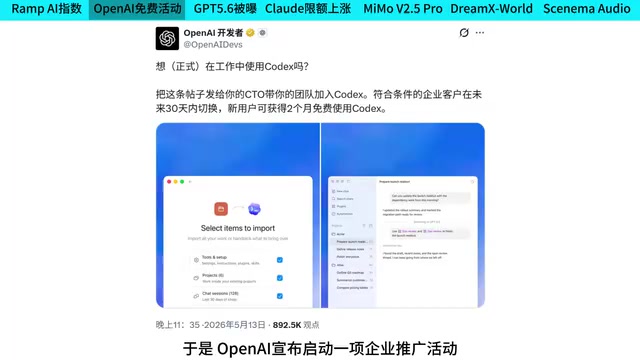
Facing Anthropic's aggressive growth, OpenAI has responded swiftly by announcing a targeted enterprise promotion: Eligible enterprise customers looking to switch from other platforms to Codex can receive two months of free Codex access. The intent behind this move is crystal clear—to curb the trend of enterprise customers migrating to Anthropic.
OpenAI's Codex is an enterprise-facing AI coding agent product. Unlike simple code completion tools, it can autonomously execute complete coding tasks in a sandboxed environment, including writing functional modules, fixing bugs, and running tests. Codex is built on OpenAI's latest reasoning models and can process multiple coding tasks in parallel. This "two months free to switch" strategy is known in the enterprise software industry as a "Competitive Migration Program," a common customer acquisition tactic in cloud computing and SaaS—AWS, Azure, and other cloud providers frequently offer free credits to customers migrating from competitors. The core logic is straightforward: once an enterprise deeply integrates its workflows into a platform, switching costs increase significantly, creating a long-term lock-in effect.
GPT-5.6 Internal Testing Underway: Call Records Discovered in Codex Logs
Even more explosive news has emerged from within OpenAI. According to multiple sources, GPT-5.6's development cycle is now fully underway at OpenAI, with the model's first checkpoints having begun internal testing in recent days.
In the large model training process, a checkpoint refers to a snapshot of model weights saved at a certain stage of training. Since large model training typically takes weeks or even months, research teams periodically save checkpoints both to prevent progress loss from training interruptions and to evaluate model performance at different training stages. When reports indicate that GPT-5.6's "first checkpoints have begun internal testing," this means training has progressed to a stage where preliminary capability assessment is possible, though final release may still require extensive alignment training, safety evaluation, and performance optimization.
Insiders discovered model call records in OpenAI's internal Codex logs, with one entry clearly pointing to "GPT-5.6." While this information has not been officially confirmed, the log records suggest GPT-5.6 has entered a callable testing phase.

From a naming convention perspective, GPT-5.6 sits between GPT-5 and a hypothetical GPT-6, suggesting OpenAI may be adopting a more granular version iteration strategy rather than waiting for major version leaps. This evolutionary path resembles the transition from GPT-4 to GPT-4o and GPT-4o-mini, reflecting the industry's shift from "major version jumps" to "continuous iteration." This "small steps, fast pace" approach helps push model capabilities to market more quickly, allowing vendors to respond more flexibly to market competition and directly counter Anthropic's rapid iteration cadence.
Claude Code Limits Surge 50%: Anthropic Doubles Down on the Developer Battle
While OpenAI intensifies its positioning, Anthropic hasn't slowed down either. Claude Code's weekly limits will increase by 50%, with this boost running from now through July 13 for all Pro, Max, and Cita-based enterprise users.
Starting June 15, paid Claude plan users can also apply for dedicated monthly programmatic usage credits covering four usage scenarios, with monthly credit values ranging from $20 to $200 depending on subscription tier. Programmatic usage credits refer to quotas for using AI models via API calls, distinct from interactive use through web interfaces. For developers, programmatic access means AI capabilities can be integrated into automated workflows, CI/CD pipelines, custom development tools, and other scenarios—a critical step in upgrading AI tools from "assistants" to "infrastructure." Anthropic's tiered design of these credits by subscription level is essentially building a layered developer ecosystem—entry-level developers can try it at low cost, while power users and enterprise teams gain greater calling capacity.
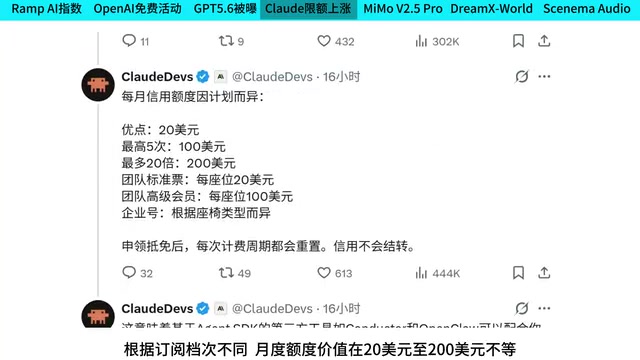
This adjustment shows Anthropic is actively expanding its coding tool market share, using more generous usage limits to attract and retain the developer community—precisely the scenario OpenAI least wants to see.
New Developments in the Open-Source AI Ecosystem: The Gap with Closed-Source Models Continues to Narrow
Mimo V2.5 Pro: Open-Source Models Approaching Closed-Source Performance Levels
Mimo V2.5 Pro has secured third place in DesignArena's open-weight model rankings, ranking eight positions higher than its predecessor Mimo V2.5 on the overall leaderboard. DesignArena is a benchmark platform specifically designed to evaluate AI model performance on design and front-end development tasks. It has models generate HTML/CSS/JavaScript code to create web interfaces, which are then assessed by human reviewers or automated metrics for visual quality, functional completeness, and code standards. "Open-weight models" refer to AI models that publicly release their weight parameters, allowing users to deploy and fine-tune them locally, as opposed to closed-source models accessible only via API.
Notably, on front-end coding tasks, Mimo V2.5 Pro is now in the same performance tier as Claude Sonnet 4.6—a quite encouraging signal for the open-source community. This means the open-source community already possesses the capability to compete with top closed-source models in specific vertical domains, which is particularly important for enterprises with strict data privacy requirements or needs for local deployment.
DreamX World Launches on ModelScope
DreamX World, developed by the DreamX team, has officially launched on the ModelScope platform. ModelScope is an AI model open-source community platform launched by Alibaba's DAMO Academy, positioned similarly to Hugging Face, providing infrastructure for model hosting, downloading, and collaboration. DreamX World is built on WAN2.2-5B—WAN is an open-source video generation model series developed by Alibaba's team, with 5B indicating 5 billion parameters—and supports Probe camera control technology. Its core positioning is to provide AI agents with an interactive, realistic virtual environment. Probe camera control technology allows users to precisely control the viewpoint of generated video by specifying camera position, angle, and motion trajectory, which is crucial for building interactive virtual environments.
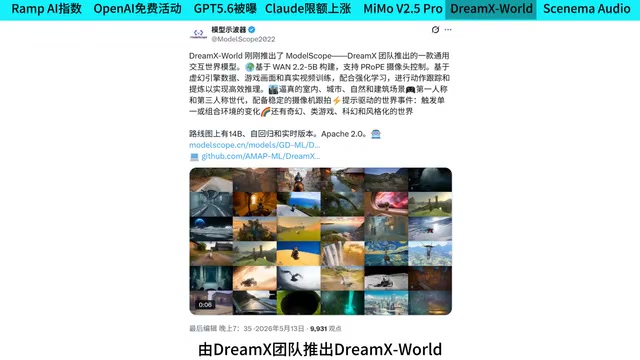
This project provides more realistic simulation scenarios for AI agent training and testing, and is expected to drive substantive progress in embodied intelligence and virtual world interaction research. Embodied AI is one of the frontier directions in current AI research, emphasizing that AI agents need to learn through perception and action in physical or virtual environments rather than relying solely on static dataset training. Compared to training robots in real physical environments, the cost of trial and error in virtual environments is virtually zero and can be infinitely parallelized, giving projects like DreamX World extremely high research value.
CinemaAudio: Zero-Shot Voice Cloning Open-Source Solution
CinemaAudio is a zero-shot expressive voice cloning and generation system, now released as an open-source project. Zero-shot voice cloning means the system requires no training data from the target speaker—it can generate speech mimicking the speaker's timbre, intonation, and speaking style using only a very short reference audio clip (typically a few seconds). This stands in stark contrast to traditional voice cloning technology, which typically requires the target speaker to record tens of minutes or even hours of speech material for fine-tuning.
The technical core of zero-shot cloning lies in the model having learned the acoustic feature distributions of numerous speakers during pre-training, enabling it to extract speaker acoustic embedding vectors from brief reference audio and inject them as conditioning information into the speech generation process. CinemaAudio's emphasis on "expressive" means the system can not only replicate timbre but also generate natural speech with emotional variation, tonal inflection, and rhythmic cadence. This holds significant application value in audiobook production, film dubbing, and virtual assistants, providing a powerful open-source alternative in the speech synthesis field.
AI Industry Competition Reaches Fever Pitch: Enterprises and Developers Are the Biggest Winners
The current AI competitive landscape is undergoing profound changes. Anthropic's rise in the enterprise market has placed substantial pressure on OpenAI, while the GPT-5.6 revelation indicates OpenAI is accelerating model iteration to maintain its technological lead. Meanwhile, the continued flourishing of the open-source ecosystem is steadily narrowing the capability gap with closed-source models.
For enterprise users and developers, this competition delivers tangible benefits: more model choices, lower usage costs, and faster technological iteration. In the coming months, whether GPT-5.6 will be officially released and whether Anthropic can maintain its enterprise market lead will be key focal points worth watching.
Key Takeaways
- GPT-5.6 appears to have begun internal testing at OpenAI, with model call records found in Codex logs
- Anthropic's enterprise adoption reaches 34.4%, surpassing OpenAI's 32.3% for the first time, with 4x growth over the past year
- OpenAI launches a two-month free Codex promotion to counter enterprise customer attrition
- Claude Code weekly limits increase by 50%, with paid users eligible for $20-$200 monthly programmatic credits
- Mimo V2.5 Pro reaches the same performance tier as Claude Sonnet 4.6 on front-end coding tasks
Related articles
 Tech Frontiers
A Rare Quiet Day in AI: Recursive Self-Improvement Stirs Beneath the Surface
A rare quiet day in AI sees multiple sources go silent simultaneously. Behind the calm, Recursive Self-Improvement (RSI) research continues. What this means for the industry.
 Tech Frontiers
Reve 2 vs. Ideogram 4: A Deep Dive into Layout Control in AI Image Generation
A deep comparison of Reve 2 and Ideogram 4's layout control capabilities, covering technical approaches, real-world use cases, and industry trends for designers and creators.
 Tech Frontiers
In the Weights: Check Your Influence Score in the AI World
In the Weights is an AI influence search engine that quantifies your presence in the AI world with a score. Explore how it evaluates practitioners and what it means for digital identity.