GPT-5.6 Launches: Comprehensive Upgrades to ChatGPT Work, Sites, and Desktop Client

OpenAI launches GPT-5.6 with ChatGPT Work, Sites, and a major desktop client upgrade, pushing AI ecosystem integration.
OpenAI released the GPT-5.6 model family (Soul, Terra, Luna) alongside ChatGPT Work, ChatGPT Sites, and a major desktop client upgrade with Computer Use support. Coding capability now edges past rivals. Meta, Google, and Kimi followed intensively, marking the AI industry's shift from a model race toward full ecosystem integration.
Article
OpenAI has once again set the industry's pace with a late-night release. The GPT-5.6 model family officially launched globally, accompanied by ChatGPT Work for office scenarios, ChatGPT Sites that turn your work into a website with one click, and a significantly upgraded desktop client. This time, OpenAI is no longer merely upgrading model parameters—it's attempting to fully connect its three product lines (ChatGPT, Codex, and Work) to build a complete agent ecosystem spanning conversation, coding, and office productivity.
The GPT-5.6 Model Family: Three Tiers, With Coding Capabilities Now Ahead of Rivals
GPT-5.6 adopts a clear three-tier product strategy. The flagship model, GPT-5.6 Soul, targets high-intensity, complex tasks and will roll out gradually to paying users within 24 hours. The GPT-5.6 Terra, positioned for everyday tasks, and the fast model GPT-5.6 Luna will be available to free users. This tiering represents not just a performance gradient, but a refined logic for cost and scenario segmentation.
This three-tier product strategy continues the "Good-Better-Best" tiered pricing model that OpenAI has been exploring since the GPT-4 era—a business logic widely validated in the cloud computing and SaaS industries. By differentiating performance and price, it simultaneously serves free users (expanding market coverage) and paying users (increasing ARPU, or average revenue per user). Classic precedents for this model come from cloud storage (Dropbox's free/Pro/Team tiers) and CRM software (Salesforce's Essentials/Professional/Enterprise tiers). Its core principle is to lower user acquisition costs with a "free tier" and then leverage the scarcity and high performance of the "flagship tier" to motivate users to move up. In the AI space, this logic is layered with the practical constraint of compute costs: the inference cost of flagship models is often dozens of times that of lightweight models, so tiered pricing is essentially also a differentiated allocation mechanism for computing resources. Notably, naming the models "Soul," "Terra," and "Luna" continues AI vendors' branding strategy of giving products emotional, personified names, aimed at reducing users' psychological distance from technical products.
On the third-party evaluation platform Artificial Analysis, GPT-5.6 Soul achieved an overall score of 59—just 1 point behind the competing Claude Fable 5. But what's truly noteworthy is the coding leaderboard: GPT-5.6 Soul scored 80, 2.8 points higher than its rival. This is a rare instance of OpenAI pulling ahead in coding capability.
In Ultra mode, the model defaults to running 4 agents in parallel, expandable to 16 for heavy-load scenarios. This means GPT-5.6 has evolved from a single reasoning model into an orchestratable agent system, achieving both higher scores and greater speed in complex evaluations such as BrowseComp and SWE-bench Pro.
Evaluation Framework Background: SWE-bench (Software Engineering Benchmark) was developed by a team at Princeton University. It contains software engineering tasks from real GitHub repositories, requiring models to automatically generate fix patches given a codebase and problem description. It's regarded by the industry as the gold standard for measuring the real-world capabilities of code agents. SWE-bench Pro is a difficulty-upgraded version that introduces more complex cross-file dependencies and vaguer requirement descriptions, further reducing the space for models to "memorize answers." BrowseComp, on the other hand, is a web information retrieval and comprehensive reasoning evaluation developed internally by OpenAI, specifically examining model performance in multi-step web browsing and information cross-verification scenarios. Unlike traditional closed-form Q&A benchmarks, both evaluations share the methodological feature of "open environment + real tool invocation"—models must interact with external environments like real engineers, rather than answering solely from static knowledge within their parameters. This makes them far more reflective of a model's actual capabilities in production environments than traditional math or logic problems. As SWE-bench gradually becomes an industry standard, the ranking battles among major vendors on this leaderboard also reflect the competitive landscape of the entire AI coding assistant market.
The Compute Explosion Revealed by Internal Data
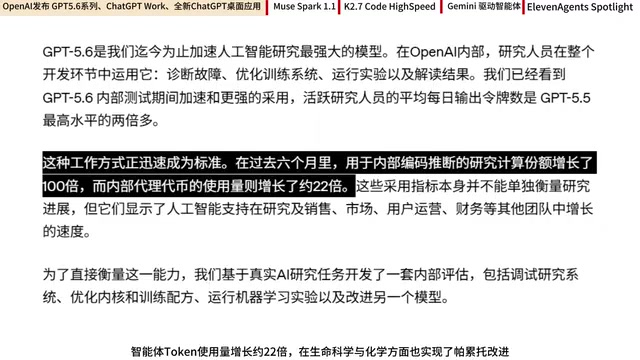
The internal data disclosed by OpenAI is quite striking: GPT-5.6 pushed researchers' average daily token output to more than double the peak of the GPT-5.5 era, internal inference compute share grew 100x within 6 months, and agent token usage grew roughly 22x. Behind these figures is a signal of the model's transformation from an "assistive tool" toward an "autonomous productivity" role.
On the safety front, GPT-5.6 is equipped with layered protection. After red-teaming amounting to roughly 700,000 A100 GPU hours, its ability to block harmful activities is about 10x higher than the previous generation. OpenAI specifically emphasized that although the model has enhanced capabilities in biology and cybersecurity, none crossed the risk threshold, and its capabilities emphasize defense rather than end-to-end attacks.
Interpreting the Red-Teaming Scale: Red teaming originated from military adversarial exercises during the Cold War and was developed in the cybersecurity field into a systematic vulnerability assessment method of "attacking to strengthen defense." In recent years, it has been introduced into AI safety, referring specifically to systematic adversarial evaluations of large language models—including jailbreaking, inducing harmful content, and probing capability boundaries. OpenAI's red team is typically composed of internal and external experts covering biosafety, cyber offense and defense, social engineering, and other specialized fields. 700,000 A100 GPU hours is an enormous amount of computation—NVIDIA A100 is a current mainstream AI training and inference chip, with a single card's peak compute of about 312 TFLOPS (FP16). Running hundreds of GPUs continuously, an accumulated 700,000 hours means hundreds of cards running for several weeks—a magnitude far exceeding the resource investment of ordinary functional testing. The public disclosure of this figure carries a dual significance: for regulators, it's a quantified proof of safety compliance investment; for the public and enterprise customers, it's a brand asset for building trust. Against the backdrop of increasingly tightening AI regulation, making "trustworthy AI" a competitive differentiator is becoming a shared strategic choice among leading vendors.
ChatGPT Work: Targeting the Core of Enterprise Office Scenarios
If model upgrades are routine, then ChatGPT Work is OpenAI's true strategic focus this time. Work helps users complete a series of office tasks including information gathering, data analysis, document writing, Excel modeling, PPT creation, and even website generation—directly targeting the core scenarios of enterprise productivity.
Work is being opened first to Pro, Lite, Enterprise, and EDU users, with Plus and Business users to follow. This pricing and rollout cadence shows OpenAI's intent to move from individual subscriptions toward the enterprise office collaboration market—precisely the battlefield fiercely contested by Microsoft Copilot and Google Workspace. Notably, the enterprise office software market has long been dominated by Microsoft Office 365 (annual revenue exceeding $50 billion) and Google Workspace, whose common moat lies in "data lock-in" and "workflow inertia." OpenAI's choice to enter at the task-execution layer rather than building a document editor from scratch is a typical "parasitic integration" strategy—leveraging existing tools' data and scenarios to layer on value with AI capabilities, rather than directly replacing them.
The Capability Leap of the Desktop Client
Alongside Work, OpenAI made a large-scale upgrade to the ChatGPT desktop client. The new app gained the ability to access local files, read browser tabs, and operate some desktop software, with support for the Computer Use feature. This means ChatGPT is no longer confined to the dialog box—it can genuinely "take over" the user's computer to complete actual cross-application operations.
Computer Use Technical Principles: The Computer Use feature is essentially a GUI agent technology based on vision-language models (VLM). Its workflow can be divided into three cyclical stages: perception (the model continuously captures screen state via screenshots and parses pixel information into semantic descriptions), planning (the model formulates the next operation plan based on the current state and user goal), and execution (simulating mouse clicks, keyboard input, scrolling, and other actions via OS-level APIs). This capability was first commercialized by Anthropic in its Claude 3.5 model in October 2024, named "Computer Use," which subsequently triggered intensive industry follow-up, with Microsoft, Google, and others advancing similar capabilities within their respective ecosystems. There are three core technical challenges: first, cross-application state consistency management—the model must understand the UI logic differences between different software; second, error recovery mechanisms—when an operation fails, it must identify the anomaly and roll back; third, fine-grained control of user authorization boundaries—maintaining a clear boundary between "what's technically possible" and "what's safe to do," to prevent misoperations or sensitive data leakage. This is also an important reason why OpenAI deeply tied this feature to the Work product line rather than opening it to all users.
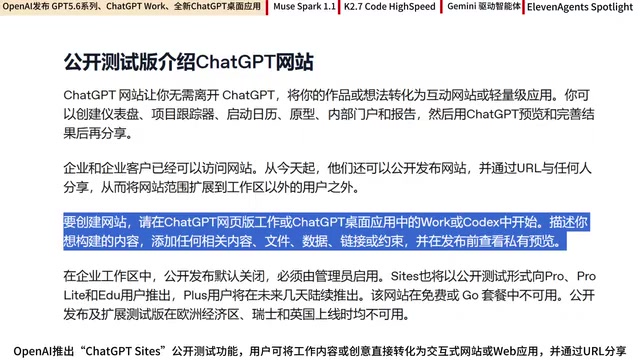
That said, OpenAI launched a public beta of ChatGPT Sites. Users can directly turn their work or ideas into interactive websites or web apps and share them via a URL with one click—suitable for scenarios like real-time dashboards, project tracking tools, prototypes, internal portals, and reports. This further lowers the barrier from "idea" to "deliverable product."
The Codex Controversy and Three Rate-Limit Resets
This release also included an intriguing side story. OpenAI co-founder and CEO Sam Altman specifically posted a promise that "Codex won't disappear," responding to community concerns that Codex was being marginalized.
Codex's Historical Significance: Codex is a code-specialized model OpenAI launched in 2021 and was the original underlying engine of GitHub Copilot. It was a groundbreaking product in the AI-assisted programming field, and its release marked the historical moment when AI advanced from "being able to read code" to "being able to write code." Codex was fine-tuned on code data based on the GPT-3 architecture and demonstrated astonishing capabilities on early programming benchmarks like HumanEval, directly giving rise to the entirely new market category of AI programming assistants. As GPT-4 and subsequent models comprehensively surpassed it in coding capability, Codex gradually faded from public view, but it still retains a considerable user base and historical dependency among enterprise API customers and the developer community. This reflects a universal tension in the process of AI product iteration: the launch of a new flagship model often triggers anxiety among existing users about the stability of their established workflows—the so-called "technical debt" and "migration cost" problems. For developers who build products relying on the Codex API, a sudden model shutdown or capability change means integration code refactoring, prompt engineering readjustment, and potential business disruption risks. This is also why OpenAI needed to proactively manage expectations within the release window—in AI platform competition, the trust of the developer ecosystem and the stability of workflows often determine a platform's long-term stickiness more than a one-time performance score.
The Codex lead subsequently announced that the usage limits for both ChatGPT Work and Codex had been fully reset, and posted again at 1:30 PM Beijing time for a second reset, hoping users would "have time to genuinely attempt ambitious tasks."
Resetting rate limits multiple times in a short period reflects, on one hand, OpenAI's urgency to push users to deeply experience the new features; on the other hand, it hints at the tight compute scheduling in the early days of the release. While this approach of "stitching together" three product lines is highly ambitious, the friction during the integration process is equally worth continued observation.
Competitors Follow Intensively; The Industry Reaches White-Hot Intensity
OpenAI's release didn't monopolize the stage—multiple vendors moved intensively during the same period.
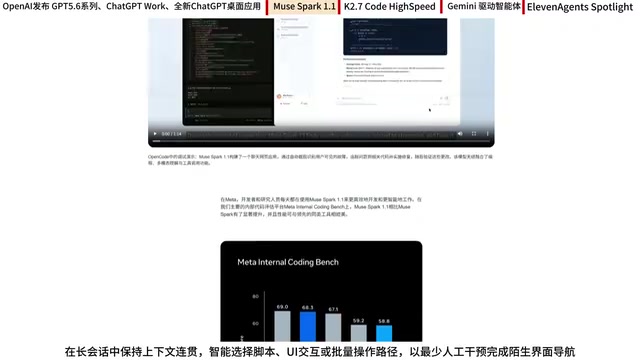
Meta released the multimodal reasoning model MuSpark 1.1, simultaneously opening the Meta Model API public preview. This model is purpose-built for agentic tasks, featuring a 1-million-token context window. It can accept various inputs including text, images, video, PDFs, and audio; coordinate multi-agent systems; adapt to new tools zero-shot; and navigate unfamiliar interfaces with minimal human intervention. The API is open to U.S. developers, with a $20 free credit upon registration.
The Technical Significance of Million-Token Context: To understand the value of ultra-long context, one must first grasp the scale of tokens. In Chinese scenarios, 1 token corresponds to roughly 0.5 to 1.5 Chinese characters, so 1 million tokens means the model can process about 500,000 to 1 million characters in a single conversation—equivalent to "reading" over a dozen full-length novels or thousands of pages of technical documentation simultaneously. This capability is especially critical for agentic tasks: when executing multi-step tasks, an agent needs to continuously track tool-call history, intermediate computation states, changes in user instructions, and external environment feedback. Ultra-long context can significantly reduce execution errors and logical breaks caused by "forgetting" intermediate states. However, achieving this capability faces severe engineering constraints: the standard attention mechanism (self-attention) of the Transformer architecture has computational complexity that grows quadratically with sequence length (O(n²)), meaning that expanding context from 100,000 to 1 million tokens would theoretically inflate computation 100x. To address this, academia and industry have developed various optimization schemes such as sliding window attention, sparse attention, and linear attention approximation. But how to control inference latency and cost while maintaining the accuracy of capturing long-range dependencies remains a core engineering problem that vendors continue to grapple with at the architectural level.
Kimi announced the full opening of K2.7 Code High Speed. Official data shows that in regular coding scenarios, the output speed is about 180 tokens/second, with overall output speed roughly 5 to 6 times that of the standard version. High Speed mode uses differentiated pricing, consuming 3x the credits of the standard version, and users can flexibly switch between Standard and High Speed on demand.
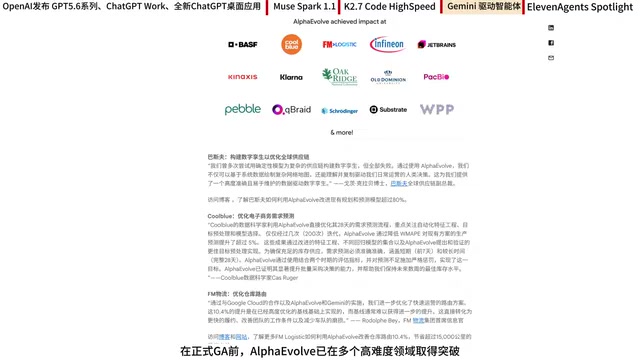
Google Cloud announced the general availability (GA) of AlphaEvolve, developed by DeepMind. Based on evolutionary algorithms, the tool uses large language models to compile and filter source code, automatically iterating toward better algorithmic solutions. Before its official release, it had already achieved breakthroughs in several high-difficulty domains—generating XS-scale GPU kernels on the Frontier supercomputer, designing error-correction schemes for quantum processors that reduced error rates 10x, accelerating molecular simulation 4x in drug discovery, and improving warehouse routing efficiency by an additional 10.4% in logistics scenarios.
The Technical Roots of AlphaEvolve: The evolutionary algorithm (Evolutionary Algorithm) used by AlphaEvolve is a class of metaheuristic optimization methods inspired by Darwin's theory of natural selection. Its core idea is to maintain a set of candidate solutions (a population) in the solution space, and iteratively generate better solutions through operations such as selection (retaining high-fitness individuals), crossover (combining substructures of excellent solutions), and mutation (randomly introducing new features). Classic evolutionary algorithms rose in the 1960s and have been widely applied in engineering optimization, scheduling problems, neural architecture search (NAS), and other fields. AlphaEvolve's innovation lies in introducing large language models into the critical "mutation operator" stage—having the LLM understand and rewrite source code at the semantic level, rather than the traditional random bit-flipping or character replacement, greatly improving search efficiency and the syntactic feasibility and logical soundness of generated solutions. This idea of combining neural networks with evolutionary computation is called "neuroevolution" in academia and has gained new vitality in recent years due to the rise of LLMs. AlphaEvolve's direct predecessor is DeepMind's FunSearch system, published in Nature in late 2023, which discovered the first new solutions in decades for mathematical open problems like the Cap Set problem, proving the real value of the "LLM + evolutionary search" paradigm in high-difficulty combinatorial optimization and laying the academic foundation for AlphaEvolve's engineering implementation.
In addition, ElevenLabs released 11 Agent Spotlight, an observability and improvement layer for conversational AI agents. It supports real-time monitoring of success rates and latency, automatically detecting anomalies and categorizing conversation topics, helping enterprises move agents from "deployed and live" toward a "continuous iteration closed loop."
From Model Race to Ecosystem Integration
This night's intensive releases convey a clear signal: the competitive focus of the AI industry is shifting from "whose model is stronger" toward "who can integrate models, coding, and office work into a complete productivity closed loop." OpenAI, by layering ChatGPT Work, Sites, and desktop client upgrades on top of GPT-5.6, is essentially using a complete product matrix to capture users' actual workflows.
That said, rivals like Meta, Google, and Kimi are each making their own moves in multimodality, algorithmic evolution, and inference speed—showing that a single point of breakthrough is no longer enough to build a moat. The real contest ahead will depend on who can make agents run stably and reliably in real office and development scenarios.
Key Takeaways
Key Takeaways
Related articles

AgentCore in Practice: Connecting Custom Tools and MCP Servers to Agents
DebuggerCafe tutorial shows how to connect custom tools and MCP servers to Amazon Bedrock AgentCore agents, covering tool contract design, MCP reuse, and production concerns.

816B Parameters Scores Only 39? The Real Cost-Effectiveness of the Open-Source LLM Parameter Race
Meta's 816B Muse Spark Open scores just 39 on Artificial Analysis, while 180B Qwen3.8-Flash-Next scores 40. This article analyzes 11 open-weight models' parameters vs. scores, exploring the real impact of activated parameters, quantized size, and deployment cost.

Aerial Manipulators: The Next Step for Drones from 'Seeing' to 'Changing'
Starting from a Reddit discussion, this article analyzes the technical challenges, potential applications, and deployment bottlenecks of aerial manipulators, exploring the key challenges for drones moving from environmental perception to physical manipulation.