GPT-5.6 Launches: Three New Models and Codex Officially Merges into ChatGPT

OpenAI releases GPT-5.6 and merges Codex into ChatGPT, upgrading from chatbot to AI agent.
OpenAI launched the GPT-5.6 model family — flagship Soul, balanced Tola, and volume-tier Luna — with benchmark scores far ahead of Anthropic's Opus 4.5 at a fraction of the cost. Simultaneously, Codex was merged into ChatGPT, transforming the product from a conversational chatbot into a full-fledged AI Agent platform capable of autonomous, multi-step task execution.
A Late-Night Rivalry
Just one hour after OpenAI's launch event ended, Anthropic's official account posted at 2:01 AM, resetting all users' 5-hour and weekly usage limits to zero. At first glance, it looked like a generous giveaway — but check the timeline and something feels off: OpenAI's event had just wrapped at 1:00 AM, and Anthropic moved less than an hour later.
What made it even more telling was that the head of Codex went into Anthropic's comments and posted: "I smell fear." What seemed like a routine product launch was actually a front-row seat to an increasingly heated war between two AI giants. So what exactly did OpenAI release to provoke this kind of reaction?
The event came down to two things: the GPT-5.6 model family, and a major product merger.
GPT-5.6: Three Models, All at Once
OpenAI released three new models in one shot, with names that carry real weight: the flagship Soul (the consciousness of the sun), the balanced Tola (the consciousness of the earth), and the high-volume Luna (the moon). Sun, earth, moon — the whole celestial set.
Look closely at the naming logic and you'll notice it mirrors Anthropic's three-tier structure (Opus, Sonnet, Haiku) almost exactly — a deliberate counter-positioning against the competition. Anthropic's naming draws from literary forms (Opus for "work," Sonnet for the 14-line poem, Haiku for the Japanese verse), using creative genre as a metaphor for capability tier — a branding approach that's built genuine recognition. OpenAI's decision to go with celestial bodies is a direct challenge to that established mental model. Ironically, this kind of mirroring is actually a good thing: OpenAI's naming conventions have historically been notoriously confusing. Labels like "o1 mini" or "o3 high" left most people unable to tell which model was newer or more capable.
A Naming System That Finally Makes Sense
For the first time, there's a consistent logic:
- Numbers indicate generation: 5.7 will always be newer and more capable than 5.6
- Names define the tier: within the same generation, Soul > Tola > Luna
- Across generations, the number wins
After years of confusion, the naming structure is finally coherent. This matters especially for developers and enterprise users — in production environments, predictable versioning directly affects the stability of system integration and cost planning.
On the specs side, GPT-5.6 supports a 1-million-token context window with a maximum output of 128K tokens. To put that in perspective: a 1M-token context means processing roughly 750,000 words in a single pass — equivalent to simultaneously "reading" dozens of full enterprise reports or an entire mid-sized codebase. That's a meaningful capability for long-document analysis, large-scale code refactoring, and similar tasks. API pricing for the flagship Soul is $5 input / $30 output — roughly half the previous generation — while the volume-tier Luna comes in at just $1 input / $6 output.
Benchmark Results: Leading on Both Performance and Cost
OpenAI's headline benchmark this time is Agent Test: Last Exam. Rather than measuring point-in-time question-answering, this test evaluates long-horizon workflow completion across 55 industries — treating AI as an employee, tasking it to carry out sustained work, and checking whether it can get things done correctly and completely.
The design philosophy behind this benchmark reflects a meaningful shift in how the industry evaluates AI. Unlike traditional static benchmarks such as MMLU (Massive Multitask Language Understanding) or HumanEval (code generation accuracy), Agent Test: Last Exam simulates multi-step, cross-tool, long-horizon real-world work scenarios — where the AI must independently plan, handle intermediate results, adapt to unexpected situations, and see tasks through to completion. This kind of "process-based" evaluation is gradually replacing "knowledge-point" evaluation as the industry's new standard for measuring practical model value.
On this benchmark:
- Soul scored 53.6
- Anthropic's flagship Opus 4.5 scored 40.5
A gap of 13 points. But what's putting real pressure on competitors isn't just the score — it's the price. According to independent analysis, even the mid-tier Tola and the volume-tier Luna outperform Anthropic's flagship, at roughly one-sixteenth the cost. Same task, one dollar versus sixteen — a gap that's genuinely hard to close.
Coding Demo: A Full Motion-Sensing Game from a Single Prompt
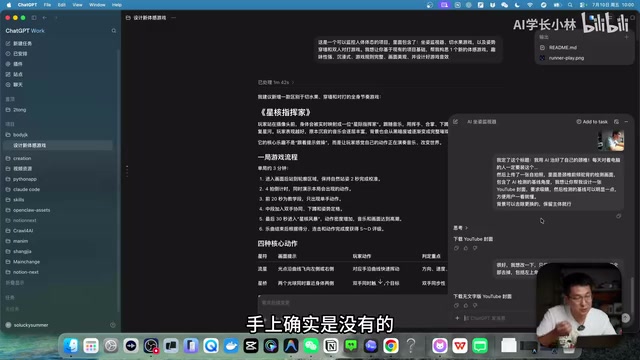
GPT-5.6 was put through its paces immediately, building on a motion-sensing game project from a previous video. Earlier work with Codex 5.5 produced reasonably solid results for "posture monitoring" and a "motion-sensing fruit ninja," while "motion-sensing wall-breaker" and "two-player fighting" came out less polished.
Switching to GPT-5.6, with minimal prompting and essentially a single round of conversation, two fully functional motion-sensing games were generated:
- Starfield Conductor: Stand in front of the camera — wave, crouch, or spread your arms to reconnect a starfield, with musical accompaniment
- Neon Sprint (subway surfer style): Sway left and right to switch lanes, raise your hands to jump, crouch to slide, and wave to smash obstacles
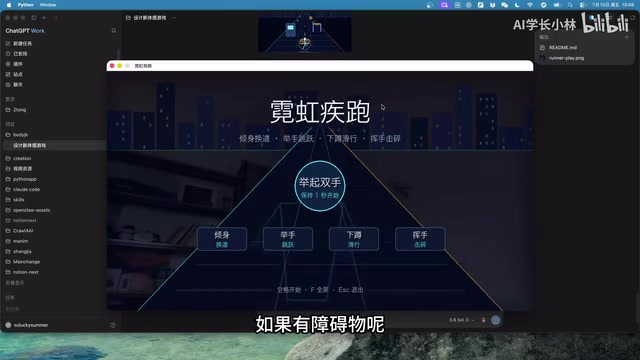
The model's ability to understand, plan, and execute the full task was impressive — game rules, visuals, sound effects, and motion recognition were all generated in one pass, with solid completeness and playability. These games have been published to GitHub with full deployment documentation.
The Main Event: Codex and ChatGPT Officially Merge
The other major move from this launch: OpenAI has officially merged Codex and ChatGPT into a single app. The standalone Codex desktop application has been shut down and absorbed into a redesigned ChatGPT desktop app.
To understand the strategic significance of this merger, it helps to trace Codex's technical evolution. OpenAI's original Codex launched in 2021 as a code-generation model — the engine powering GitHub Copilot — with a core capability of translating natural language comments into code snippets. After years of deep iteration, it's unrecognizable from that starting point. It has accumulated a complete Agent infrastructure: how to decompose vague large tasks into executable sub-steps, how to safely run code in sandboxed environments, how to manipulate file systems and browser interfaces through tool calls, and how to stay on track through hours of continuous task execution. These capabilities represent the hardest problems in building any Agent product today.
After the update, the original Codex app icon changes to a question mark. Entering via the ChatGPT app reveals a completely new landing page — the original ChatGPT conversation window is replaced directly by the Codex conversation window, with interfaces that look nearly identical. The old Chat window is folded into the upper left, accessible by switching to the "Work" mode.
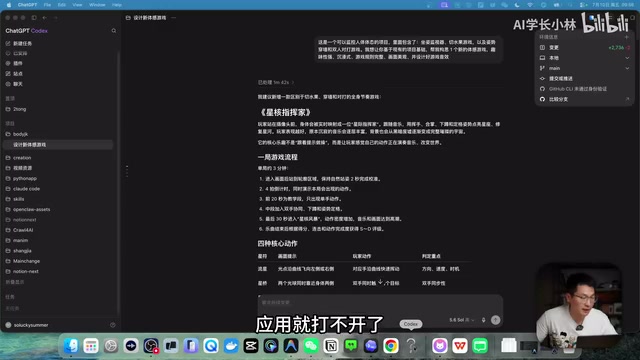
All historical chat logs — including previously designed custom GPTs — are collapsed and hidden inside the left-side chat entry. It's clear how much OpenAI is prioritizing the Codex paradigm. For longtime Codex users, the UI change is minimal; for users who have only used ChatGPT, there may be an adjustment period.
From ChatBot to Agent: A Fundamental Shift in Product Logic
The logic behind this merger is quite clear, but understanding it requires distinguishing between ChatBots and Agents. Traditional ChatBots operate in single or multi-turn conversation mode: the user asks, the AI answers, each interaction is relatively self-contained, and the AI doesn't initiate actions or cross conversation boundaries to operate external systems. Agents, by contrast, have a complete "perceive-plan-act" loop: they can proactively break down goals, call external tools like search engines or code executors, dynamically adjust strategy based on intermediate results, and keep executing until the task is complete — all without user intervention. This isn't incremental improvement; it's a paradigm shift.
Codex spent years deeply embedded in programming workflows, systematically distilling a full set of real-world Agent capabilities: how to decompose large tasks, how to run them safely, how to operate computer interfaces — even sustaining multi-hour task execution without losing direction.
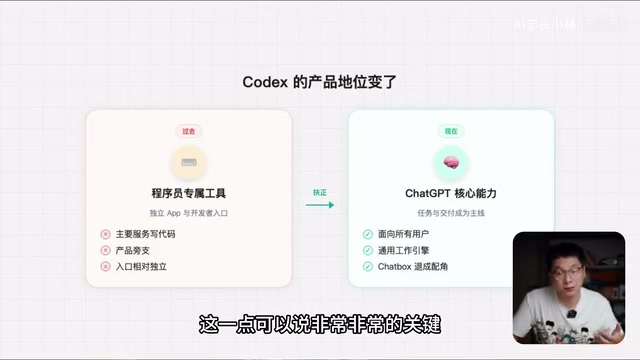
OpenAI realized: why should this capability set be limited to writing code? Building a presentation, generating a report, scaffolding a website, running a workflow — at the engine level, it's all the same infrastructure. So the more accurate framing isn't that Codex was "merged into" ChatGPT. It's that the Codex engine was installed into ChatGPT, the product with the largest user funnel. Nominally, Codex was absorbed — but in practice, it became the foundation of the entire product. ChatGPT has officially upgraded from ChatBot to Agent. This is a fundamental shift in product logic.
Consolidating for an IPO
There are a few practical realities driving this consolidation:
First, compute resources are finite. GPUs can't sustain two parallel product lines. Rather than have multiple teams fighting over the same resources, it makes more sense to concentrate firepower on a single bet. The GPU cluster costs for training and running large language models are enormous — industry estimates put a single GPT-4-scale training run at over $100 million, and ongoing inference is a continuous operational expense. Before an IPO, resource centralization is a necessary strategy for maintaining competitiveness.
Second, winning user mindshare. Over the past year, Anthropic has reportedly surpassed OpenAI in enterprise market penetration, thanks largely to its strong coding performance. Recent issues with Anthropic account bans and usage limits have taken a toll on its reputation, while Codex's reputation has only grown. OpenAI is seizing this moment to elevate Codex as the primary entry point and open it to free users — using consumer-scale traffic to establish an early lead in the Agent market.
Third, preparing for an IPO. The launch event also brought a "deprecation notice" — Atlas, the AI browser that launched with fanfare last year, has been announced for gradual shutdown after less than a year of life. This signals OpenAI actively narrowing its focus, concentrating resources into a unified app ecosystem in preparation for commercialization and valuation. Streamlining the product line and consolidating user data also helps present a cleaner business model and growth narrative to prospective investors.
The Competitive Logic Is Changing
The biggest takeaway from this launch: the competition in AI is shifting from "who is smarter" to "who can make intelligence actually land and get used."
Models are like engines. Products are the cars. No matter how powerful the engine, what customers ultimately pay for is whether the car is good to drive. Tune it well, handle it well, and you can accomplish more with a simpler model. What OpenAI did here, at its core, was install the most powerful engine into the car with the most traffic — and swap the steering wheel at the same time. The interface upgraded from "you ask, I answer" to "you assign, I deliver."
Whether this car wins the next round of the race — that remains to be seen.
Key Takeaways
Related articles

Poison-Resistant Concept Anchoring: A New Approach to Defending Against AI Data Poisoning
Deep dive into Poison-Resistant Concept Anchoring, defending against data poisoning via signed anchors and bounded updates. Experiments show 62% poison isolation with 0% false rejection rate.

Hungarian Algorithm Explained: Principles, Complexity, and Engineering Implementation Guide
In-depth explanation of the Hungarian Algorithm: core principles, O(N³) time complexity advantages, and engineering implementation. Covers assignment problem definition, step-by-step algorithm walkthrough, Python/C++ libraries, and applications in multi-object tracking and resource scheduling.
OpenAI's First Enterprise AI Report: H…
OpenAI's First Enterprise AI Report: How ChatGPT Is Changing the Way Organizations Work
OpenAI's first enterprise AI report reveals three key traits of ChatGPT Enterprise adoption: the shift from novelty to necessity, writing and coding as top use cases, and data governance as a core prerequisite.