GPT-5.6 Sol Continues Optimization, Luna Opens to Free Users: Decoding the Model Tiering Strategy

OpenAI's GPT-5.6 splits into Sol for power users and Luna for free users, signaling a model tiering strategy.
OpenAI is pursuing a dual-track update for GPT-5.6: continuously optimizing the high-performance Sol model for paying users while opening the efficiency-optimized Luna variant to free users. This sun-and-moon naming convention reflects a deliberate product tiering strategy that balances performance ceilings with service scale, driven by competitive pressure and the need to democratize AI access while managing inference costs.
Dual-Track Updates for the GPT-5.6 Family
Recently, OpenAI signaled important updates regarding the GPT-5.6 model series on community platforms like Reddit: on one hand, continuously optimizing the GPT-5.6 Sol model capabilities within ChatGPT, and on the other, expanding GPT-5.6 Luna access to free users. This move continues OpenAI's dual-track strategy of model segmentation and access democratization—serving power users with stronger flagship models while lowering barriers so a broader user base can access cutting-edge AI capabilities.
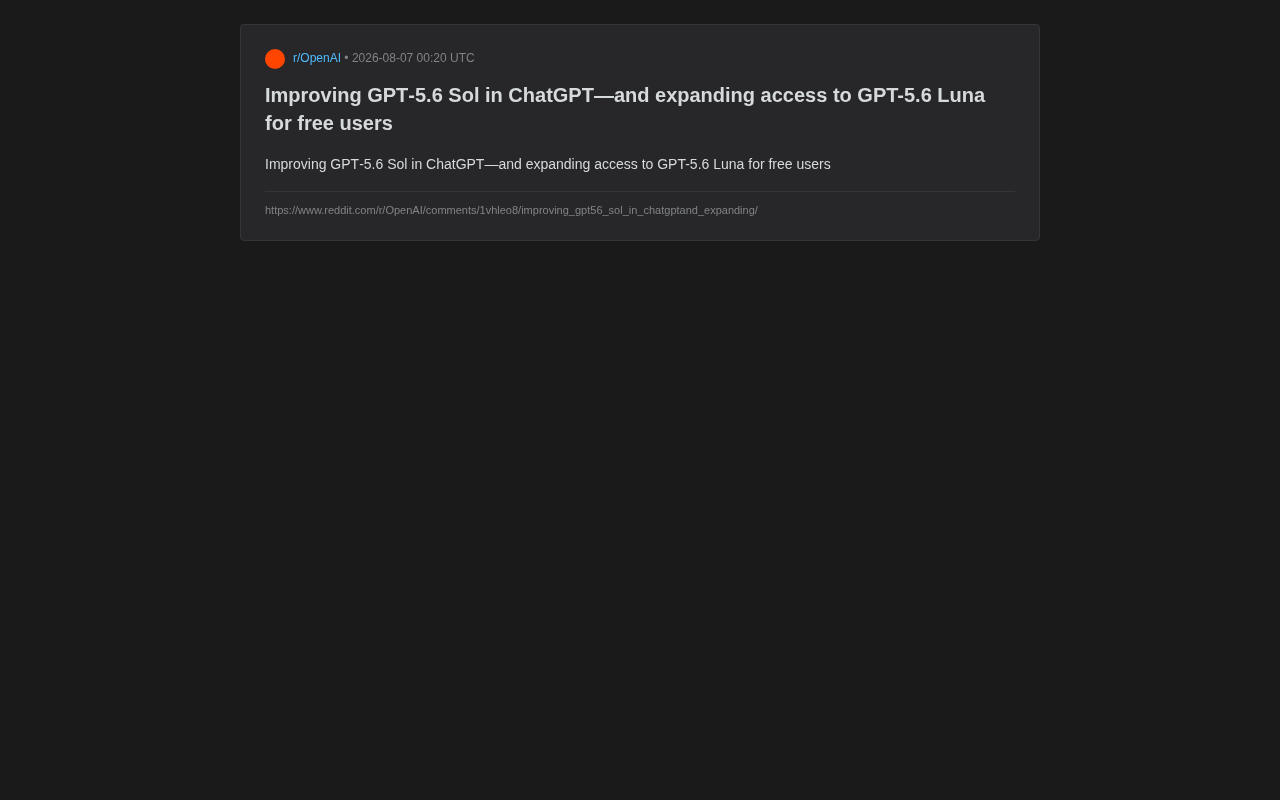
It should be noted that this article is based on information surfaced through community channels, and some details still await official confirmation from OpenAI. However, based on the naming logic and update direction, we can offer an interpretation of the product thinking behind these changes.
Sol and Luna: A New Naming Approach for GPT-5.6 Model Tiering
From Numeric Versions to Semantic Naming
OpenAI has adopted semantic codenames—"Sol" (Sun) and "Luna" (Moon)—to distinguish different variants within the same model generation. This differs from the previous approach of relying solely on numbers (e.g., GPT-4, GPT-4o, GPT-4 Turbo) or letter suffixes.
This naming convention typically suggests that the two models differ in positioning and optimization direction:
- Sol (Sun): Positioned as the primary, high-performance version, emphasizing reasoning depth and comprehensive capabilities, targeting core use cases within ChatGPT;
- Luna (Moon): A lighter, more efficient version, suitable for serving free users at scale and lower cost.
This "sun and moon division of labor" design fundamentally balances performance ceiling against service scale—using stronger models to serve paying users and more economical models to cover free users, expanding the user base while keeping inference costs under control. Notably, this tiering strategy has long precedents in the cloud computing industry. For example, AWS divides instances into compute-optimized, memory-optimized, general-purpose, and other tiers—the underlying logic is the same: matching differentiated product lines to differentiated needs and willingness to pay.
GPT-5.6 Sol's Continuous Iteration Strategy
The "continuous improvement" of Sol reflects OpenAI's established approach: even under the same version number, models are constantly iterated through post-training, alignment optimization, instruction-following fine-tuning, and other techniques.
Post-training refers to a series of additional training stages after a large model completes pre-training, aimed at improving the model's utility and safety. This typically includes Supervised Fine-Tuning (SFT, using human-annotated high-quality conversation data), Reinforcement Learning from Human Feedback (RLHF), and Direct Preference Optimization (DPO), among other techniques. The pre-training stage gives the model broad linguistic and world knowledge, while the post-training stage teaches it how to interact with users in a helpful, honest, and harmless manner. OpenAI's continuous iteration under the same version number essentially means constantly optimizing these post-training steps—using better alignment data and more refined reward models to progressively improve user experience.
This means the Sol that users experience in ChatGPT may receive incremental improvements in response quality, reasoning stability, and hallucination suppression, without waiting for a major version release.
Regarding hallucination suppression, this is one of the core challenges facing all large language models today. Model "hallucination" refers to the generation of information that appears plausible but is actually incorrect or fabricated. Technical approaches to suppressing hallucinations include: Retrieval-Augmented Generation (RAG, having the model retrieve relevant documents before answering), Chain-of-Thought reasoning (forcing the model to show reasoning steps to reduce logical leaps), factuality alignment training (specifically penalizing fabricated content during RLHF), and self-consistency verification (having the model sample multiple times and selecting the most consistent answer). Among OpenAI's continuous optimizations for Sol, hallucination suppression is very likely one of the highest-priority improvement areas.
The Strategic Significance of Opening GPT-5.6 Luna to Free Users
Lowering Barriers, Expanding AI Ecosystem Coverage
Opening GPT-5.6 Luna to free users is a key step for OpenAI in expanding user coverage. Free users are often a critical source of product growth and serve as a reservoir for future paid conversions. Letting free users access newer-generation model capabilities helps to:
- Improve the overall free product experience, strengthening user retention;
- Build a larger usage data feedback loop, providing real-world scenario data for continuous model optimization;
- Address competitive pressure—with Google Gemini, Anthropic Claude, and various open-source models offering strong capabilities for free, OpenAI must maintain competitiveness at the free tier.
Since 2024, competition among major AI vendors at the free tier has intensified dramatically. Google has made the Gemini series models freely available, Anthropic's Claude offers free usage quotas, and Meta's Llama series as open-source models can be freely deployed by anyone. This competitive landscape stems from network effects—the value of AI products increases with user scale. More users means more usage data, more ecosystem partners, and stronger brand recognition. Therefore, even though free services create cost pressure in the short term, they represent a critical investment in establishing market dominance in the long run. This explains why OpenAI must maintain competitive model capabilities at the free tier.
Balancing Inference Costs and Scale
Providing a new-generation model to hundreds of millions of free users is an enormous test of inference computing power. The inference cost of large models is one of the core bottlenecks constraining large-scale deployment. Taking GPT-4-level models as an example, a single inference requires distributed computation across hundreds or even thousands of GPUs, with each generated token involving billions of floating-point operations. Industry estimates suggest that ChatGPT's daily inference costs during peak periods can reach millions of dollars. To reduce costs, the industry widely employs Speculative Decoding, KV cache optimization, batch scheduling optimization, and dedicated inference chips.
This also indirectly confirms that Luna is very likely an efficiency-optimized version—maintaining sufficient capability while minimizing per-inference cost. Knowledge Distillation is one of the core techniques for achieving this goal, proposed by Geoffrey Hinton and others in 2015. The core idea is to have a small model (student model) learn the probability distributions (soft labels) output by a large model (teacher model), rather than learning only the hard labels of the original training data, thereby retaining most capabilities despite a significant reduction in parameter count. Beyond distillation, common model efficiency techniques include quantization (compressing floating-point parameters to lower precision), pruning (removing redundant connections), and architecture search (designing more efficient network structures). These techniques enable inference cost reductions of several times while model performance only degrades by single-digit percentages. Such "distilled" or "miniaturized" efficient models are becoming standard configurations for large companies in scaled services.
Impact of GPT-5.6 Updates on Users and the Industry
What It Means for Regular Users
For free users, the most direct benefit is access to stronger models at zero cost. Experiences in daily writing, information retrieval, code assistance, study Q&A, and other scenarios will significantly improve. For paying users, Sol's continuous optimization means more reliable outputs for professional and complex tasks.
It's worth noting that model capability improvements are not linear or uniform—in some tasks (such as multi-step reasoning, long-text comprehension) users may notice significant progress, while in others (such as simple Q&A) differences may be less apparent. This is because post-training optimization typically targets the model's weak points for focused breakthroughs, rather than uniformly improving all capability dimensions.
Impact on the AI Industry Landscape
This update once again highlights two main threads in current AI competition:
- The capability race: Whose flagship model is stronger, less prone to hallucination, and capable of deeper reasoning;
- The accessibility race: Who can deliver advanced capabilities to ordinary users at lower cost and greater scale.
Through the Sol and Luna division of labor, OpenAI is effectively fighting both battles simultaneously. This also foreshadows that future product strategies from large model vendors will increasingly lean toward multi-tier, multi-variant combinations rather than a single "one model fits all" approach. This trend is also reflected upstream in the supply chain—chip manufacturers like NVIDIA are also rolling out complete product lines from high-end training chips (H100/B200) to low-cost inference chips. The entire AI industry is transitioning from a "technology breakthrough phase" to a "scaled deployment phase."
Conclusion: Model Tiering Is an Inevitable Trend for Large Model Deployment
The continuous improvement of GPT-5.6 Sol and the free release of Luna—while information still awaits full official disclosure—reveal clear product logic: using a tiered model matrix to match tiered user needs. This is both an inevitable choice as technology matures and a rational strategy under fierce market competition.
From a broader perspective, model tiering reflects a critical transformation as the AI industry moves from "laboratory products" to "mass consumer goods." Just as the smartphone industry evolved from early "one flagship fits all" approaches to product matrices covering high, mid, and low-end segments, large model services are undergoing the same product maturation process.
For users following AI developments, it's worth continuing to monitor OpenAI's subsequent official announcements to confirm the specific capability boundaries, access scope, and usage limitations of Sol and Luna. Predictably, this "sun and moon division of labor" is likely just the beginning—in the future, we will see increasingly refined model product systems gradually taking shape.
Key Takeaways
Related articles

Free Tweet Mockup Generator: Create Realistic X Platform Content Assets Instantly Without Watermarks
Tweet Mockup Generator is a free, no-watermark, locally-run tool for creating realistic X/Twitter tweet mockups with custom avatars, verification badges, engagement data, and multimedia content.

Boston Dynamics Spot Robot Calibration Target: The Sensor Calibration Science Behind a $6 Thrift Store Find
A Reddit user found a Boston Dynamics Spot calibration target for $6 at a thrift store. We explore how calibration targets enable robot vision, multi-sensor fusion, and why this matters.

Folding Laundry: The Billion-Dollar Challenge for Robotics Companies
Why do billion-dollar robot companies like Figure and Physical Intelligence all demo folding laundry? A deep dive into deformable object manipulation, Moravec's Paradox, and why laundry folding is the ultimate test of general-purpose robotics.